


Every evening for several days, I sat in the same chair, at approximately the same time, and let a small machine squeeze my arm three times.
Then I breathed in a specific way for five minutes. Then the machine squeezed my arm three more times. Then I wrote down what it said and noted what kind of day it had been.
This is not glamorous science. There is no control group. There are no blinded assessors. But this experiment was never trying to prove anything to the literature. It was trying to answer a more personal question: does this particular practice do something measurable in this particular body?
The answer, it turns out, is yes, sort of.
I should say upfront that I find the n=1 study format slightly hilarious, which is perhaps not something you expect to read on a science-based newsletter. But testing things on myself has been a running theme ever since I left the lab, and I find it illuminating. This is not the first experiment I have run on my own body, and it will not be the last. This format owes a debt to @marnieexperiment, whose idea of running software development-style sprints into her own life to test what works and what does not I found immediately compelling. I have been experimenting for a while, but the sprint approach gave it a shape. I went with 14 sessions rather than a formal sprint window, because I am only human and life is not controlled.
This post sits in the Stress Management, Resilience and Self-Care area of the Mind Pillar, as a companion to Your Stress Toolkit post. If that post is the map of what the research says works, this one is what happened when I took one tool off the map and tested it on my own nervous system.
New here? Start here:

Swiss Army Mum is a practical guide to long-term health for busy women, built on four pillars: Body, Mind, Glow, and Flow.
Not every tool. Just the right ones.
Why Blood Pressure, and Why This Breathing Technique
Blood pressure is a useful thing to measure in this context because the mechanism connecting slow breathing to blood pressure is direct, well-understood, and does not require a laboratory to observe.
Here is how it works. Your body has a continuous pressure-regulation system called the baroreflex: pressure sensors built into the walls of your aorta and carotid arteries that report to your brainstem in real time. Think of it as a thermostat, except instead of monitoring room temperature it is monitoring the force of blood against your vessel walls. When the reading goes up, the thermostat sends a signal that slows the heart and relaxes the vessels. When it goes down, it speeds things up again.
The extended exhale phase of slow breathing hijacks this system in a useful direction. As you breathe out slowly, your heart rate naturally drops: this is called respiratory sinus arrhythmia, and it is one of the most well-replicated phenomena in cardiovascular physiology.1 The longer and slower the exhale, the more the parasympathetic system dominates during that phase, and the more the baroreflex pulls blood pressure in the same direction.
The specific technique I used is cyclic sighing, which a 2023 Stanford study found outperformed box breathing, mindfulness, and cyclic hyperventilation for daily positive affect and respiratory rate reduction.2 The method is simple: two short inhales through the nose (the second one topping up the lungs fully), then one long slow exhale through the mouth. No counting. No apps. No special equipment except the blood pressure monitor, which doesn’t cost much and is available in every pharmacy in Europe.
The Protocol
Same chair. Same arm. Same time of day (early evening). Five minutes of rest before the first reading. Three readings before breathing, averaged. Five minutes of cyclic sighing. Thirty seconds of sitting quietly. Three readings after, averaged. One honest sentence about the context of the day.
Fourteen sessions over three weeks.
What is cyclic sighing and how do you do it?
Cyclic sighing involves two inhales through the nose (a longer first inhale followed by a short top-up to fully inflate the lungs) then one long slow exhale through the mouth, with the exhale roughly twice the duration of the combined inhale. No counting is needed. The technique was compared to box breathing, mindfulness, and cyclic hyperventilation in a 2023 Stanford RCT and produced the greatest improvement in daily positive affect and the greatest reduction in respiratory rate over 28 days.
What the Numbers Said
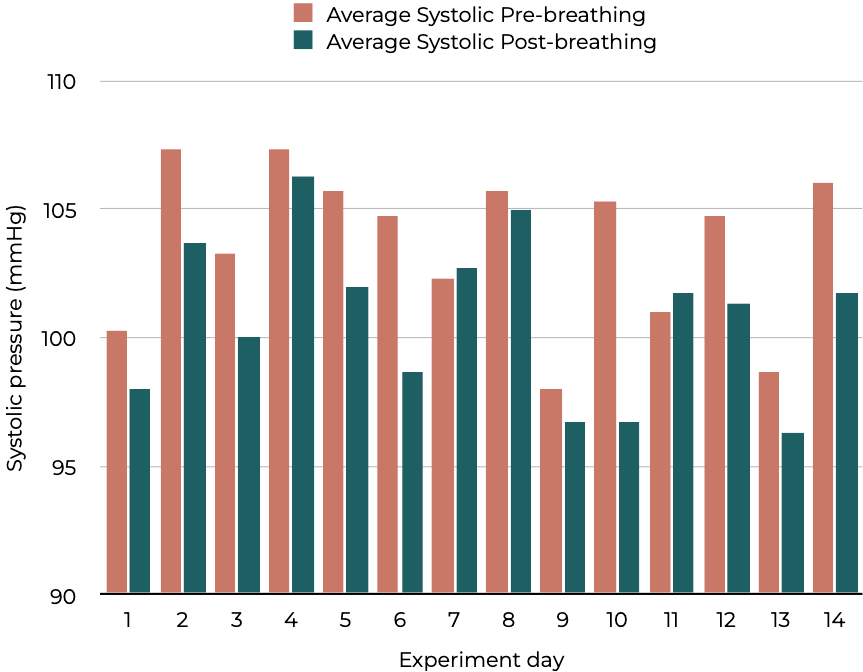
The average systolic blood pressure (the top number, which reflects the force of each heartbeat) was 103.6 mmHg before breathing and 100.8 mmHg after. A mean drop of 2.8 mmHg, with 12 of 14 sessions showing a reduction and only two sessions showing a small rise.
The standard deviation (SD) of those changes was 2.5 mmHg. Standard deviation is the average distance between each individual result and the mean: a small SD means results cluster tightly around the average, a large one means they scatter. An SD of 2.5 against a mean of 2.8 is, to be statistically honest, almost as large as the effect itself. This means I cannot tell you with confidence that the 2.8 mmHg figure is a reliable number to expect on any given evening. What I can tell you is that blood pressure never systematically rose after breathing across 14 sessions, and that getting 12 drops in 14 attempts is more consistent than random chance would predict. The direction is more trustworthy than the magnitude. That is a more accurate summary than "it dropped by 2.8 mmHg," even if it is a less satisfying headline.
Two numbers are worth understanding before going further. Blood pressure is measured in millimetres of mercury (mmHg), a unit inherited from the days when pressure was literally measured by how high it pushed a column of liquid mercury up a glass tube. Normal systolic pressure for a healthy adult sits roughly between 90 and 120 mmHg. A 2.8 mmHg change sounds small because it is small. Whether it is meaningful depends on what you were starting from and what you were trying to do. And to be honest, my BP is already low as is, so trying to bring it down even further may be a lost cause. And I’m a pretty laid back gal.
For context: the Goessl et al. meta-analysis of slow breathing and HRV biofeedback found effects in the 3 to 8 mmHg range in clinical populations, which tend to have higher baselines to begin with.3 For someone whose resting systolic sits around 103 (my record low is somewhere in the 80s after a nap), a 2.8 mmHg drop is proportionally reasonable and consistent with what the mechanism would predict.
The diastolic (the bottom number, which reflects resting vessel pressure between beats) did essentially nothing. Seven sessions went down, six went up, one stayed flat. The average change was a tenth of a mmHg in either direction depending on how you round it.
Heart rate was noisier and less interpretable. Seven sessions went down, seven went up. Average change: +1.1 bpm (beats per minute).
Does cyclic sighing lower my blood pressure?
In a personal 14-session experiment using a standardised protocol (three pre-readings averaged, five minutes of cyclic sighing, three post-readings averaged), systolic blood pressure dropped in 12 of 14 sessions with a mean reduction of 2.8 mmHg. The effect was larger when the pre-reading baseline was higher (mean drop of 3.7 mmHg when systolic was 105 or above) and smaller or absent when already in a relaxed state (mean change near zero in sessions noted as calm). Diastolic blood pressure showed no consistent change. This is n=1 data, not a clinical trial!
The Finding I Found Most Interesting
Here is the part I did not expect, and the part that is most honest.
When I looked at the sessions where my notes said I was already calm, already resting, already having a slow day, the breathing did almost nothing to my blood pressure. Sessions 7 and 11 both involved days off, HIIT training earlier, and an already-relaxed state before sitting down. Both showed a systolic change of less than +1 mmHg. One went fractionally up.
Compare that to Session 2, noted as a stressful day (Cycle Day 23, for what that is worth): systolic dropped 3.7 mmHg. Or Session 8, after a very long day of meetings: dropped, again.
The thermostat analogy makes sense of this. A thermostat does not turn the heating on when the room is already warm. The baroreflex is a homeostatic system: it corrects deviations from baseline. When there is no deviation, there is nothing to correct. The breathing appears to work when there is something to downregulate and to do very little when the system is already quiet.
This is not a failure of the technique. It is the technique working exactly as described. But it does puncture one version of the wellness narrative, which suggests that breathing exercises are always beneficial, always calming, a practice that pays dividends regardless of circumstance. The more accurate version, at least in my data, is that it is an acute regulatory tool: reach for it when the system is activated, and do not expect much from it when it is not.
There is one more pattern in the data worth naming, because it was not something I went looking for. On the eight days when I had done strength training earlier, my average pre-reading was 101.8 mmHg. On the six days when I had not trained, it was 106.0 mmHg. A difference of 4.2 mmHg in baseline, before the breathing started.
This is almost certainly not an acute effect of that day’s training session. By evening, post-exercise hypotension has typically resolved. What you are probably seeing is the chronic adaptation effect of regular strength training on resting cardiovascular function. The heart becomes more efficient, vascular compliance improves, and the system settles at a lower baseline over time. The literature on this is considerably more robust than the literature on breathing interventions.
The uncomfortable implication: the strength training I was doing anyway may be doing more for my resting blood pressure than five minutes of cyclic sighing. Which does not make the breathing useless. It makes it the right tool for a specific moment rather than a general solution. The two are not competing. They are operating on completely different timescales.
What This Does and Does Not Tell Me
What it does tell me: Five minutes of cyclic sighing produces a consistent, modest systolic blood pressure reduction in this body. Twelve out of fourteen times. Average 2.8 mmHg. The effect is larger when starting from a higher baseline, smaller when already relaxed. The diastolic pattern is mechanistically coherent. The acute effect is modest but real (when BP is higher).
What it does not tell me: Whether the effect is specifically from the breathing pattern versus simply sitting quietly for five minutes (no control condition). Whether the effect persists for more than a few minutes after the session (the monitor only takes one snapshot). Whether fourteen sessions over four weeks produces any lasting change to resting blood pressure (my pre-readings averaged 104.4 in week one and 102.8 in week two, a small drift but well within normal variation). This is not a clinical trial. It cannot answer clinical questions.
What the data clarifies about how to use this tool: The best moment for cyclic sighing is not when you are already calm. It is in the ten minutes before something activating: a difficult conversation, a long meeting, an anxious evening. That is when the thermostat has something to correct, and when the correction is most legible as a felt experience.
Population-level effect sizes tell you about averages. Your body is not average. This is what mine said.
When does slow breathing work best for stress relief?
Based on both the baroreflex mechanism and personal experimental data, slow breathing produces the greatest physiological effect when the autonomic nervous system is already activated: before an anticipated stressor, during a high-stress day, or when heart rate and blood pressure are above resting baseline. When the body is already calm, the baroreflex has less to correct and the measurable effect is minimal. Cyclic sighing is an acute regulatory tool best used targeted rather than habitually.
How to Run This Yourself
Upper-arm blood pressure monitor (more reliable than wrist). Seated, back supported, feet flat, arm at heart level. Five minutes of rest before the first reading. Three readings, averaged. Five minutes of cyclic sighing: two short nasal inhales to fully inflate the lungs, then one long slow oral exhale, roughly twice the duration of the combined inhale. Thirty seconds of sitting. Three post-readings averaged.
Evening is better than morning. You want the baroreflex to have something to work with. Do it for at least ten sessions before drawing any conclusions. Note the context honestly: a relaxed baseline will produce a different result than an activated one, and both are valid data.
When the paid tier launches, subscribers will get a Google Sheet version of the tracker I used: enter your three readings before and after, and it calculates the averages and deltas automatically. No spreadsheet skills needed. There will also be a prompt in the SAM Prompt Library that takes your completed data and analyses it against the literature, so you get a personalized read on what your numbers are actually telling you.
The 80/20
The finding, in plain terms: this works as an acute tool, not a transformation. Five minutes of slow breathing before an activating event is better-evidenced in my own data than five minutes of breathing into a calm evening. Use it targeted rather than habitual and you will see more from it.
If you run the same experiment and your numbers do not move: that is also real data, and it means this particular tool has a smaller individual response in your body. Not every intervention works for every person. Finding that out is the point.
Your Turn
Have you ever tried to measure the effect of a wellness practice on yourself, rather than just feeling whether it worked?
Drop it in the comments. I read every one.
Thank you
Thank you for reading, sharing, and supporting this work. Whether you’ve been here since the beginning or just found Swiss Army Mum, I’m glad you’re here.
Building a life with more intention takes a village. If something resonated, I’d be grateful if you forwarded this to someone who might need it, or hit the ♥️ or ↻ Restack button. It helps more people find this space.
This is educational, not personal medical advice. Your biology, history, and context matter. Work with a qualified healthcare professional.
References
Balban MY, Neri E, Kogon MM, Weed L, Nouriani B, Jo B, Holl G, Zeitzer JM, Spiegel D, Huberman AD. Brief structured respiration practices enhance mood and reduce physiological arousal. Cell Rep Med. 2023 Jan 17;4(1):100895. https://doi.org/10.1016/j.xcrm.2022.100895
Russo MA, Santarelli DM, O'Rourke D. The physiological effects of slow breathing in the healthy human. Breathe (Sheff). 2017 Dec;13(4):298-309. https://doi.org/10.1183/20734735.009817
Goessl, V C et al. “The effect of heart rate variability biofeedback training on stress and anxiety: a meta-analysis.” Psychological medicine vol. 47,15 (2017): 2578-2586. https://doi.org/10.1017/S0033291717001003