


Here is something nobody told me when I started reading the stress literature seriously: some of the most popular stress management advice makes things worse. Not marginally worse. Measurably, empirically worse.
The catharsis hypothesis (the idea that releasing stress through venting, hitting things, or screaming) has been tested for fifty years. It reliably increases anger rather than reducing it. Venting, as Bushman puts it, is like using petrol to put out a fire.1 That is where the stress science starts getting interesting.
This post is part of the Stress Management, Resilience and Self-Care area of the Mind Pillar. If the Purpose and Philosophy area gave you a compass for navigating the world, and the Inner World area gave you the capacity to know yourself accurately, this area gives you the practical toolkit for when the day is already hard and the nervous system is already lit.
We are going to cover what the research actually supports, what the wellness industry has overclaimed, and what is specifically worth knowing if you are a woman in midlife, where the hormonal context changes the rules in ways most of the standard advice ignores.
New here? Start here:

Swiss Army Mum is a practical guide to long-term health for busy women, built on four pillars: Body, Mind, Glow, and Flow.
Not every tool. Just the right ones.
The Female Stress Response: Why The Standard Advice Misses You
Most of what you have read about stress management was not written for you. Before 1995, women were approximately 17% of participants in laboratory studies of physiological and neuroendocrine responses to stress.2 The fight-or-flight framework, which underpins most of the stress management advice still circulating, was built primarily on male data. The tools extrapolated from it are reasonable hypotheses for women. They are not confirmed findings.
Here is what the female-specific research actually shows. Estrogen dampens the HPA axis, which is the hypothalamus-pituitary-adrenal cascade: the hormonal chain that produces cortisol when your brain registers a threat. Progesterone is metabolised into allopregnanolone, a compound that acts on GABA-A receptors. GABA is the nervous system’s braking signal. This means progesterone has a direct anxiolytic mechanism, which is why the week before a period (when progesterone drops sharply) often brings a disproportionate spike in anxiety or irritability that has nothing to do with life circumstances.
In perimenopause, the relevant variable is not hormone level. It is hormone volatility. Research by Gordon and colleagues found that greater estradiol fluctuation, not low mean estradiol, predicted negative affect, heart-rate reactivity to stress, and cortisol response.3 This is counterintuitive and important: it is not the decline itself but the unpredictability of the decline that drives mood instability. You are not imagining that some weeks feel neurologically impossible while others feel fine. That is what fluctuating estrogen does to the stress response.
Where we have female-specific data, this post will say so. Where we are extrapolating from male-dominant research, this post will say that too.
Two Directions: Downregulation and Discharge
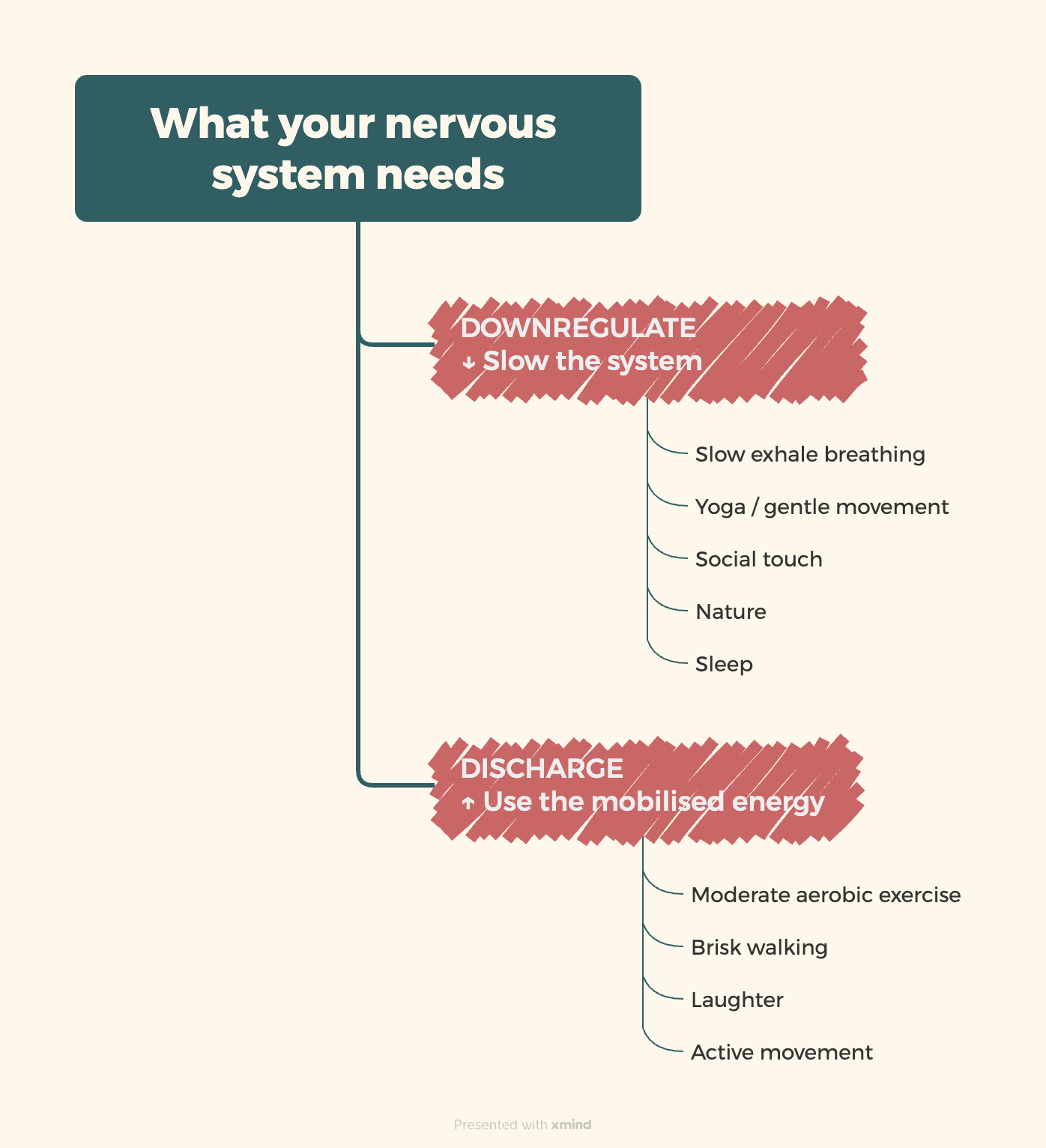
Before sorting the tools, it helps to understand that stress regulation is not one thing. It has two opposite directions, and mixing them up is where most advice goes wrong.
Downregulation works by slowing the system. It activates the parasympathetic nervous system (the brake) and reduces cortisol and sympathetic arousal. Breathing techniques, restorative leisure, nature, social touch, and sleep all work this way. The nervous system is being asked to do less.
Discharge works by using the energy the stress response mobilized. When your brain registers a threat, it floods your bloodstream with glucose and mobilizes your cardiovascular system for action. If the action never happens (because the threat is a difficult conversation or a deadline, not a predator) that mobilized energy stays in the system. Aerobic exercise and physical movement discharge it by using it for its intended biological purpose.
The mistake most people make is treating these as equivalent. They are not. What your nervous system needs on a particular day depends on the type and duration of what is stressing you. Someone who needs downregulation does not benefit from HIIT and as you will see, may actually be made worse by it. Someone who needs discharge may find that a breathing exercise feels inadequate because the body has energy to spend.
Knowing which direction you need is the beginning of an actual toolkit.
What Actually Works, Sorted by Evidence
Exercise: the kind matters more than you think
Exercise is one of the most robust stress regulators in the literature. But the specific finding from a 2025 network meta-analysis of 44 randomised trials in psychologically distressed adults is one most people have not heard: yoga produced the largest cortisol reduction (roughly double the effect of standard aerobic exercise) followed by qigong and multicomponent exercise. HIIT, counterintuitively, trended toward increasing cortisol in distressed people rather than reducing it.4
The practical translation: if you are in a period of high stress, swap the HIIT class for a long walk, a yoga session, or a moderate run. If you are not particularly distressed and are managing stress proactively, HIIT is excellent for fitness and reasonable for resilience-building over time. But it is not the tool for the hard week.
One specific female perimenopause finding is worth noting. Philip and colleagues reviewed randomised trials of exercise in perimenopausal women and found total Kupperman Index scores (a composite of menopause symptoms including irritability and sleep disturbance) fell by 15.7% from baseline with exercise.5 Not all metrics improved, but the direction is consistent.
Breathing: real, modest, and worth doing
Slow breathing works. The mechanism is clean and uncontested: the extended exhale phase activates the baroreflex, a pressure-sensing feedback loop that increases parasympathetic outflow as you exhale. Heart rate slows. Peripheral resistance drops. The cortisol cascade that was building takes a small step back.
The best-studied specific technique is cyclic sighing: two short inhales through the nose to fully inflate the lungs, followed by a long slow exhale through the mouth. Balban and colleagues compared four breathing practices in a well-designed trial of 111 participants: cyclic sighing produced the greatest improvement in daily positive affect and the greatest reduction in respiratory rate compared to mindfulness meditation.6
The honest caveat is that the effect sizes are modest. A small-to-moderate reduction in self-reported stress across 28 days. One trial, not yet independently replicated. Breathing is a genuinely useful acute regulation tool, something to do in the five minutes before a difficult meeting, or when the cortisol has started but the action has not yet been taken. It is not a substitute for the structural changes that would actually reduce the load.
Think of it as a hand brake: useful for slowing down on a particular descent, not for redesigning the road.
Social touch and in-person contact
This finding is one of the most practically useful in the entire stress literature, and one of the least often cited in wellness content. In a study by Dreisoerner and colleagues (2021), 159 participants were exposed to a standardised stress protocol, then randomised to three conditions: receiving a hug from another person, self-soothing touch (hand on heart or belly), or folding paper as a control.7 Both touch conditions produced significantly lower post-stress cortisol than the control. Heart rate and subjective stress did not differ significantly between conditions.
Two things stand out. First: self-soothing touch works. You do not need another person present to get a physiological effect. Hand on heart, slow breath, for two or three minutes, is not performative wellness. It is a mechanistically grounded intervention. Second: the Berretz study found that women who embraced a romantic partner after stress showed attenuated cortisol responses. Men in the same study did not.8 This is a clean sex-difference finding that the “hug someone” advice in most wellness content glosses over.
The related finding that deserves its own sentence: text-based contact produces no oxytocin response and cortisol equivalent to the no-contact group.9 The auditory voice is the active ingredient, not the words. If you are stressed and you reach for the phone, call. Do not text.
Sleep: the upstream lever
Sleep is covered in depth in the Body Pillar. Here the relevant note is simply that CBT-I (Cognitive Behavioural Therapy for Insomnia) makes someone more than three times as likely to achieve remission from insomnia compared to standard care. Sleep hygiene advice alone does not substitute.
Restorative leisure and nature
Gardening is the best-evidenced specific activity: Van Den Berg and Custers showed 30 minutes of allotment gardening after a stressor produced significantly greater cortisol decline and mood restoration than indoor reading. Nature walks reduce rumination and subgenual prefrontal cortex activity. The mechanism is Attentional Restoration Theory: when directed attention, the kind needed for decisions and cognitive work, has been used to capacity, low-demand absorbing activities in pleasant environments allow it to recover.
Laughter: underrated and evidence-backed
A 2023 meta-analysis of eight studies found laughter interventions produced a 31.9% reduction in cortisol compared to control groups. The heterogeneity is high, studies are small, and the effect is not going to replace exercise or sleep. But it is a signal worth taking seriously. The nervous system does not distinguish between laughter at something genuinely funny and laughter that was structured into a group exercise. Physiologically, laughter is discharge: it uses the body, it is social, and it appears to move cortisol in the right direction.
What Doesn’t Work And What Makes It Worse
Catharsis is empirically dead
Screaming into pillows, rage rooms, hitting punching bags: this is the most thoroughly disproven category in the stress management literature.
The catharsis hypothesis, which proposed that expressing strong negative emotion would drain it away, has been tested by Bushman and others for fifty years. The consistent finding: venting while ruminating reliably increases anger and aggression rather than reducing it. The mechanism makes intuitive sense once you understand it. Rehearsing a state amplifies it. Expressing anger with your body while thinking about the thing that angered you is not releasing the state, it is practicing it.
Rage rooms are fine as entertainment. They are not stress management.
HIIT in a stressed system
Already covered above. Worth restating because this contradicts a lot of wellbeing content. Moderate-intensity exercise for cortisol reduction. HIIT for fitness, cardiovascular health, and metabolic adaptation. They are not interchangeable tools, and under conditions of high psychological distress, HIIT may worsen cortisol rather than reduce it.
Cold plunging: the norepinephrine is real; the stress benefits are not
The cold plunge literature has a genuine finding at its core. Cold water immersion produces a substantial spike in norepinephrine along with documented brown adipose tissue activation and metabolic effects. The biology of cold exposure is real and interesting.
The stress benefit is another matter. A 2025 systematic review and meta-analysis by Yankouskaya and colleagues found no significant stress reduction immediately after cold-water immersion, at one hour, at 24 hours, or at 48 hours. A delayed 12-hour effect emerged in limited data with substantial heterogeneity. A 2025 review by Schepanski and colleagues summarised the field directly: “the scientific evidence supporting these claims remains fragmented.”
Try cold exposure if you enjoy it. Do not build your stress management strategy around it.
Your morning coffee is probably fine
The claim that morning coffee spikes cortisol is technically true for someone who does not regularly drink coffee. For habituated daily drinkers, it is largely false. Lovallo and colleagues showed that five days of daily caffeine intake abolished the cortisol response to a morning caffeine challenge.
The cortisol response is not eliminated entirely, but for the regular coffee drinker, the morning cup is not the physiological event it is often claimed to be. The advice to avoid coffee in your cortisol awakening response window is largely irrelevant if you drink coffee every day.
Solitude does not directly lower cortisol
This one is genuinely counterintuitive and worth naming honestly. Ecological momentary assessment studies consistently find that cortisol is higher when people are alone than when they are with others. This does not mean solitude is bad: it restores directed attention, supports cognitive processing, and serves real functions.
But the specific claim that alone time lowers cortisol is not supported. What lowers cortisol is co-regulation: the presence of a trusted person. Chosen solitude and stress relief are different mechanisms, and conflating them leads to advice that directs people away from the thing that would actually help.
The 80/20
Three tools, in order of evidence strength.
Moderate-intensity exercise. This is the single most reliably replicated intervention across the entire stress literature. Not HIIT. Not running yourself into the ground. A long walk, a yoga session, a moderate run at a pace where you can speak in short sentences.
Slow exhale breathing for five minutes before anticipated stressors. Cyclic sighing: two short inhales, one long exhale. Do it before the difficult meeting rather than after. The acute effect is real; the timing matters.
One in-person or phone call with someone you trust in the first 24 hours of a difficult period. Not a text. A voice. Preferably a hug if proximity allows. The cortisol-buffering effect of social co-regulation is among the most robust findings in the literature, particularly for women.
Thank you
Thank you for reading, sharing, and supporting this work. Whether you’ve been here since the beginning or just found Swiss Army Mum, I’m glad you’re here.
Building a life with more intention takes a village. If something resonated, I’d be grateful if you forwarded this to someone who might need it, or hit the ♥️ or ↻ Restack button. It helps more people find this space.
This is educational, not personal medical advice. Your biology, history, and context matter. Work with a qualified healthcare professional.
References
Bushman, B. J. (2002). Does Venting Anger Feed or Extinguish the Flame? Catharsis, Rumination, Distraction, Anger, and Aggressive Responding. Personality and Social Psychology Bulletin, 28(6), 724-731.
Taylor, S E et al. “Biobehavioral responses to stress in females: tend-and-befriend, not fight-or-flight.” Psychological review vol. 107,3 (2000): 411-29. https://doi.org/10.1037/0033-295x.107.3.411
Gordon JL, Rubinow DR, Eisenlohr-Moul TA, Leserman J, Girdler SS. Estradiol variability, stressful life events, and the emergence of depressive symptomatology during the menopausal transition. Menopause. 2016 Mar;23(3):257-66. https://doi.org/10.1097/GME.0000000000000528
Li, X.; Huang, J.; Zhu, F. The Optimal Exercise Modality and Dose for Cortisol Reduction in Psychological Distress: A Systematic Review and Network Meta-Analysis. Sports 2025, 13, 415. https://doi.org/10.3390/sports13120415
Philip A, Singh H, Nanjundiah S, et al. (March 19, 2025) Impact of Exercise on Perimenopausal Syndrome: A Systematic Review of Randomized Controlled Trials. Cureus 17(3): e80862. https://doi.org/10.7759/cureus.80862
Balban MY, Neri E, Kogon MM, Weed L, Nouriani B, Jo B, Holl G, Zeitzer JM, Spiegel D, Huberman AD. Brief structured respiration practices enhance mood and reduce physiological arousal. Cell Rep Med. 2023 Jan 17;4(1):100895. https://doi.org/10.1016/j.xcrm.2022.100895
Dreisoerner A, Junker NM, Schlotz W, et al. Self-soothing touch and being hugged reduce cortisol responses to stress: A randomized controlled trial on stress, physical touch, and social identity. Comprehensive Psychoneuroendocrinology. 2021 Nov;8:100091. https://doi.org/10.1016/j.cpnec.2021.100091
Berretz G, Cebula C, Wortelmann BM, Papadopoulou P, Wolf OT, Ocklenburg S, Packheiser J. Romantic partner embraces reduce cortisol release after acute stress induction in women but not in men. PLoS One. 2022 May 18;17(5):e0266887. https://doi.org/10.1371/journal.pone.0266887
Seltzer LJ, Prososki AR, Ziegler TE, Pollak SD. Instant messages vs. speech: hormones and why we still need to hear each other. Evolution and Human Behavior : Official Journal of the Human Behavior and Evolution Society. 2012 Jan;33(1):42-45. DOI: 10.1016/j.evolhumbehav.2011.05.004
This was helpful. I especially appreciated knowing that what works depends on what kind of stress your body is experiencing. And I’m relieved my morning coffee can stay!