


This is the central guide to Swiss Army Mum.
Read on to understand the concept and for the links to the content, which is updated as new posts come out. All core articles are organized below by pillar.
New here? Download the SAM Quick Start Guide for the full picture in one page.

The Swiss Army Knife
You know what makes the Victorinox Classic SD the best-selling Swiss Army knife in history? It’s not the one with 87 functions. It’s the compact one—7 tools that actually get used. Blade, scissors, screwdriver, tweezers… That’s it.
Over 100 million sold because it fits on your keyring and solves real problems.
This newsletter works the same way. Not every tool, just the essential ones that get the job done.
The Problem With Modern Wellness
We’re drowning in advice. Morning routines that require waking at 5 AM. Supplement stacks that cost more than your grocery bill. Twelve-step skincare routines. Meal plans that assume you have a private chef.
You’ve read the books. Listened to the podcasts. Maybe tried the hacks.
And you’re tired. Not just physically tired. Decision-fatigued. You’re juggling work, family, your own health, and a thousand small fires. The last thing you need is another guru telling you to add one more weird hack to your plate.
Nobody’s showing you an integrated system— all the pieces of the puzzle presented together in a simple and clear way. Showing what actually matters when you strip away the noise and the Instagram aesthetics.
Who I Am and Why This Exists
I’m Micaela - though you’ll see me sign as Sam, for Swiss Army Mum.
I’m in my early forties, living in Switzerland with my husband, two kids, and one very opinionated dog. I’ve lived in five countries, speak four languages fluently, and hold a Master’s and PhD in chemical engineering. I spent about ten years doing research in catalysis and another decade in scientific publishing and research support.
That means I know how to read research papers. Not just skim abstracts—actually parse methodology, spot statistical tricks, and extract useful insights. Then translate them into real-life takeaways. Not in a dry, academic way, but in a “how does this help me live better today?” way.
I’ve always had a scientific mind. Ever since I can remember, I’ve seen the world as systems, workflows, and mind maps. That way of thinking has helped me stay organized, cut through noise, and get a surprising amount done for someone with a full-time job, a family, and multiple fermentation projects bubbling away on the counter.
Over the past few years, I’ve read tons of books on health, longevity, psychology, and productivity. I’ve looked at the research. I’ve tested protocols on myself—glucose monitors, sleep trackers, strength programs, stoic journaling, DIY beauty recipes, life operating systems. What I found: It’s so easy to go down the rabbit hole watching advice on a very narrow area of wellness. But you don’t need all of it.
Pareto1 knew what we need. We need the 20% that will give you 80% of the results. The tools that compound. The frameworks that fit real life, not carefully curated social media life.
So I built a bluprint around four pillars: Body, Mind, Glow, Flow. Each pillar is science-informed, actionable, and designed for real-life implementation—not theoretical perfection.
Building this Substack is my way of packaging all of that—the systems, the checklists, the experiments, the insights—into one resource hub, even for me! A place where you don’t have to fall down the rabbit hole of yet another fitness or nutrition influencer with fifty new tips you forget the second you scroll. I hope you want to follow along.
Built for consistency, not perfection. Named after a tool you actually use, not one that sits in a drawer looking impressive.
A Science-Based Health Framework for Real Life in four pillars
Every time I read a new book, paper or found something insightful, I added it to my blueprint, which looks something like this2:
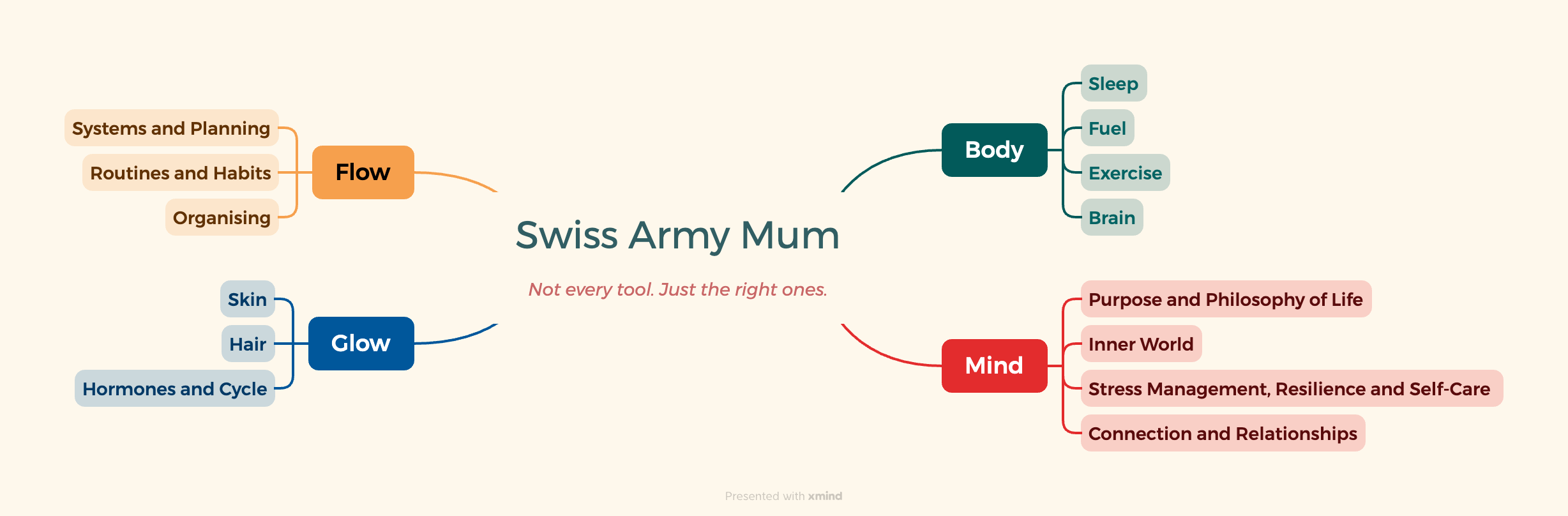
The idea is to have a central hub where all the important information and resources can be found.
Each pillar is presented with an overarching principle, in bold, a “why does it matter” section, a “key takeaways” where the bulk of the scientific insights are, collaged from different sources, a “80/20” section, where the most impactful things we can do are listed, and a “the next level” where you can find more ideas and strategies if you’ve mastered the 80/20.
In between, you’ll find links to SAM resources, quotes, tips, or links to external sources and resources.
I find summarizing and organizing knowledge this ways helps you build connections you otherwise don’t see and distill the really essential stuff. It’s both a process for internalizing knowledge and a way to clearly display connections and concepts. If you like summarized visual information, this is for you.
Body: Sleep, Eat, Move, Repeat
Sleep is the foundation. Everything else crumbles without it. When you sleep, your brain clears metabolic waste, your body repairs tissue, your hormones recalibrate. Chronic sleep deprivation disrupts insulin sensitivity, increases inflammation, undermines decision-making, and shortens lifespan. Matthew Walker’s Why We Sleep lays this out in detail:
The shorter your sleep, the shorter your life.
Fuel is information. What you eat sends signals to your cells. Glucose control is the master lever—it affects inflammation, energy, mood, fat storage, disease risk. Chronic glucose spikes damage mitochondria, trigger glycation, drive insulin resistance, and set the stage for metabolic dysfunction. Jason Fung’s The Obesity Code - and so many others - breaks this down brilliantly: focus on stabilizing blood sugar (via a few key changes), and most other health markers improve downstream.
Exercise is medicine. Not for aesthetics - for longevity. Muscle is an organ that regulates glucose, protects bones, and supports metabolic flexibility. VO₂ max - your cardiovascular fitness - is one of the strongest predictors of lifespan. Strength training maintains muscle mass and bone density, especially critical as we age. Stability and mobility work prevent falls and injuries. High-intensity interval training triggers metabolic adaptations that counteract the effects of declining hormones. Stacy Sims’ Next Level shaped how I think about exercise: it’s not about looking good, it’s about staying functional and independent into your eighties and beyond.
These three prongs: sleep, exercise, and fuel all interplay to create - or destroy - your metabolic health, which in turn is the key to avoiding chronic disease and improving healthspan.
Mind: Mens Sana in Corpore Sano
A healthy mind in a healthy body. The Romans understood something we’ve spent the last century rediscovering: mind and body aren’t separate. They reinforce each other.
Mental health isn’t one thing—it’s layers (and very complicated at that!). I like to think of it in terms of Maslow’s hierarchy of needs3, but with a twist: you need foundations before you can build higher.
At the foundation, your physical health directly shapes your mental state: better sleep improves emotional regulation, exercise reduces anxiety and boosts neuroplasticity, stable glucose prevents brain fog and mood swings. Without this baseline - when you’re hungry, exhausted, sick or don’t feel safe - your mind can’t regulate itself effectively. The Body pillar handles this foundation. Above that, you need connection: humans are social animals, and loneliness kills as surely as smoking. Strong social ties increase happiness and resilience. Then comes stress management - not eliminating stress, but learning to respond instead of react. Tools like breathwork, mindfulness, and gratitude practices. Not hours of meditation you won’t do, but five minutes of intentional breathing or ten minutes journaling. At the top sits purpose: a philosophy of life, a compass for navigating life. Purpose and guiding values protect against despair and give direction when everything feels chaotic.
For me, that compass is Stoicism. Marcus Aurelius, Epictetus, Seneca—they wrote for people dealing with real-world chaos, loss, frustration, mortality. Their advice is practical, not mystical. Reframe events. Distinguish what you can control from what you can’t. Accept what is. It’s emotional resilience built through consistent practice. William Irvine’s A Guide to the Good Life is an excellent introduction, and Massimo Pigliucci’s How to Be a Stoic gave me the structure for daily practice.
It’s surprising how such ancient wisdom applies so well to modern times. Don’t jump to quick conclusions with respect to Stoicism. It’s not about avoiding emotion and keeping a stiff upper lip. It’s about minimizing negative emotions and maximizing positive ones. It’s about living a life worth living. The kind I want.
Glow: Less Is More (and it costs less!)
Hair, skin, self-care, without the 12-step routines or $200 serums.
The beauty industry thrives on complexity. More products, more steps, more money. Miracle claims that require either a scalpel or a syringe to deliver. But the science tells a different story: most of it doesn’t matter (and doesn’t look that great to begin with!). What matters is consistency, damage protection and accepting the normal process of aging.
The fundamentals are surprisingly simple. Retinoids stimulate collagen production and cell turnover. Niacinamide strengthens the skin barrier and reduces inflammation. Sun protection prevents photoaging and skin cancer. Red light therapy supports mitochondrial function in skin cells. That’s the core. Everything else is marketing.
Hair follows the same principle: less damage, more maintenance. Your hair doesn’t need seventeen products - it needs protection from heat and chemical damage and scalp health. The goal isn’t Instagram-perfect hair - it’s strong, healthy hair that ages well alongside you.
Hannah English’s Skintelligent cuts through the noise and focuses on evidence-based minimalism. I only use a handful of products for my hair and skin, of no particular brand. Just the cheapest safest option available that has the active ingredients I’m looking for. I use a 2-ingredient exfoliating mask from stuff in my kitchen once a week. It works. It’s cheap. It doesn’t require remembering seventeen steps or setting three phone alarms.
This pillar also covers hormones: how to prepare for and navigate perimenopause and post-menopause, because your skin, hair, and overall vitality shift with hormonal changes, and understanding that matters.
The point isn’t avoiding aging—it’s aging in the best possible way without accelerating the process through overzealous interventions or neglect. To cite the great Anna Magnani,
Leave me all my wrinkles, don’t take even one away. I paid dearly for every one of them. It took me a lifetime to get them!
Flow: Systems Over Willpower
This pillar is all about automating the boring stuff so your brain can rest. Once you set up systems, they run on autopilot, freeing up your time and mind for the things that actually matter.
Decision fatigue is real and measurable. Every choice you make - what’s for dinner, when to work out, how to structure your day - depletes your mental energy (it does mine!). The research is clear: willpower is a finite resource. The solution isn’t more discipline. It’s fewer decisions.
Weekly meal rotations eliminate the weekly “what’s for dinner?” spiral. Template libraries for grocery lists, workout schedules, and budget tracking turn recurring tasks into one-time setup efforts. Habit stacks chain multiple healthy behaviors together so one cue triggers several actions. Checklists offload memory demands from your brain to external systems.
Second brain tools store your systems externally. AI tools like ChatGPT or Claude handle the tedious setup work - building meal rotations, drafting workout templates, structuring databases. Not to replace thinking, but to scaffold the boring parts so you just refine and personalize. The key is knowing how to prompt it effectively - which I’ll show you.
Once you built the systems, you can leave them on autopilot and focus on doing more of the stuff you love, which to me means fermenting stuff - kombucha, sourdough, kefir, kimchi, yogurt, you name it. Singing while baking - or in the shower. Long walks with my bonkers but terribly cute dog. Trying (and mostly failing) to learn guitar. Movie and game nights with the family. Knitting while listening to audiobooks…
How to navigate Swiss Army Mum
All content is organized by pillar (as presented above) and by type of post (blueprint, zoom, book club, behind the scenes). Below, you’ll find the list of posts already in the SAM library. This list is updated after each new article:
General

Body
Sleep
Sleep: The Non-Negotiable Foundation - Blueprint
Book Club: Why We Sleep - Book club
The Postpartum Sleep Paradox: Why New Mums Are Built to Sleep Less - Zoom
Fuel
Fuel: The Master Lever for Metabolic Health - Blueprint
Book Club: The Metabolic Health Library - 8 Books Reviewed - Book club
The Insulin Resistance Story (And My Glucose Monitor Data) - Zoom, behind the scenes
Gut Health: The Metabolic Ally You’re Probably Ignoring (+ Why I Brew Kombucha) - Zoom, behind the scenes
Exercise
Exercise: Muscle as a Longevity Organ (You Need Less Than You Think) - Blueprint
Strength Training for Women Over 35: Build Muscle or Lose It - Zoom
Balance, Mobility & Plyometrics for Women Over 35: Prevent Falls, Build Bone Density - Zoom
Book Club: Next Level by Stacy Sims - A Busy Woman’s Take - Book Club
My Home Workout Setup and System (What I Actually Use Every Week) - Behind the scenes
Much Ado About Peakspan: Staying Close to your Peak for Longer - Zoom
Brain
Mind
Mind: Beyond Not Breaking Down - Blueprint
Purpose and philosophy of life
Purpose and Philosophy of Life: Why Your Life Needs a Map - Blueprint
On Anxiety and Worry - Sample chapter
On Overwhelm and Decision Fatigue - Sample chapter
On Envy and Comparison - Sample chapter
Inner Life
Knowing Yourself: The Case for an Inner Life - Blueprint
Solitude Without Loneliness - Zoom
What Personality Tests Can Actually Tell You And What to Do With the Map - Behind the scenes
Stress Management, Resilience and Self-Care
Stress Management, Resilience and Self-Care - Blueprint
The Science of Rest: Why Deliberate Leisure Is Healthcare - Zoom
My Wholesome Activities - Behind the scenes
The Blood Pressure Experiment: Does Breathing Actually Move the Needle? - Behind the scenes
Three Books on Stress Reviewed Honestly - Book club
Connection
Glow
Coming soon. Skin, hair, hormones, and the biology of aging well without the twelve-step routines.
Flow
Coming soon. The systems, routines, and habits that make the other three pillars actually stick.
Each article links back to this page so you can always navigate the system from one place.
Want the whole framework at a glance? Download the Quick Start Guide
How the Pillars Work Together
They compound.
Better sleep makes you want to workout. Better workouts stabilize glucose. Stable glucose improves mood and decision-making. Better decisions reduce stress. Lower stress improves sleep.
Better sleep improves emotional regulation. Exercise reduces anxiety and boosts neuroplasticity. Stable glucose prevents brain fog and mood swings. Stress management protects your gut microbiome, which affects your mental health. It’s all connected.
You don’t need to master all four at once. Start with one. Add over time. Let them reinforce each other.
What This Substack Is (And Isn’t)
This is science-backed frameworks - I’ve done the research so you don’t have to. Practical tools you can use today: templates, trackers, protocols. Real-life implementation: messy, imperfect, sustainable. Minimalist and realistic. Designed to help you age well, not look 25 forever.
This isn’t another guru telling you to wake up at 5 AM. It’s not expensive supplements or biohacking gadgets you don’t need (most of what I buy to test, is second hand!). It’s not perfection-based wellness culture or quick fixes or miracle claims.
It’s showing up and working towards a life worth living.
The knowledge is always free. Every post, every pillar, every tool. Because access to good science shouldn't come with a paywall.
If you want to go further, SAM has a paid tier for women who are ready to move from reading the science to actually using it. Tools, trackers, prompts, and a personal written audit to tell you exactly where to start.
Curious what membership includes? Start Here.
Already a member? Your toolkit is in the SAM Vault.
Your Turn
Subscribe, it’s free!
Then comment and tell me: which aspect interests you the most right now? Sleep? Systems? Stress management? I’d love to know a bit more about your story.
Vilfredo Pareto was an Italian engineer, economist, and sociologist. He is best known for observing that wealth and outcomes in many systems are unevenly distributed - a pattern later popularized as the 80/20 rule (or Pareto principle). The principle states that roughly 80% of results often come from 20% of causes (e.g. a small number of inputs, efforts, or factors produce most of the impact). While the exact numbers vary, the insight is widely used as a heuristic in economics, business, productivity, and systems thinking. https://en.wikipedia.org/wiki/Vilfredo_Pareto
The blueprint looks like a fractal spider when fully deployed - and is hard to read all at once!
Abraham Maslow was an American psychologist best known for Maslow’s hierarchy of needs, a model of human motivation. It proposes that people progress through levels of needs—from basic physiological needs, to safety, love/belonging, esteem, and finally self-actualization. His framework has been somewhat contested and controversial but I personally find the idea useful for ordering my thoughts. https://en.wikipedia.org/wiki/Maslow%27s_hierarchy_of_needs
I just had a conversation (today!) with my husband about how we’re going to keep our bodies together/energetic as we age…so that by the time our toddler is backpacking through the Alps in college, we can be there too. And I stumbled across your page!! Very excited to learn from you!
Ok you convinced me
When do we start.