


I do not go looking for social contact. Left to my own defaults, I would spend most evenings reading or knitting, talk to a handful of people I genuinely like, and consider that sufficient. I am not anxious in social settings. I simply do not find them energising.
And then I read the research on loneliness.
The finding that adequate social connection is among the most consistent predictors of long-term health (on a par with not smoking, maintaining a healthy weight, and exercising) is not a soft wellness claim. It is a robust finding from several decades of large-scale epidemiological work. If you’re someone who does not naturally seek social contact, that finding lands differently.
This post is about what that research actually says, what it says specifically about people who are introverted, and what “enough” connection looks like when you are someone who genuinely prefers your own company.
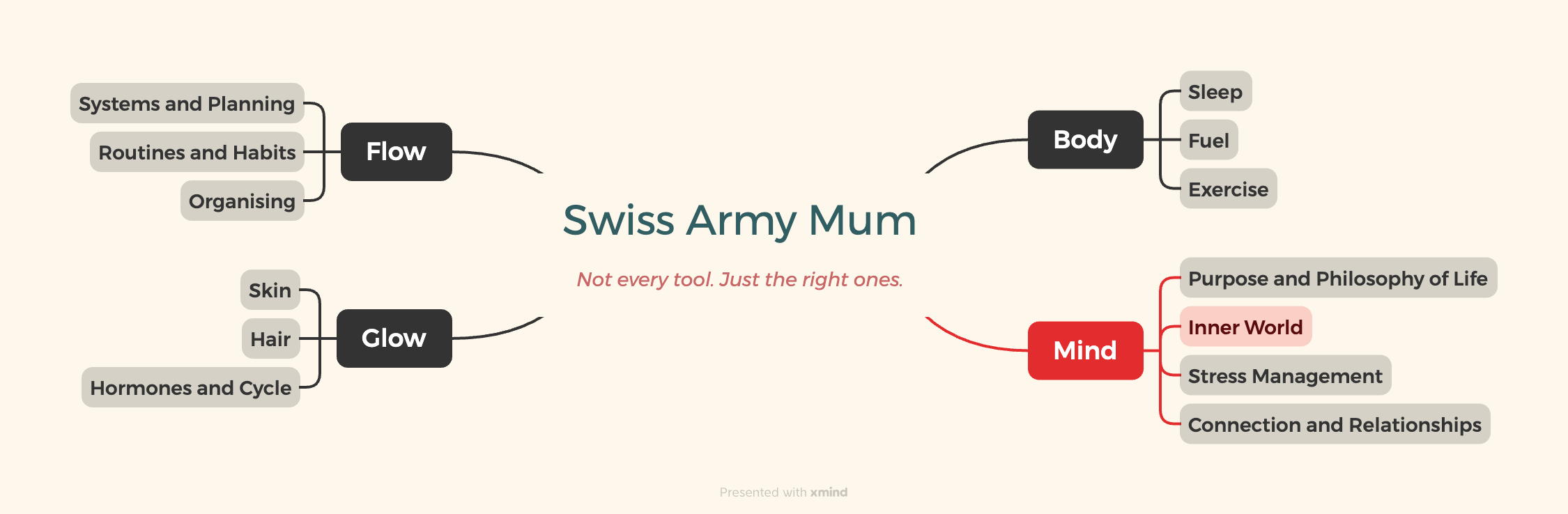
This post sits in the Inner World area of the Mind Pillar. The previous post in this area established what self-awareness actually is and why most of us have less of it than we think.
This one covers the conditions that make it possible: specifically, what it means to be alone with yourself in a way that builds rather than drains, and what the research says about how much social connection you actually need: especially if you are introverted and do not naturally reach for it.
It bridges directly into the Connection and Relationships area later in the series, because the capacity to be with yourself and the capacity to genuinely connect with others turn out to be two sides of the same coin.
What follows is a brief tour of what the science actually says, which turns out to be both more alarming and more reassuring than the popular version, depending on which part you are starting from.
New here? Start here:

Swiss Army Mum is a practical guide to long-term health for busy women, built on four pillars: Body, Mind, Glow, and Flow.
Not every tool. Just the right ones.
Loneliness Is a Health Risk: Here Is What the Research Actually Shows
The epidemiological evidence on social connection and health is substantial and converging. The two landmark meta-analyses here are both from Julianne Holt-Lunstad and her colleagues.
The 2010 paper synthesised studies with a combined 308,849 participants and an average follow-up of 7.5 years. People with stronger social relationships had roughly a 50% greater likelihood of being alive at follow-up than those with weaker ones.
The 2015 paper sharpened the question. It disaggregated three distinct constructs: social isolation (objective deficit in social contacts), loneliness (the subjective feeling that your social needs are not met), and living alone. They found each independently predicted an increase of mortality of about 30%.1
Holt-Lunstad has framed the magnitude of this finding herself: lacking social connection is comparable to smoking up to 15 cigarettes per day.2 It is important to be precise here: this is a benchmark comparison, not a verbatim finding from the meta-analyses. It is constructed by aligning the effect sizes against independent meta-analyses for other risk factors.
Think of it this way: if your GP told you that something you were doing (or not doing) carried the same health risk as smoking, you would take it seriously. Social disconnection is that thing. Most of us just never received the memo in those terms.
The accurate claim is that social disconnection is in the same risk-factor league as smoking, obesity, and physical inactivity, not that it is precisely equivalent to a specific cigarette count.
Two other things the research clarifies, both of which matter for this post.
First: loneliness and social isolation are distinct. Many people are objectively isolated but not lonely. Many more are surrounded by people and chronically lonely. The subjective experience of feeling that your social needs are not being met is the critical variable, and it has its own independent health implications, separate from the objective number of people in your life.
Second: midlife is, on average, the least lonely period of adult life. A coordinated analysis of nine longitudinal studies with over 128,000 participants across 20 countries found loneliness follows a U-shape across the lifespan: highest in young adulthood, lowest in midlife, rising again after the mid-60s.⁴3 This does not mean midlife is fine for everyone. People experiencing major role transitions (divorce, bereavement, relocation, empty-nest, caregiving) are at significantly elevated risk regardless of their life stage. But the population-level picture is more nuanced than the public-health alarm sometimes implies.
Is loneliness really as bad as smoking?
Epidemiologist Julianne Holt-Lunstad's meta-analyses of 148 studies found that adequate social connection is associated with roughly 50% greater likelihood of survival compared to social isolation. Holt-Lunstad herself describes this as comparable to smoking up to 15 cigarettes per day, a benchmark comparison, not a verbatim finding from the data.
The accurate claim: social disconnection is in the same risk-factor league as smoking, physical inactivity, and obesity.
Solitude Is Not Loneliness
The most useful finding in the solitude literature is also the simplest: solitude and loneliness are not the same thing, and the research treats them completely differently.
In one of my favourite studies in this whole area, participants were left alone with nothing to do but sit with their own thoughts for fifteen minutes. A significant minority preferred to give themselves mild electric shocks rather than continue.4 I find this both surprising and extremely recognizable. The mind unsupervised and unoccupied is, for many people, not a pleasant place to be, at least not without practice.
The practical implication: alone time is not the same as restorative solitude. The alone-time most busy women actually get (at the end of a depleted day, scrolling a phone, with the vague sense they should be doing something else) is not the kind research identifies as restorative.
Restorative solitude is chosen, low-demand, approached without guilt, and without a screen functioning as a barrier between you and your own thoughts. You cannot benefit from solitude until you have some capacity to be with your own inner life without immediately fleeing it.
What the Research Actually Says About Introverts
Here is the thing I genuinely did not expect to find in this literature. The popular account of introversion says: introverts are self-sufficient, they need less social contact, they recharge alone, they are fine. The research says something considerably more complicated, and, if you are introverted, considerably more important to know.
Extraversion (measured by validated instruments like the Big Five, not by MBTI types) does predict the size of your social network. More extroverted people tend to know more people and interact with more of them. But extraversion does not predict the emotional closeness of your relationships, or the quality of the few connections you have. The relationship between extraversion and network size is real; the relationship between extraversion and network depth is not.5
A 2020 meta-analysis found that introverts are, on average, lonelier than extroverts.6 That is a meaningful finding and it goes in the opposite direction from the popular claim that introversion is some kind of social self-sufficiency.
Read that again if you need to. Introverts (the people most likely to tell themselves they do not need much connection) are, on average, the loneliest.
Card and Skakoon-Sparling found that the relationship between social support and happiness was stronger for people lower in extraversion than for those higher.7 In other words: the happiness benefit of high-quality social connection may be at least as large for introverts as for extroverts, possibly larger.
The research does not support the idea that introverts can safely tolerate more isolation. If anything, the evidence runs the other way.
What introverts appear to need, based on the available evidence, is not fewer connections but fewer interactions of higher quality, with adequate solitary recovery time built around them. That is a quantity preference (fewer, longer, deeper) not a reduced need. The distinction matters because misreading it as “I don’t need much social contact” leads to under-investing in the relationships that research consistently shows are among the most powerful predictors of long-term wellbeing and health.
The “social interactions drain introverts” framing also turns out to be more complicated than it sounds. The version with caveats is: introverts may carry more cost from sustained high-intensity social engagement than extroverts do, but ordinary social interaction with people they like is not typically experienced as aversive in the moment.
Introverts do not need less social connection, and may benefit from it at least as much as extroverts.
How Many Friends Do You Actually Need?
Building a close adult friendship is less like meeting someone and more like seasoning a cast iron pan. It requires repeated exposure, the right conditions, and more time than feels reasonable before it actually works. Hall's research estimated roughly 200 hours of chosen time together to reach the level of a close friend.8 At two hours a week, that is almost two years. This is not a counsel of despair. It is a permission slip to stop feeling like you are doing friendship wrong when it does not happen faster.
William Rawlins’s research on adult friendship across the lifespan documents what most of us have experienced: midlife friendship is structurally squeezed by competing obligations. Many adults find their closest friendships were formed earlier in life and survive as relationships that can pick up where they left off, not because adult friendship is impossible, but because the conditions that produced earlier friendships (proximity, repeated unplanned contact, shared context) have largely dissolved.¹⁵
What the research suggests actually works for intentional adult friendship formation: repeated, predictable contact in a shared context (a class, a club, a regular commitment); enough absolute time (Hall’s hours matter); activity that allows conversation and unstructured time, not just task completion; and graduated reciprocal disclosure: sharing something real about yourself and making space for the same in return.
For someone low in sociability, the structural recommendation is: pick fewer contexts and invest more in them. One committed, repeated activity is worth more than three occasional ones for friendship formation purposes. And accept the timeline. Six months is not failure. It is the research-supported pace of how connection actually builds.
The Stoic Thread
Seneca wrote, in one of his letters to Lucilius:
“Recede in te ipse.”
Retreat into yourself.9 He was not recommending isolation. He was describing the inner citadel. The internal reference point that holds regardless of external circumstances. For Seneca, the capacity to be alone with yourself, to not flee from your own company, was not a character preference. It was a philosophical discipline.
There is a version of chosen solitude that is genuine inner-world work. And there is a version that is avoidance dressed as self-sufficiency. The research helps you tell them apart. If your solitude is building self-knowledge, restoring attentional capacity, and supporting the deeper connections you return to, it is the former. If it is substituting for connection while you tell yourself you do not need it, it is the latter. The Stoic practice of honest self-examination is precisely the tool for making that distinction.
Solitude entered voluntarily (particularly in low-demand environments) reliably reduces high-arousal emotion and supports self-concept clarity. Imposed solitude (being alone against your preference) tends toward loneliness and rumination.
The 80/20
Two things.
First: one period of chosen, screen-free solitude built into the week as maintenance, not as a reward for completing everything else. Twenty minutes of genuine quiet does more for attentional restoration than an hour of scrolling “to decompress.”
Second: identify one relationship you value and are currently under-investing in, and make a specific plan (not an intention, a plan) to rebuild contact. Hall’s research says the hours matter and that they need to be in chosen, unstructured time together. What does that look like, practically, this month?
Thank You
Thank you for reading, sharing, and supporting this work. Whether you’ve been here since the beginning or just found Swiss Army Mum, I’m glad you’re here.
If this one landed, I’d be grateful if you forwarded it to someone who might need it, or hit the ♥️ or ↻ Restack button. It helps more people find this space.
Medical note: This is educational, not personal medical advice. Your biology, history, and context matter. Work with a qualified healthcare professional.
References
Holt-Lunstad, Julianne et al. “Loneliness and social isolation as risk factors for mortality: a meta-analytic review.” Perspectives on psychological science : a journal of the Association for Psychological Sciencevol. 10,2 (2015): 227-37. https://doi.org/10.1177/1745691614568352
The “15 cigarettes” framing is a benchmark comparison, not a verbatim finding: see https://www.julianneholtlunstad.com/15-cigarettes for the author’s own clarification.
Graham, Eileen K et al. “Do We Become More Lonely With Age? A Coordinated Data Analysis of Nine Longitudinal Studies.” Psychological science vol. 35,6 (2024): 579-596. https://doi.org/10.1177/09567976241242037
Wilson TD, Reinhard DA, Westgate EC, Gilbert DT, Ellerbeck N, Hahn C, Brown CL, Shaked A. Social psychology. Just think: the challenges of the disengaged mind. Science. 2014 Jul 4;345(6192):75-7. https://doi.org/10.1126/science.1250830
Pollet, T. V., Roberts, S. G. B., & Dunbar, R. I. M. (2011). Extraverts have larger social network layers: But do not feel emotionally closer to individuals at any layer. Journal of Individual Differences, 32(3), 161–169. https://doi.org/10.1027/1614-0001/a000048
Buecker, S., Maes, M., Denissen, J. J. A., and Luhmann, M. (2020) Loneliness and the Big Five Personality Traits: A Meta-analysis. Eur. J. Pers., 34: 8–28. https://doi.org/10.1002/per.2229.
Card KG, Skakoon-Sparling S. Are social support, loneliness, and social connection differentially associated with happiness across levels of introversion-extraversion? Health Psychol Open. 2023 Jun 30;10(1):20551029231184034. https://doi.org/10.1177/20551029231184034
Hall, J. A. (2019). How many hours does it take to make a friend? Journal of Social and Personal Relationships, 36(4), 1278-1296. https://doi.org/10.1177/0265407518761225
Seneca. Letters to Lucilius, Letter VII. Public domain translation.
I’m extroverted hehe, but I just love how much citation and research u do. I LOVE research and how all these conclusions and good practices and patterns come up. And loneliness is such an important topic that your info explains WHY my high school friendships sometimes feel not fulfilling cause they’re very sparse and all. Amazing article :D
This is a painful topic for me.
I enjoyed the article, thank you.