



There is a version of me that can describe, in some detail, what is wrong with almost any argument she encounters. What she struggles to describe is what she is actually feeling on a given Tuesday afternoon.
Not “stressed”. That is a category, not a feeling. Not “fine”. That is a door politely closed. Something more specific. Something that, if named accurately, might actually be useful information rather than background noise.
This is the gap the Inner World area of the Mind Pillar is about. Not the absence of emotion, the absence of access to it. Not the inability to manage what you feel, but the prior and more fundamental problem: not knowing what you feel precisely enough to do anything useful with it.
This post is the foundation. Everything in the Inner World area (solitude, personality, self-examination) rests on some baseline capacity to actually know what is going on inside you. And the research suggests that capacity is rarer, and harder to develop, than most of us assume.
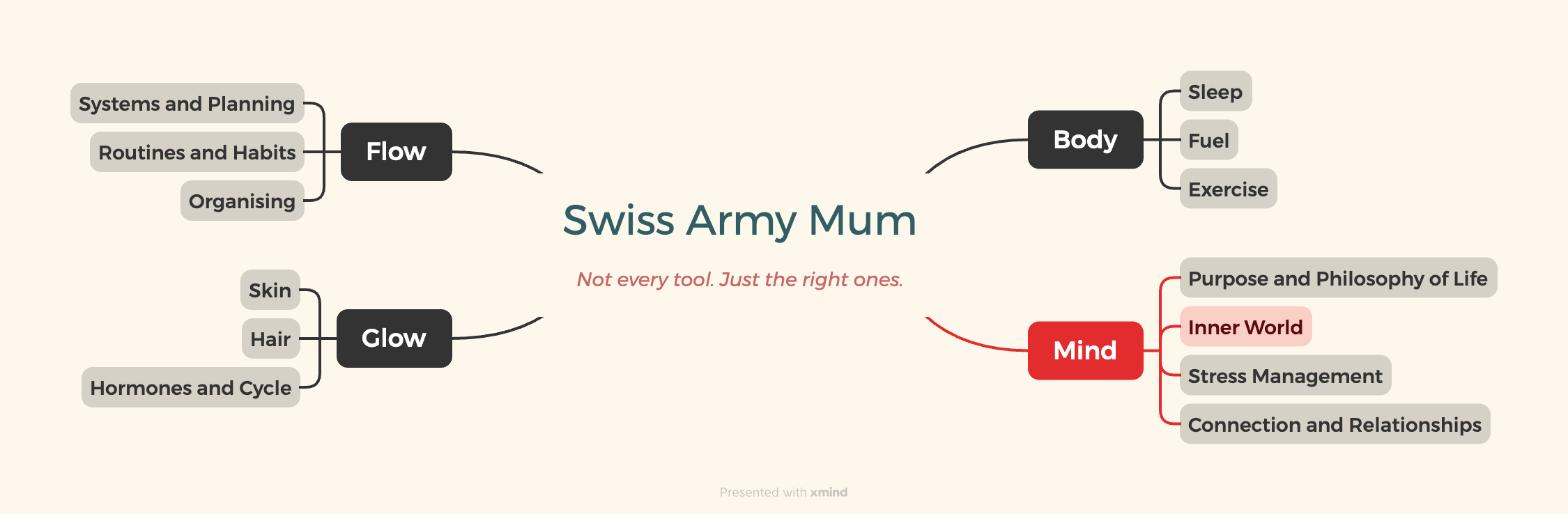
This post sits within the Inner World area of the Mind Pillar. The Body Pillar gave you the physical foundation. The Purpose and Philosophy area gave you a compass. The Inner World is the hand holding the compass. If you do not know what you are actually feeling, not the performed version, not the story you tell yourself, but what is actually happening, the compass is pointing somewhere you cannot read.
New here? Start here:

Swiss Army Mum is a practical guide to long-term health for busy women, built on four pillars: Body, Mind, Glow, and Flow.
Not every tool. Just the right ones.
What Self-Awareness Actually Is, And What It Isn’t
Self-awareness is not a personality trait. You are not born with it or without it. It is a capacity, and like most capacities, it varies across situations, develops over time, and can be actively cultivated or allowed to atrophy.
Researchers distinguish at least three layers.1 Bodily self-awareness: knowing your physical state. Psychological self-awareness: knowing your traits, values, and emotional patterns. Meta-cognitive self-awareness: knowing what you do and do not know about yourself. These three are meaningfully distinct. Someone can be highly attuned to their body and completely opaque to their own motivations. Someone else can have excellent insight into their values and no idea how others perceive them.
A distinction that has influenced how people talk about self-awareness in the past decade comes from Tasha Eurich, an organisational psychologist who distinguishes internal self-awareness (clarity about your own values, reactions, and impact) from external self-awareness (accurate understanding of how others see you). These two turn out to be essentially uncorrelated, you can score high on one and low on the other.2 A word of honesty here: Eurich’s widely cited statistic that “only 10-15% of people are truly self-aware” comes from her industry research and book, not from a peer-reviewed journal with a published methodology. The underlying conceptual distinction is sound and consistent with academic work. The specific percentage should be held loosely.
What the peer-reviewed literature does support, clearly and repeatedly, is the uncomfortable finding that introspection is not a reliable route to accurate self-knowledge. In a landmark 1977 paper, Nisbett and Wilson showed that people frequently generate plausible-sounding explanations for behaviour driven by causes they cannot consciously detect.3 We produce the story that makes sense rather than the story that is true.
The practical implication is not that self-reflection is useless. It is that self-reflection done a particular way is worse than useless: it sharpens the story you already tell yourself rather than uncovering what is actually driving you. Silvia and Gendolla’s careful review of the literature found that self-focused attention frequently increases consistency with your self-image rather than with external reality.4
There is a better approach, and it is counter-intuitive.
Why This Is Genuinely Hard to Think About
I want to stop here and name something, because if you are finding this difficult to hold in your head, that is not a reading problem. It is a feature of the subject matter.
Self-awareness research asks you to think about how you think about yourself. Which immediately creates the problem of which self is doing the thinking. You are using the instrument to study the instrument. At a certain point this starts to feel like trying to see your own cornea without a mirror.
Every attempt to catch yourself in the act of thinking produces a new act of thinking, which is itself not yet examined. The observer keeps moving. You can get closer, but you cannot collapse the distance entirely.
I found this genuinely reassuring when I first read it. Not because it resolves the difficulty, but because it means the difficulty is real. You are not failing to grasp something simple. You are bumping up against something that has occupied serious philosophers and psychologists for decades, without a clean resolution.
The practical implication is that direct introspection is probably not the right tool for the job. Not because you are doing it wrong. Because the job is structurally resistant to being done that way.
Why Asking 'Why' Backfires And What to Ask Instead
You have probably noticed this yourself. You snap at someone and later explain it as stress. But stress was not the reason, it was the available explanation.
Research by Eurich and others converges on a finding that is both simple and difficult to implement: asking what produces more useful self-insight than asking why.
“Why did I react that way?” generates a fabricated explanation almost every time. The question is too open, too inviting of a coherent story, and too comfortable with whatever answer arrives. “What am I actually feeling right now?” is a more honest question because it resists easy answers. It requires you to look at something, not explain something.
The why habit is pervasive among thoughtful people. It feels like reflection. It often produces insight-shaped content that is simply not true.
A related practice that the research consistently endorses is seeking feedback from what Eurich calls “loving critics”: people who know you well, who care about your wellbeing, and who will tell you the truth.
Solo introspection has an inherent limitation: it works on the information you already have about yourself, filtered through the story you already tell. Someone who knows you well has information you don’t, and if they are honest, that information is more reliable than most of what introspection produces.
Emotional Granularity: The Skill You Can Actually Train
One of the most practically useful concepts in recent self-awareness research is emotional granularity: the ability to distinguish between specific emotional states rather than collapsing them into broad, vague categories.
Most people feel something and call it “stressed,” or “bad,” or “overwhelmed.” High-granularity individuals feel something and call it “frustrated because I feel unheard,” or “anxious about a specific outcome that I can influence,” or “resentful because a boundary I haven’t set is being crossed.” These are not just different words. They are different information. And different information leads to different responses.
The research on what high emotional granularity predicts is striking. It is associated with less use of maladaptive coping: less binge drinking, less aggression, less self-injury.
The difference between "I feel terrible" and "I feel resentful because I took on something I did not want to and did not say so" is not just vocabulary. The first sentence is a dead end. The second one has a next step in it.
Emotional granularity is not a fixed trait. Lisa Feldman Barrett’s research has shown it can be cultivated through the deliberate practice of noticing and labelling emotional states with specificity.5 This is genuinely trainable.
The tool is simply this: when you notice you are feeling something, resist the generic label and push for the specific one. Not “anxious”: anxious about what, exactly, and why does that thing have this much charge? Not “tired”: tired of what, specifically?
The Body As a Source of Self-Knowledge
One of the most interesting developments in recent self-awareness research is the growing evidence that bodily signals are not just accompaniments to emotional states. They are, in part, constitutive of them.
Interoception is the brain’s capacity to sense and interpret signals from inside the body: heartbeat, breathing, gut state, temperature, fatigue.
Think of your body as a slow correspondent. It has been sending you signals all day — the tight jaw, the shallow breath, the heavy feeling in the chest that is not quite tiredness. Most of us have learned to override the messages rather than read them. Interoception research asks what happens when you start reading them instead.
The connection to emotional regulation is significant and growing: people with higher interoceptive accuracy tend to have better access to their emotional states and more capacity to regulate them. The body is not just reacting to your emotions. It is, in part, how emotions are constructed and communicated upward to conscious awareness.
A practical note here, and one the literature review that informed this post flags explicitly: the specific claim that estrogen decline in perimenopause causally alters interoceptive accuracy is mechanistically plausible but not yet established in peer-reviewed work. The connection between hormones, interoception, and midlife emotional experience is an active area of research. It is worth knowing it exists, while holding the specific causal claims loosely.
What Actually Works
Given that introspection is unreliable and emotional granularity is the target, what are the evidence-based tools?
The Pennebaker protocol
The most replicated and actionable finding in this entire literature is the Pennebaker expressive writing protocol.6 James Pennebaker and Sandra Beall’s 1986 study launched four decades of research: 15-20 minutes of writing about your deepest thoughts and feelings about a meaningful stressor, on each of three to four consecutive days or evenings. The writing is private. Grammar does not matter. The goal is not to produce good writing but to convert vague emotional experience into structured narrative.
The mechanism is thought to involve multiple pathways: cognitive processing (forcing coherent narrative around chaotic experience), emotional exposure (reducing intensity through repeated engagement), and linguistic integration (building causal and insight language around the experience).
What the research consistently shows works better: specificity of the topic (something that is genuinely weighing on you, not something mild), spacing the sessions (evenings work well), and genuine emotional engagement rather than detached description. Effects are larger for real distress than for manufactured writing prompts. And for people who are carrying something they have not fully processed, the protocol is worth doing.
The Pennebaker protocol:
Set a timer for 15-20 minutes
Write about your deepest thoughts and feelings about one meaningful stressor
Repeat on three to four consecutive evenings
Keep the writing private, grammar does not matter
Marcus Aurelius wrote the Meditations as private notes to himself, never intended for publication, never meant to be read. They are the most sustained, serious practice of deliberate self-examination that has survived from the ancient world. Not because he had achieved self-knowledge. Because he had not, and he knew it, and he worked at it daily anyway.
The practice is the point.
The Evening Review
If the Stoic Compass is the navigational tool for the external world, the evening review is what you do at the end of the day to check whether you have been navigating by it honestly. Three questions. Two minutes. The same practice Seneca described two thousand years before Pennebaker published his first study.7
Where did I fall short today? Where did I act well? What do I do differently tomorrow?
The 80/20
Pick one thing and do it consistently.
The Pennebaker protocol: 15 minutes, three or four evenings, one thing that has been weighing on you, is the highest-evidence option if you have something specific to process.
The evening review: two minutes, three questions, every night, is the sustainable daily practice for building the habit of looking inward honestly rather than performing wellness.
Not both. Consistency over intensity.
The inner life is built in the same way everything else worth having is built: slowly, repeatedly, without expecting it to feel complete.
Thank You
Thank you for reading, sharing, and supporting this work. Whether you’ve been here since the beginning or just found Swiss Army Mum, I’m glad you’re here.
If something in this post landed, I’d be grateful if you forwarded it to someone who might need it, or hit the ♥️ or ↻ Restack button. It helps more people find this space.
Medical note: This is educational, not personal medical advice. Your biology, history, and context matter. Work with a qualified healthcare professional.
References
Morin, Alain. “Levels of consciousness and self-awareness: A comparison and integration of various neurocognitive views.” Consciousness and cognitionvol. 15,2 (2006): 358-71. https://doi.org/10.1016/j.concog.2005.09.006
Eurich, T. (2018). What self-awareness really is (and how to cultivate it). Harvard Business Review, January 2018. https://hbr.org/2018/01/what-self-awareness-really-is-and-how-to-cultivate-it. Note: the 10-15% figure comes from Eurich’s industry research, not a peer-reviewed journal.
Nisbett, R. E., & Wilson, T. D. (1977). Telling more than we can know: Verbal reports on mental processes. Psychological Review, 84(3), 231–259. https://doi.org/10.1037/0033-295X.84.3.231
Silvia, P.J. & Gendolla, G.H.E. (2001). On introspection and self-perception. Review of General Psychology, 5(3), 241-269. https://doi.org/10.1037/1089-2680.5.3.241
Barrett, L.F. (2017). How Emotions Are Made. Houghton Mifflin Harcourt.
Pennebaker, J. W., & Beall, S. K. (1986). Confronting a traumatic event: Toward an understanding of inhibition and disease. Journal of Abnormal Psychology, 95(3), 274–281. https://doi.org/10.1037/0021-843X.95.3.274
Seneca. On Anger, Book III, c. 45 CE. Public domain translation.
Thank you for this article. I love my own perception of myself being challenged, especially from a scientific perspective...I often find myself thinking that people seem to have a lot of random stuff in their heads that makes them act in all sort of unexplicable ways and I know that I am the same, but I am just not completely aware of my own personal "load of crap" despite my very best efforts...this article confirms it...I've screenshot the evening review questions...going to try to work on them. Thanks