


I was sixteen when I first understood that a social network could simply evaporate.
My family moved from Argentina to Spain. The friendships I had spent years building, the ones that felt like the permanent architecture of my life at that age, dissolved almost immediately into distance, silence, and eventually the polite awkwardness of two people who have become strangers.
I rebuilt in university in Spain, which worked, but differently. Something had shifted. I made connections more carefully, held them less tightly, kept a certain emotional distance that had not been there before. Whether consciously or not, I had learned that the people around you could disappear through no fault of either party, and the lesson stuck.
The pattern that emerged over the years: I gravitated toward other people who were far from home. Expats, people in transition, people who understood the particular texture of building a life somewhere you were not from. Some of those friendships did not survive the next move. Some have. The ones that lasted are a specific kind: people you see perhaps once every two years, and every time it is as if no time has passed at all. Those are the ones worth paying attention to.
This is not unique to me. The social connection research has a framework for exactly this, and it turns out the quality of that framework has implications far beyond personal history. Your relationships are not just a source of comfort or pleasure. They are doing something to your body, measurably and continuously.
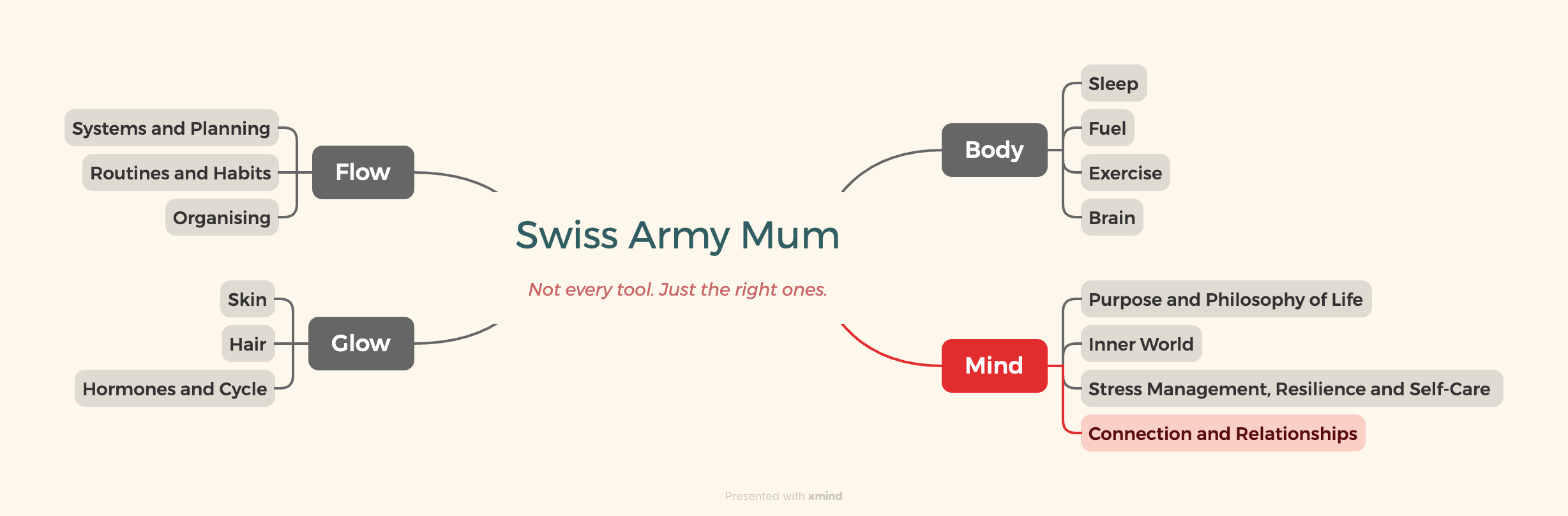
This post is the foundation for the Connection area of the Mind Pillar. It makes the health case for taking your social connections seriously as a biological variable, not just a personal one. The post on making friends is the practical companion: what you actually do about it.
New here? Start here:

Swiss Army Mum is a practical guide to long-term health for busy women, built on four pillars: Body, Mind, Glow, and Flow.
Not every tool. Just the right ones.
The Survival Data
In 2010, Julianne Holt-Lunstad and colleagues published a meta-analysis in PLOS Medicine that pooled 148 studies and 308,849 people tracked over time. The finding was stark: people with stronger social relationships were 50% more likely to survive across the study periods than those with weaker ones.1 Fifty.
To put that in context, the effect was comparable in magnitude to quitting smoking, and larger than the effects of obesity and physical inactivity. The comparison to cigarettes (you may have seen the “Lacking social connection is comparable to smoking up to 15 cigarettes per day.”2) is an analogy based on effect size, not a precise equivalence, and the exact number has been challenged by subsequent researchers. But the point is robust: social isolation sits in the same order of magnitude of risk as the health habits we spend enormous amounts of time and money addressing.
A follow-up meta-analysis in 2015, this time across more than 3.4 million people and 70 studies, found something that should specifically matter to this audience. The mortality risk from social deficits was stronger in samples with an average age under 65 than in older populations.3
Does social connection affect physical health?
Yes, with robust evidence. A 2010 meta-analysis by Holt-Lunstad and colleagues found that people with stronger social relationships had a 50% greater likelihood of survival across follow-up periods compared to those with weaker social ties. A 2015 follow-up across more than 3.4 million people found social isolation associated with a 29% increased mortality risk. The effect was stronger in populations under 65, making this relevant to midlife rather than only old age.
Quality Over the Size of Your Group Chat
Here is where the research gets interesting, and where most wellness advice misses the point.
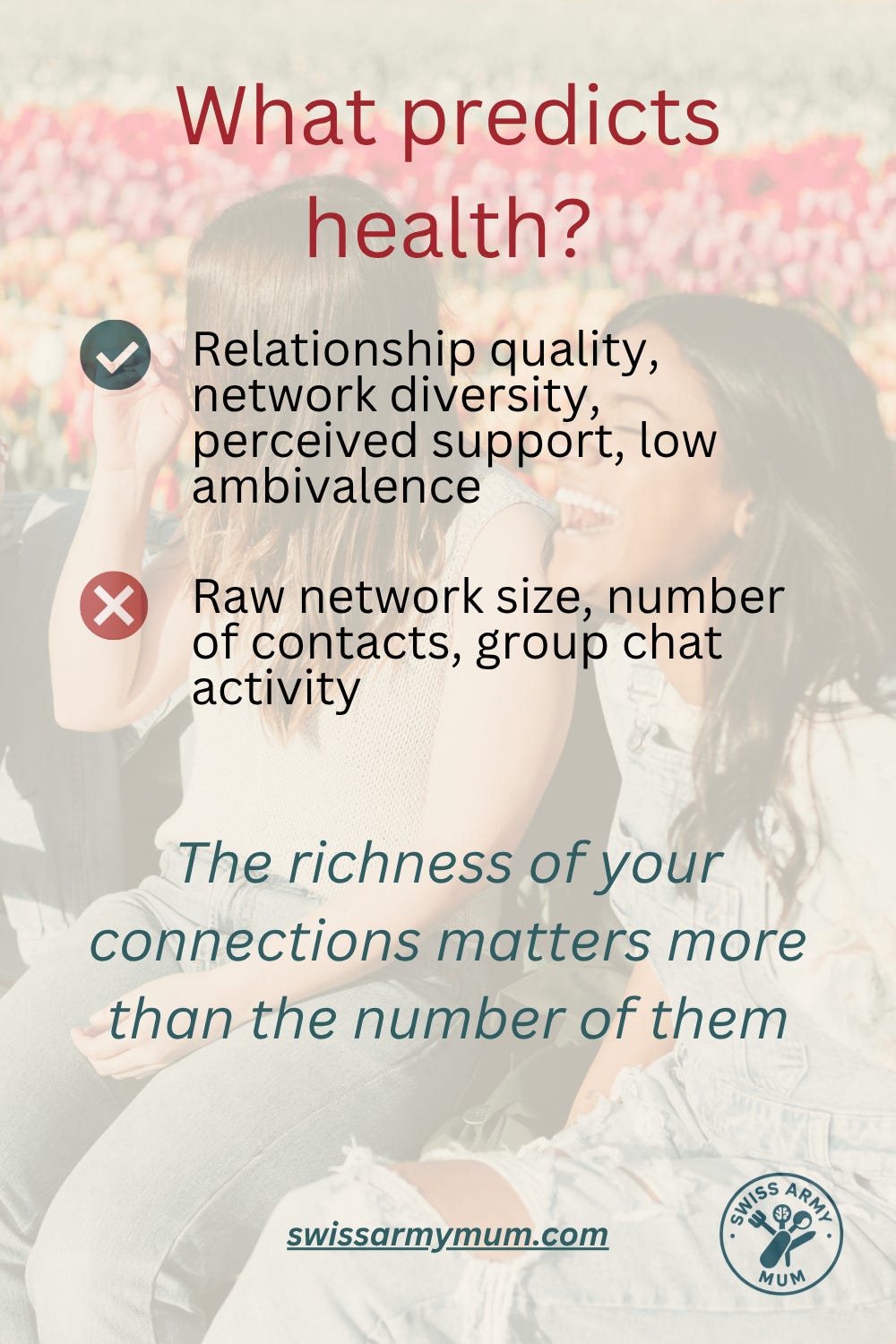
A 1997 study in JAMA exposed 276 healthy volunteers to a cold virus (directly, in controlled conditions) and then tracked who actually got sick. The people with the most diverse social networks, meaning those who had connections across multiple types of relationships (friends, family, colleagues, community), were the most resistant. Those with the fewest types of social ties had roughly four times the risk of developing a cold. Crucially, it was network diversity that predicted illness resistance, not raw network size.4
This distinction between quality and quantity runs through the entire literature. What predicts your health outcomes is not how many names are in your phone. It is the depth and supportiveness of your closest relationships, and whether the people you spend time with reliably make you feel better or worse.
That second part is where the research gets uncomfortable.
The Relationship That Drains You as Much as It Supports You
There is a type of relationship that psychologists call ambivalent: someone who feels simultaneously close and difficult, supportive and stressful, warm and unreliable. Someone whose name on your phone screen produces a feeling you cannot quite categorise.
Researchers at Brigham Young University measured ambulatory blood pressure in 102 adults over three days as they went about their normal social interactions.5 Interactions with ambivalent contacts produced the highest blood pressure readings, higher even than interactions with people the participants purely disliked. A purely aversive relationship is at least predictable. An ambivalent one keeps you in a state of unresolved activation.
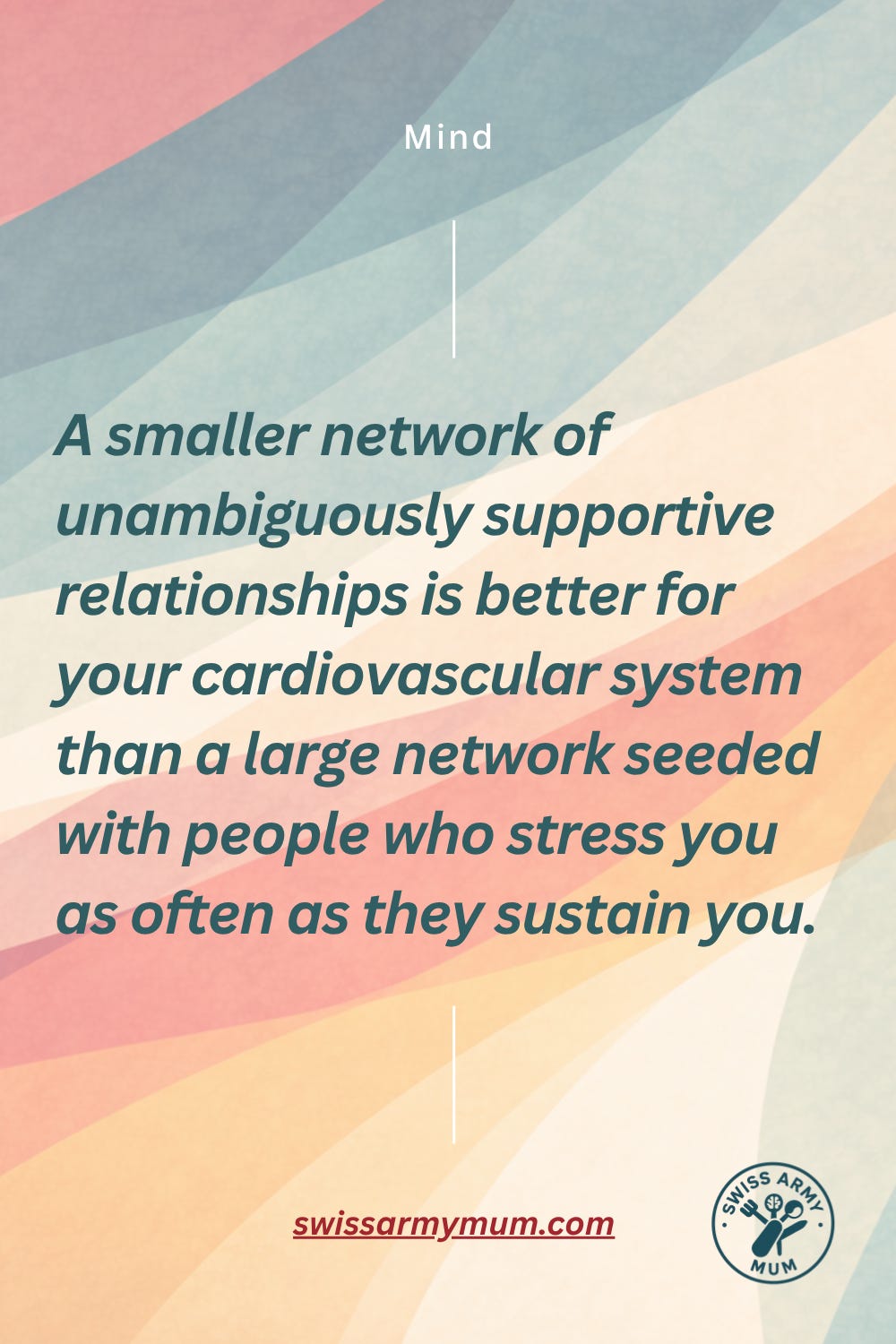
This reframes the quality-over-quantity principle with a hard edge. A smaller network of unambiguously supportive relationships is better for your cardiovascular system than a large network seeded with people who stress you as often as they sustain you.
Are ambivalent relationships bad for health?
Yes. Research by Holt-Lunstad and colleagues measured ambulatory blood pressure in 102 adults over three days and found that interactions with ambivalent contacts produced the highest blood pressure readings, higher than interactions with people participants purely disliked. A network of fewer, unambiguously supportive relationships appears better for cardiovascular health than a larger network containing ambivalent ties.
Social Networks in Midlife: What the Data Shows
Networks peak in the early thirties. Then they contract.
A 2013 meta-analysis by Wrzus and colleagues, pooling data across the lifespan, found that the total size of social networks declines after the early thirties, with the steepest drops in the outer layers: acquaintances, weak ties, professional contacts.6 The inner core, the small group of closest relationships, stays more stable. But the overall ecosystem thins.
For women in midlife specifically, the contraction has an additional driver. The sandwich generation phenomenon: simultaneously managing caregiving responsibilities for children and ageing parents, often alongside demanding careers, compresses discretionary social time to near zero. The social investments that would maintain the network get crowded out by the social obligations that cannot be refused.
A Note for Introverts
If you are reading this thinking “but I genuinely prefer a quiet evening to most social situations”, that is a preference, and a valid one (I’m generally with you!). But it is not the same as a need for less connection.
I know this territory personally. The personality test work I did a while back placed my sociability in the bottom 10% and my social boldness in the top 10%. What that combination looks like in practice: I can walk into any room, talk to anyone, and leave as soon as I reasonably can. I do not need a large network. I need a very small number of people to whom I can say anything, and adequate distance from everyone else.
The research is clear that both introverts and extraverts benefit equally from the quality and depth of their closest relationships for health and wellbeing outcomes. Extraversion predicts higher average daily happiness, but it does not predict who benefits more from meaningful connection. The biological need for connection does not have a personality exception.
The introvert reframe is not “you need fewer people.” It is “you need the right people, and less noise around them.” That is a different thing, and a higher standard to meet, I think.
One More Thing About Your Phone
You already know that a text message is not the same as a conversation. The research confirms it in specific terms.
A 2012 study by Seltzer and colleagues exposed young participants to a stressor, then randomised them to different types of contact with a trusted person: in-person, phone call, or instant message. In-person and phone contact both produced genuine physiological stress relief. Instant messaging produced no measurable benefit: stress hormones remained as high as the no-contact control group.7 The voice, not just the words, appears to carry the calming signal.
A phone call of fifteen minutes with someone you genuinely like is better-evidenced as a health behaviour than an extended text exchange with the same person. This is not nostalgic. It is physiological.
The 80/20
Two things, specifically.
Protect a small number of unambiguously supportive relationships with deliberate, recurring contact. Not a long list. Two or three people. Phone calls, not texts. Scheduled.
And look honestly at the relationships that leave you feeling drained as often as supported. The research is not asking you to cut everyone difficult from your life. It is asking you to notice that ambivalent relationships have a physiological cost that is not cancelled out by the positive moments.
The quality of your relationships is a health metric. It belongs in the same category as sleep, movement, and what you eat.
Thank you
Thank you for reading, sharing, and supporting this work. Whether you’ve been here since the beginning or just found Swiss Army Mum, I’m glad you’re here.
If something resonated, I’d be grateful if you forwarded this to someone who might need it, or hit the ♥️ or ↻ Restack button. It helps more people find this space.
This is educational, not personal medical advice. Your biology, history, and context matter. Work with a qualified healthcare professional.
References
Holt-Lunstad, Julianne et al. “Social relationships and mortality risk: a meta-analytic review.” PLoS medicinevol. 7,7 e1000316. 27 Jul. 2010, https://doi.org/10.1371/journal.pmed.1000316
Holt-Lunstad J, Smith TB, Baker M, Harris T, Stephenson D. Loneliness and social isolation as risk factors for mortality: a meta-analytic review. Perspectives on Psychological Science : a Journal of the Association for Psychological Science. 2015 Mar;10(2):227-237. https://doi.org/10.1177/1745691614568352
Cohen S, Doyle WJ, Skoner DP, Rabin BS, Gwaltney JM Jr. Social ties and susceptibility to the common cold. JAMA. 1997 Jun;277(24):1940-1944. https://doi.org/10.1001/jama.1997.03540480040036
Holt-Lunstad, J., Uchino, B. N., Smith, T. W., Olson-Cerny, C., & Nealey-Moore, J. B. (2003). Social relationships and ambulatory blood pressure: Structural and qualitative predictors of cardiovascular function during everyday social interactions. Health Psychology, 22(4), 388–397. https://doi.org/10.1037/0278-6133.22.4.388
Wrzus, C., Hänel, M., Wagner, J., & Neyer, F. J. (2013). Social network changes and life events across the life span: A meta-analysis. Psychological Bulletin, 139(1), 53–80. https://doi.org/10.1037/a0028601
Seltzer, L. J., Prososki, A. R., Ziegler, T. E., & Pollak, S. D. (2012). Instant messages vs. speech: Hormones and why we still need to hear each other. Evolution and Human Behavior, 33(1), 42–45. https://doi.org/10.1016/j.evolhumbehav.2011.05.004