


My previous post on solitude without loneliness was about being alone well. This post is about connecting well.
I have lived in five countries. Each time I moved, the same pattern repeated: a new context formed, and a new social network grew around it. University in Spain after leaving Argentina. The PhD lab. The postdoc. Then motherhood, which opened an entirely new one, built around school gates and nap schedules and the particular solidarity of people who have not slept properly in months. Each of those contexts did the work that I thought I was doing. The institution, the shared situation, the repeated proximity: these were the invisible machinery behind what felt like personal connection.
The problem with this model is that it keeps working beautifully right up until the context dissolves. And then you are an adult, with a full life and a busy calendar, standing in the wreckage of a social infrastructure that nobody warned you was temporary.
Making friends as an adult is not harder because you have become less interesting, or because everyone else is fully booked with people they met at twenty-two. It is harder because the scaffolding has been dismantled, and nobody told you it was structural in the first place.
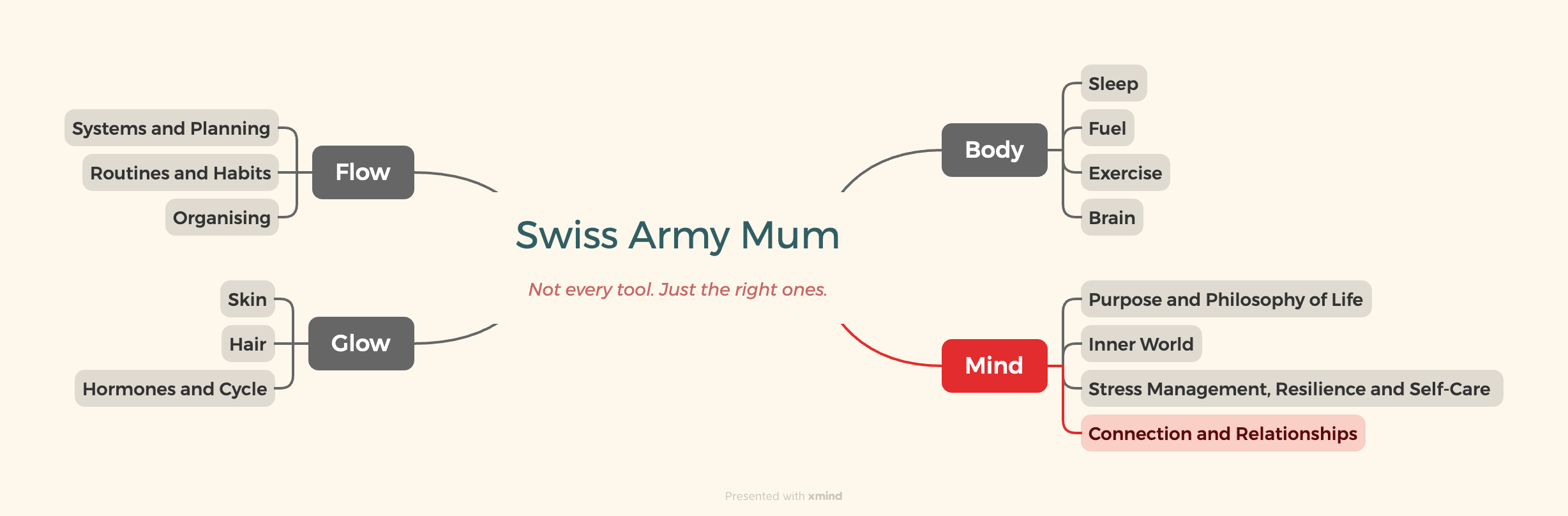
This post closes the Connection area AND the Mind Pillar. It is the practical companion to my previous post on the quality of your relationships as a health metric, which made the health case for taking your relationships seriously. This one is about what you actually do.
New here? Start here:

Swiss Army Mum is a practical guide to long-term health for busy women, built on four pillars: Body, Mind, Glow, and Flow.
Not every tool. Just the right ones.
Your Network Is Quietly Contracting
Think of your social world as a concentric system. At the centre: a small inner circle of your closest relationships. In the rings around it: good friends, reliable contacts, loose acquaintances. At the edges: people you know but rarely see.
Research by Wrzus and colleagues, drawing on data across the lifespan, found that social networks peak in the early thirties and then steadily contract.1 The outer rings lose people first. The inner circle is more stable, but not immune. What actually keeps the whole together is active contact. Without it, even strong ties drift toward the outer rings. Friendship, unlike kinship, is voluntary. And voluntary ties are the ones that fade when life fills up.
The midlife version of this is starker: you are simultaneously managing peak career demands, peak family responsibilities (children/teens and/or parents), and for many women, the beginning of a hormonal transition that affects energy and mood. The time available for social investment shrinks exactly when the network most needs maintenance.
The Problem With the Popular Advice
Jeffrey Hall’s research, published in 2019, gave us the figures most people have since repeated as rules: roughly 50 hours of shared time to move from acquaintance to casual friend, 90 hours to “friend,” and 200 or more hours to close friend.2
The finding is credible and useful: shared leisure time predicts closeness. Time together matters, and leisure time together matters more than functional or work-related time. That is a truly actionable insight.
But the precise hour thresholds rest on two self-report studies, neither of them independently replicated. People estimated how much time they had spent with someone, and the correlation with closeness was strong but also contaminated by the obvious reverse: we spend more time with people we already like. The 50/90/200 numbers are illustrative, not calibrated constants.
The honest version: closeness accumulates through repeated shared experience over time, and it takes longer than most people expect. Months, not weeks.
The specific numbers are not the finding. The patience required is the finding.
You Are More Liked Than You Think
Erica Boothby and colleagues have run a series of studies investigating what they call the liking gap: the consistent underestimation of how much new acquaintances like us.3 After conversations between strangers, both parties reliably reported that they had liked the other person more than they believed they themselves had been liked. The gap persists across different types of conversation, different countries, and different ages. It has been replicated.
The mechanism appears to be that we are on the inside of our own experience during a conversation (aware of every stumble, every awkward pause, every time we did not say quite what we meant) while we only observe the surface of the other person’s experience, which looks smoother than it is. We are applying different standards to ourselves and to them.
What is the liking gap?
The liking gap, identified by Boothby and colleagues, is the consistent and replicated finding that after conversations between strangers, both parties underestimate how much they were liked by the other person.
We are aware of our own internal stumbles during a conversation but see only the smoother surface of the other person’s experience. The asymmetry is systematic, cross-cultural, and persists across different ages.
The practical implication? people like you more than you feel they do during and after conversations.
The Highest-Yield Move You Are Probably Not Making
Before building new friendships from scratch, there is a higher-yield and lower-friction option that most people overlook.
Some of the most durable relationships in my life are the ones I see infrequently. People scattered across countries from different chapters (a lab colleague from the postdoc years, someone from the Argentina days, a friend from one of the many moves). We do not maintain contact week to week. But every time we see each other, within twenty minutes it is as if no time has passed at all. The conversation picks up exactly where it left off, and the ease of it still surprises me each time.
This is not an accident. Research by Levin, Walter and Murnighan found that reactivating dormant strong ties produces surprising value precisely because the foundation of trust and mutual understanding does not fully decay with time and distance the way we assume it does.4 The reconnection is easier than anticipated. The relationship resumes rather than restarts.
It’s simpler than it seems. Reference a specific shared memory, express genuine interest in what they are doing now, and propose a concrete next contact. Not “we should catch up sometime.” A specific time, a specific format, a specific next step. The vagueness of “sometime” is where dormant ties go to stay dormant.
What Actually Makes New Friendships Form
Given that the old structural conditions are gone, the most evidence-consistent strategy is to engineer the conditions rather than wait for them.
The research points to one thing more than anything else: a standing, recurring, shared-activity commitment. Not a one-off event. Not a group chat. A context in which you encounter the same people, repeatedly, over months, doing something that gives you something to talk about.
When my children were younger, a group of us organised a mums’ night out. Nothing elaborate: a pub, a pint, a couple of hours. No agenda except to be somewhere that was not the house, with people who understood what the exhaustion of that season felt like. It ran for years, longer than the season that had created it, because by then it had become its own thing rather than just a response to a shared situation.
We also have a group of friends with whom we do cooking nights: arrive in the morning, spend the whole day cooking together, eat what we have made. The activity is the point and also beside the point. What it provides is a recurring context, shared effort, and enough time together to have real conversations rather than the status-exchange version of catching up.
Why is it hard to make friends as an adult?
Adult friendship formation is structurally harder because the conditions that produced it automatically (proximity, repeated unplanned interaction in shared settings) are built into school and university environments and disappear in adulthood. Adulthood disperses people into separate households and schedules, removing the infrastructure entirely.
The solution is to deliberately engineer the substitute: standing, recurring, shared-activity commitments that manufacture the repeated contact the environment no longer provides.
The activity matters less than the repetition and the shared reference it creates.
On Keeping the Ones You Have
Adult friendship has a silent failure mode. It does not end. It just fades.
Robin Dunbar’s research on friendship maintenance suggests that voluntary ties require active contact above a certain threshold to maintain their warmth and closeness, and that without it, even strong friendships drift toward the periphery within months.5 There is no rupture, no argument, no decision. The shared experiences that maintained the contact disappears, and one day you realise you have not spoken in a year.
The counter-move is not complicated, but it is deliberate. A standing call, a recurring commitment. The research on what sustains long-term friendships consistently points to responsiveness. That costs attention more than time. And we have precious little of that!
The 80/20
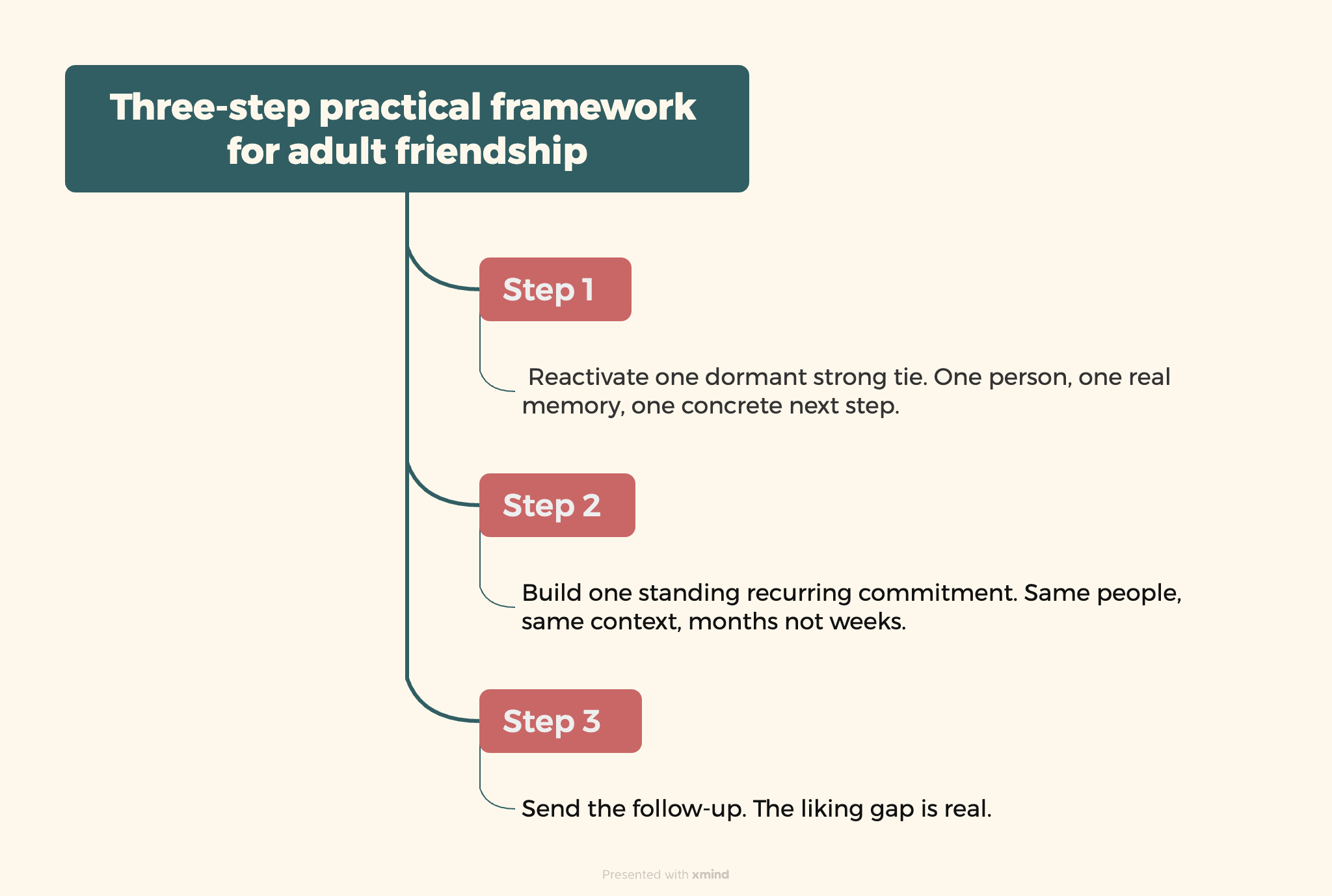
Three moves, in order of evidence strength.
Reactivate one dormant strong tie this month. One specific person, one message that references something real from your shared history, one concrete proposal for next contact. This is the highest-yield move in this area, and the lowest effort relative to its return.
Build one standing, recurring, shared-activity commitment. A context that puts you in the same space as the same people, repeatedly, over months, doing something you actually like doing. The activity does not matter. The regularity does. Maybe you can stack it with other things that are good for you, like deliberate leisure activities or exercise.
Send the follow-up you have been second-guessing. The liking gap is real and replicated. They liked the conversation more than you think.
This is educational, not personal medical advice. Your biology, history, and context matter. Work with a qualified healthcare professional.
Reference
Wrzus, C., Hänel, M., Wagner, J., & Neyer, F. J. (2013). Social network changes and life events across the life span: A meta-analysis. Psychological Bulletin, 139(1), 53–80. https://doi.org/10.1037/a0028601
Hall, J. A. (2019). How many hours does it take to make a friend? Journal of Social and Personal Relationships, 36(4), 1278–1296. https://doi.org/10.1177/0265407518761225
Boothby, E. J., Cooney, G., Sandstrom, G. M., & Clark, M. S. (2018). The liking gap in conversations: Do people like us more than we think? Psychological Science, 29(11), 1742–1756. https://doi.org/10.1177/0956797618783714
Levin, D. Z., Walter, J., & Murnighan, J. K. (2011). Dormant ties: The value of reconnecting. Organization Science, 22(4), 923–939. https://doi.org/10.1287/orsc.1100.0576
Roberts, S. G. B., & Dunbar, R. I. M. (2011). Communication in social networks: Effects of kinship, network size, and emotional closeness. Personal Relationships, 18(3), 439–452. https://doi.org/10.1111/j.1475-6811.2010.01310.x