


Three people walk into a bookshop looking for something on stress.
The first wants to understand what is actually happening in her body. The second wants practical tools anchored to brain science. The third wants something she can actually read during the ten minutes she has between school pickup and dinner.
The stress management bookshelf is not short of options. Most of them sit in the same register: reassuring, accessible, lightly evidenced, heavy on anecdote. These three stand apart because they approach the same subject from genuinely different angles: the neuroendocrinology, the clinical psychology, and the clinical practice and reading them in sequence builds something closer to a complete picture than any single one provides.
This post sits within the Stress Management, Resilience and Self-Care area of the Mind Pillar. These books are three of the best pre-curated syntheses of that literature: each with a different scope, a different level of scientific rigour, and a different reader in mind.
New here? Start here:

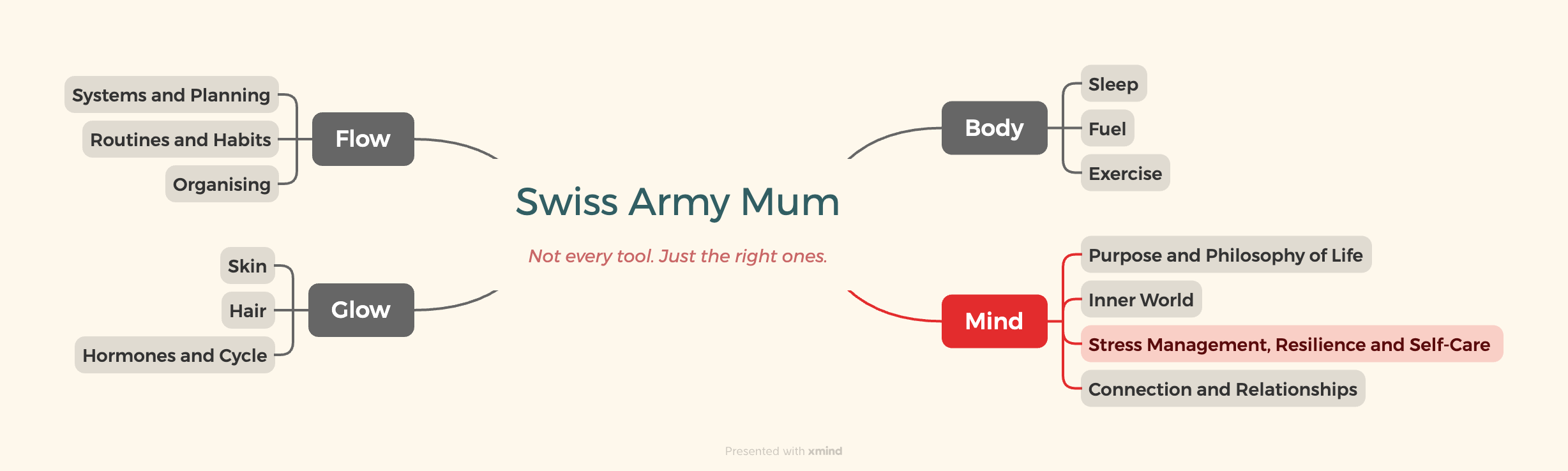
Swiss Army Mum is a practical guide to long-term health for busy women, built on four pillars: Body, Mind, Glow, and Flow.
Not every tool. Just the right ones.
Why These Three Together
Sapolsky gives you the mechanism. He explains why chronic psychological stress is as physiologically damaging as physical trauma. He will tell you what stress does to your heart, your gut, your immune system, your brain, and your capacity for sleep, chapter by chapter, system by system, with footnotes.
Greenberg gives you the brain architecture and the toolkit. Where Sapolsky explains what goes wrong, Greenberg explains the two competing systems (the reactive amygdala and the rational prefrontal cortex) and what to do when the first has hijacked the second.
Nerurkar gives you the entry point. Her five resets are a practical organising framework for someone who needs something to start with, presented in the kind of clear, encouraging prose that makes the subject feel manageable rather than overwhelming.
Read in this order: Sapolsky, then Greenberg, then Nerurkar. Or start with Nerurkar if the other two feel like too much right now. The important thing is to have a map of the territory before you pick your tools.
Why Zebras Don’t Get Ulcers by Robert Sapolsky
What it is
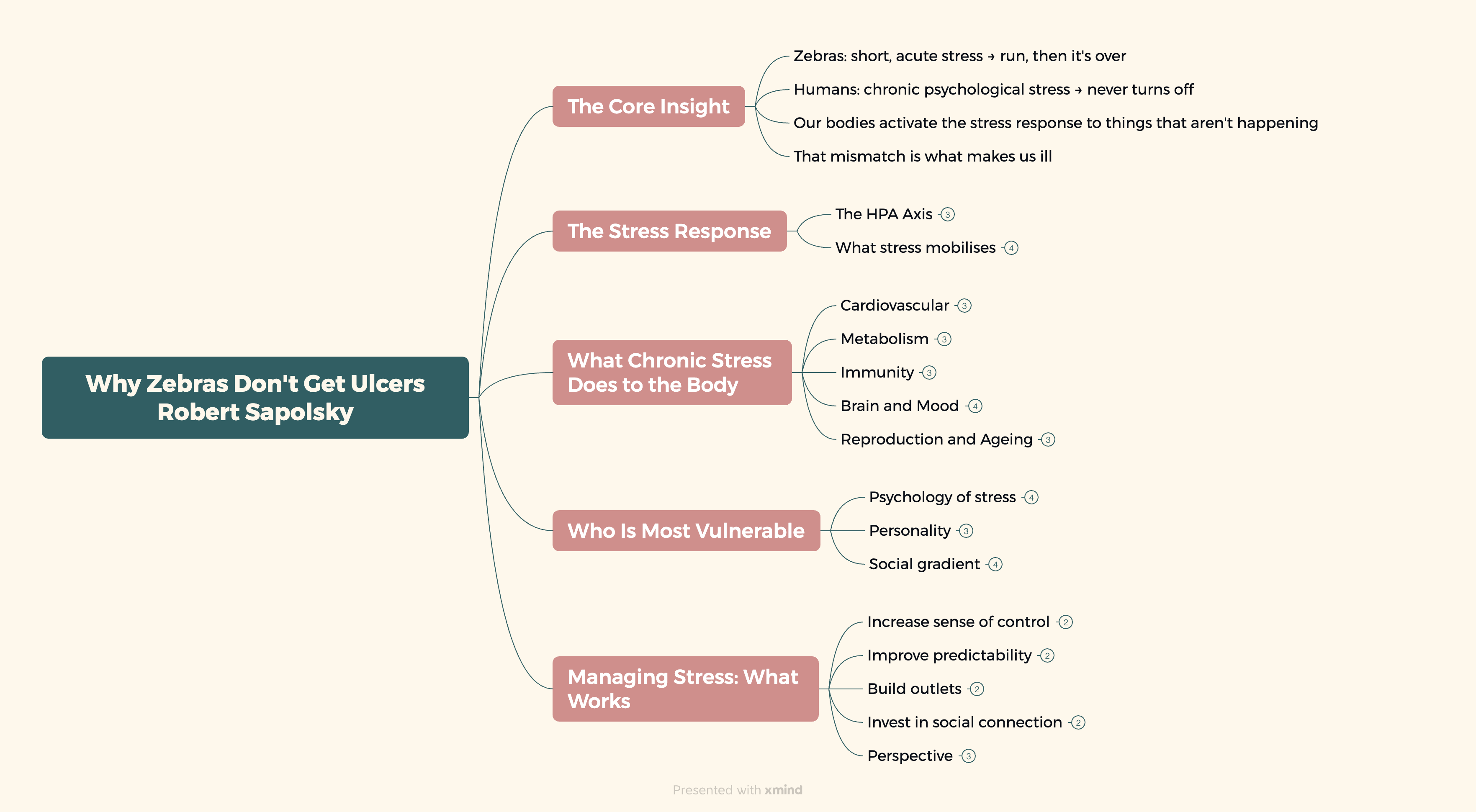
A Stanford neuroendocrinologist explains the stress response from the ground up, with wit, humanity, and an extraordinary willingness to go wherever the science leads even when it is inconvenient.
The central argument: zebras get stressed. A predator appears, the stress response activates, and then one of two things happens: the zebra escapes and the stress response turns off, or the zebra does not and the stress response turns off permanently. In either case, the acute stress response does its job. Humans get stressed too. But we activate the same physiological cascade (cortisol, adrenaline, cardiovascular mobilisation, immune modulation) in response to things that are not physically happening. A rumination about a conversation that occurred three days ago. An anticipation of a meeting scheduled for next week. A general, unfocused sense that something is not right.
The crisis is not the stress response. It is the stress response left running continuously with no physical threat and no physical resolution.
The strongest chapters
Chapter 13 (on the psychology of stress) is probably the most practically useful chapter in the book and one of the most useful things I have read on this subject. It identifies five variables that determine how damaging a given stressor is: whether you have outlets for frustration, whether you have social support, whether you have a sense of control, whether you have predictive information, and whether things feel as though they are improving. These are not therapeutic frameworks. They are the variables that predict ulcer rates, cardiovascular disease, and immune suppression across hundreds of studies. When you understand these five, a great deal of the stress management research becomes more legible.
Chapter 17 (the social gradient chapter) is the most sobering. Sapolsky documents what the data show about the relationship between rank in a social hierarchy and chronic physiological stress. Low socioeconomic status, low control over working conditions, and low perceived status all correlate with elevated baseline cortisol, accelerated cardiovascular ageing, and compromised immune function. Some of what drives stress is structural. Individual tools help, but they are not sufficient for stressors that are built into the conditions of someone’s life. Sapolsky does not offer a solution to this. He does not pretend there is a breathing exercise for structural inequality. That honesty is part of what makes this book worth reading.
The honest caveats
Dense in places. The book rewards patience with the endnotes, which contain Sapolsky’s candid assessments of which findings are contested and which are robust.
Most of the mechanistic studies cited were conducted in male samples or male-dominant animal models. Sapolsky flags this himself in places, but it is worth noting: this is the book that explains the stress response as science knew it in 2004, primarily derived from male biology. The female-specific layer requires supplementing.
The depression chapter has held up better than most of the book given its age. The sleep chapter, added in the third edition, remains excellent.
Who it’s for
Anyone who wants to understand the mechanism before choosing the tools. Non-negotiable reading for the intellectually curious reader. Start here if you have the appetite for it.
The Stress-Proof Brain by Melanie Greenberg
What it is
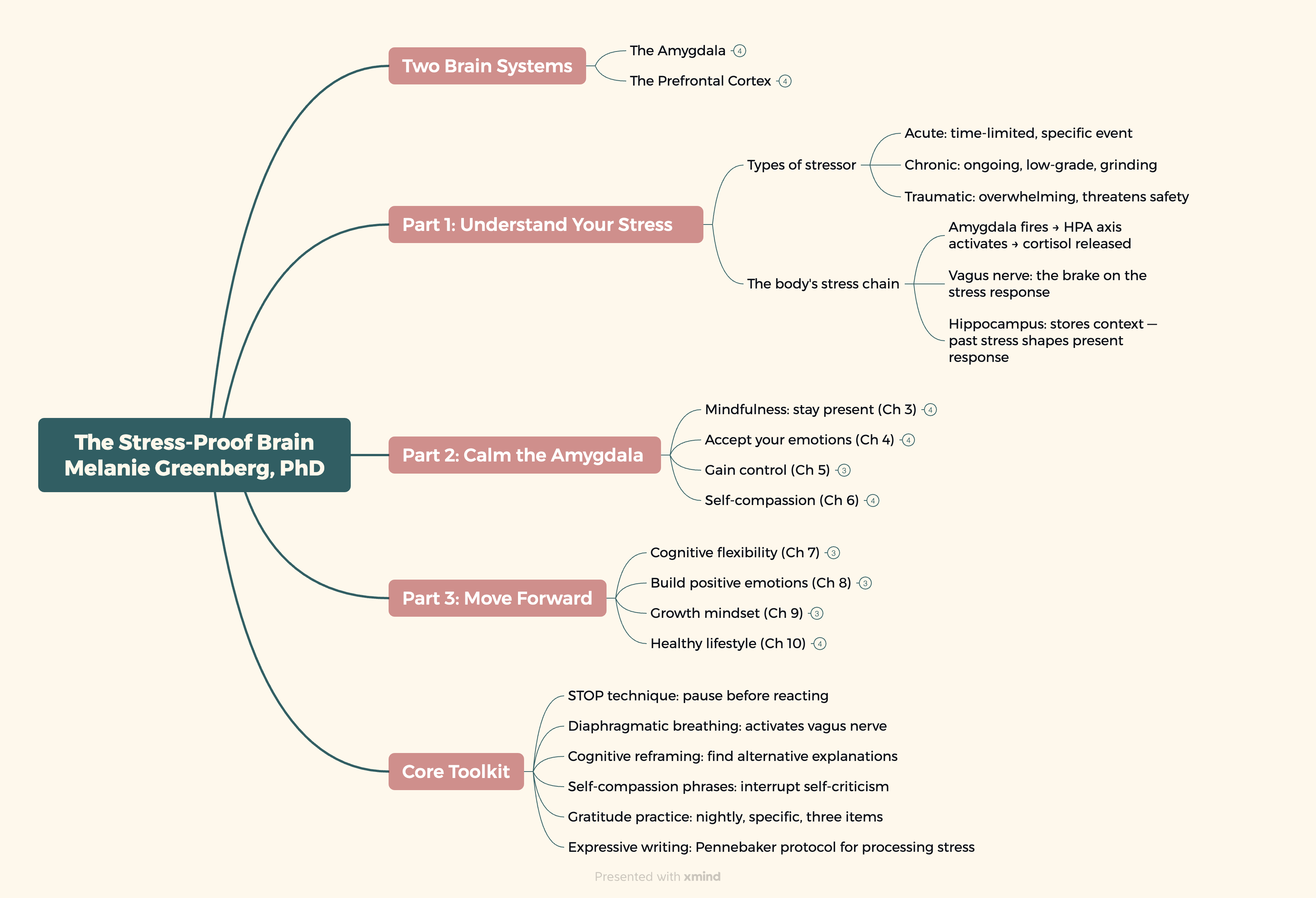
A clinical psychologist presents a two-system model of the stress response (the reactive amygdala and the rational prefrontal cortex) and ten chapters of evidence-based tools for keeping the second system online when the first tries to take over.
Where Sapolsky is the why, Greenberg is the what and how. The book is structured around a clean progression: first understand the two systems and what you are facing, then learn to calm the amygdala with four specific tools, then learn to move forward with the prefrontal cortex using four more. It reads like a well-organised clinical practitioner sharing what has consistently helped her patients.
What earns its place
The tool selection is grounded in specific research traditions rather than general wellness advice. The self-compassion material draws on Kristin Neff’s programme, which has a genuine RCT base. The positive emotion work references Fredrickson’s broaden-and-build theory, which is one of the more replicated frameworks in positive psychology. The cognitive flexibility chapter on reframing and diffusion draws on CBT and ACT in ways that are accurate and practically useful.
The “name it to tame it” finding (that labelling an emotion with a specific word reduces its neural intensity) is real and underused. Greenberg explains it clearly and connects it to the amygdala mechanism in a way that makes the practice feel mechanistically grounded rather than merely therapeutic.
The honest caveats
The framing of “rewiring your brain” in a few weeks of brief practice oversells what the published trials demonstrate. Structural changes in amygdala-prefrontal connectivity in meditation studies typically come from eight-week MBSR protocols with 30-45 minutes of daily practice. The practices in this book are valuable but are unlikely to produce the kind of imaging-level structural changes the framing implies.
The book is more useful for the reader who is already functioning reasonably well and wants tools for maintaining that. It is less useful as a resource for someone in acute high-load stress, where the capacity to engage the prefrontal cortex is precisely what is compromised.
Who it’s for
The reader who has understood the mechanism from Sapolsky and now wants specific techniques with a theoretical anchor. Particularly strong on self-compassion and on the acceptance-based approaches that the wellness category tends to underserve. The natural second book.
The 5 Resets by Aditi Nerurkar
What it is
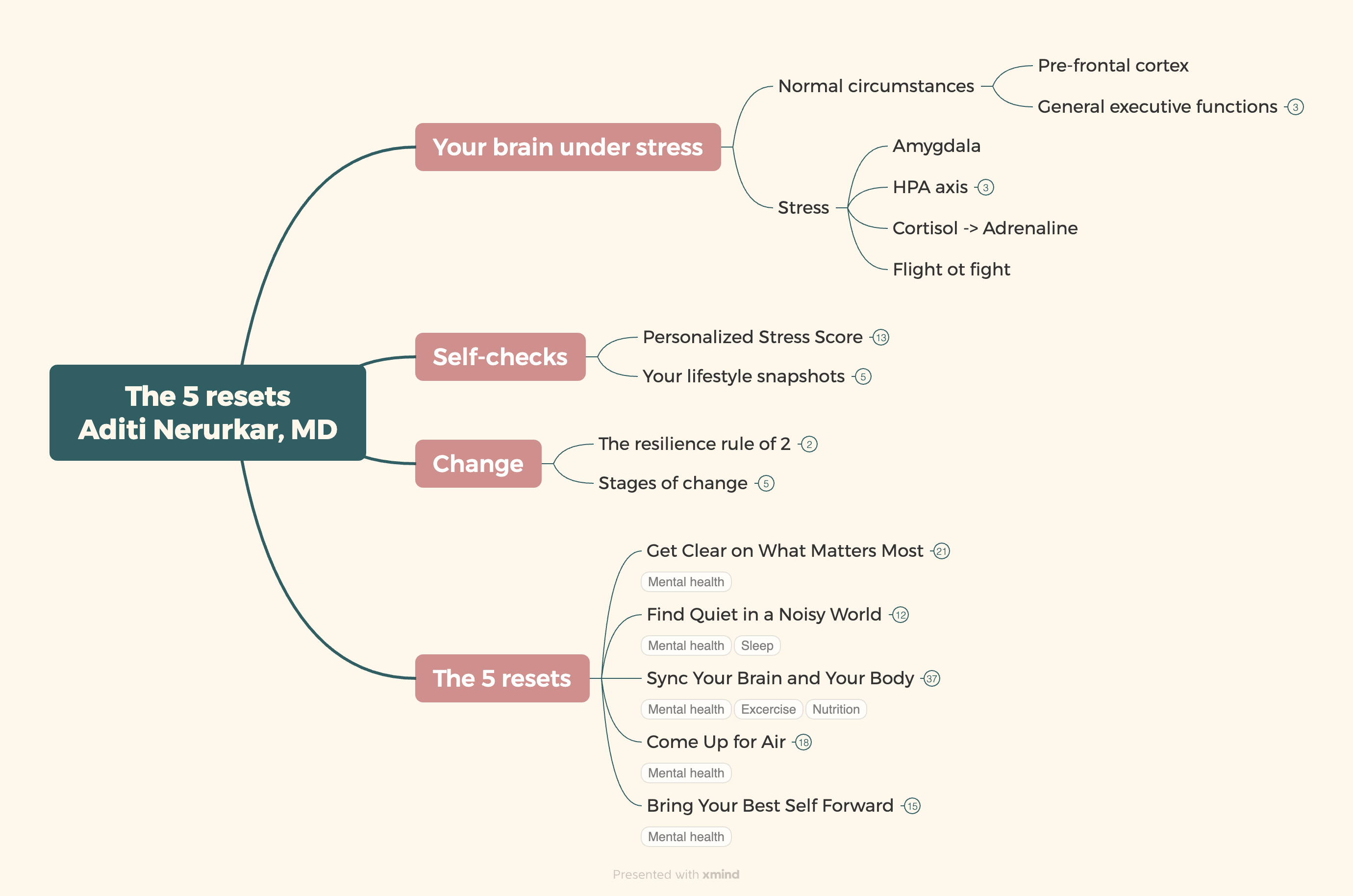
A Harvard-affiliated integrative-medicine clinician presents five reset frameworks (clarify what matters most, reduce digital noise, sync brain and body through breathing and movement, come up for air through sleep and rest, bring your best self forward through gratitude and self-compassion) as an accessible entry point to managing chronic stress.
An honest assessment of the author
Nerurkar’s credentials are genuine: MD, MPH, board-certified in internal medicine, clinical background at Beth Israel Deaconess Medical Center at Harvard. She is a credentialed clinician and a skilled communicator.
Her independent peer-reviewed research record is modest, though. She is not an active stress researcher in the sense that Sapolsky or Elissa Epel are active researchers. She is a clinician who has synthesised a practice framework from the available literature. That is a different and entirely legitimate contribution. But the “Harvard stress expert” positioning should be read as reflecting her clinical affiliation rather than a sustained primary research programme.
What the evidence says about the five resets
Reset 3 (breath work and daily movement) is the best-evidenced of the five. The exercise evidence is robust.
Resets 1 and 5 (values clarification, gratitude, and self-compassion) are supported by positive psychology research with small-to-moderate effect sizes. The gratitude journaling literature shows statistically significant but modest effects on wellbeing and depression. The self-compassion work has a stronger trial base.
Reset 2 (digital boundaries) is plausible, supported by correlational data on smartphone use and sleep/attention, and has small effects in the few randomized trials of digital detox interventions.
Who it’s for
The reader who wants a practical, accessible starting point and is not looking for deep mechanistic grounding. The right gateway book. Read it first if the others feel daunting. Supplement with Sapolsky and Greenberg for depth.
What They Agree On
Exercise is recommended by all three. Social connection is recommended by all three, in different ways (Sapolsky as a cortisol buffer supported by the strongest population data, Greenberg as a source of positive emotion and co-regulation, Nerurkar as a reset explicitly focused on community).
Sleep is treated as non-negotiable by all three, with varying levels of mechanistic detail.
Some form of present-moment attention or mindfulness runs through all three, from Sapolsky’s chapter on why psychological stress is stressful (it is almost always about the past or the future) through Greenberg’s mindfulness-as-amygdala-calming and Nerurkar’s Stop-Breathe-Be practice.
Where They Differ
Sapolsky is the most honest about the limits of individual intervention. Chapter 17 documents the evidence that chronic stress is not merely a function of individual stress reactivity but of the structural conditions of someone’s life. No breathing exercise addresses what low control over working conditions does to the cardiovascular system over decades. Individual tools help. They are not complete.
Greenberg is the most technique-oriented and the most useful for someone who is already managing and wants specific evidence-based additions to their toolkit.
Nerurkar is the most optimistic and the most accessible. The book is warmer and more encouraging than the other two, which makes it the right starting point and a less reliable guide to the limits of the evidence.
The SAM Reading Order
If you read one: Sapolsky. The mechanism matters more than the tools. If you understand the mechanism, the tools make sense. If you only have the tools, you are following instructions without knowing why.
If you read two: add Greenberg. The clinical toolkit is well-chosen and well-explained.
If you want to start somewhere more accessible before committing to the others: Nerurkar, with the caveats above clearly in mind.
The 80/20
Read one book fully before starting another. The stress management reading trap is accumulating books about stress rather than reducing stress. One book, read carefully and with intention to apply something, is worth more than three books skimmed.
Start with whichever of the three matches where you are. If you want understanding, Sapolsky. If you want tools, Greenberg. If you want to start, Nerurkar.
Thank you
Thank you for reading, sharing, and supporting this work. Whether you’ve been here since the beginning or just found Swiss Army Mum, I’m glad you’re here.
Building a life with more intention takes a village. If something resonated, I’d be grateful if you forwarded this to someone who might need it, or hit the ♥️ or ↻ Restack button. It helps more people find this space.
This is educational, not personal medical advice. Your biology, history, and context matter. Work with a qualified healthcare professional.