


Before we get into what the Mind pillar is, I want to take a moment on why it exists separately from the Body pillar at all. Because the honest answer is: it almost didn’t.
When I built out the Body pillar, covering sleep, movement and nutrition, I kept telling myself that was the foundation. Get the basics right. Everything else follows. And I believed it, for a while.
The body was taken care of. The mind was still feral.
The Romans had a phrase for this: mens sana in corpore sano. A healthy mind in a healthy body. It is usually quoted as a goal, a thing to aim for. What gets less attention is the implication underneath it: the two are not the same thing. You can have one without the other. And having only one is not enough.
This is actually what the research predicts. The biopsychosocial model, which underpins modern medicine and psychiatry, is explicit on this point: biological, psychological and social factors all interact in health and illness1. You cannot fix one layer and call it done. The Body pillar and the Mind pillar are not competing frameworks. They are two floors of the same building. The body is the ground floor: it has to be structurally sound or nothing above it works. But you do not live on the ground floor. You live upstairs.
That is where this pillar begins.
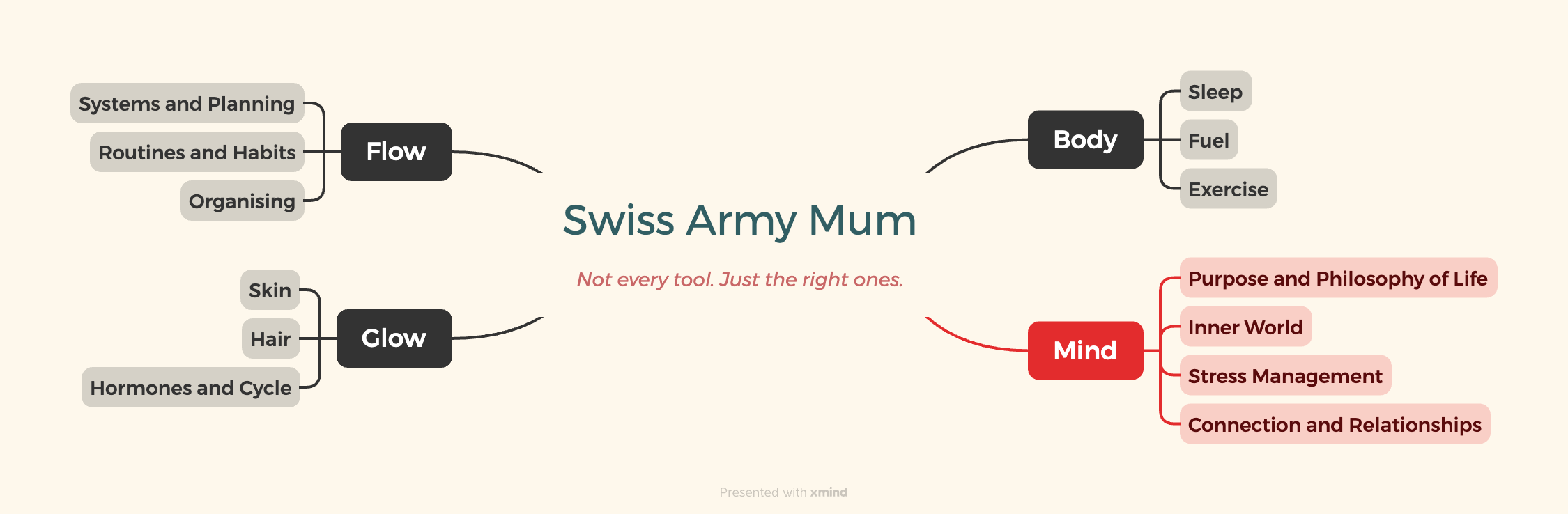
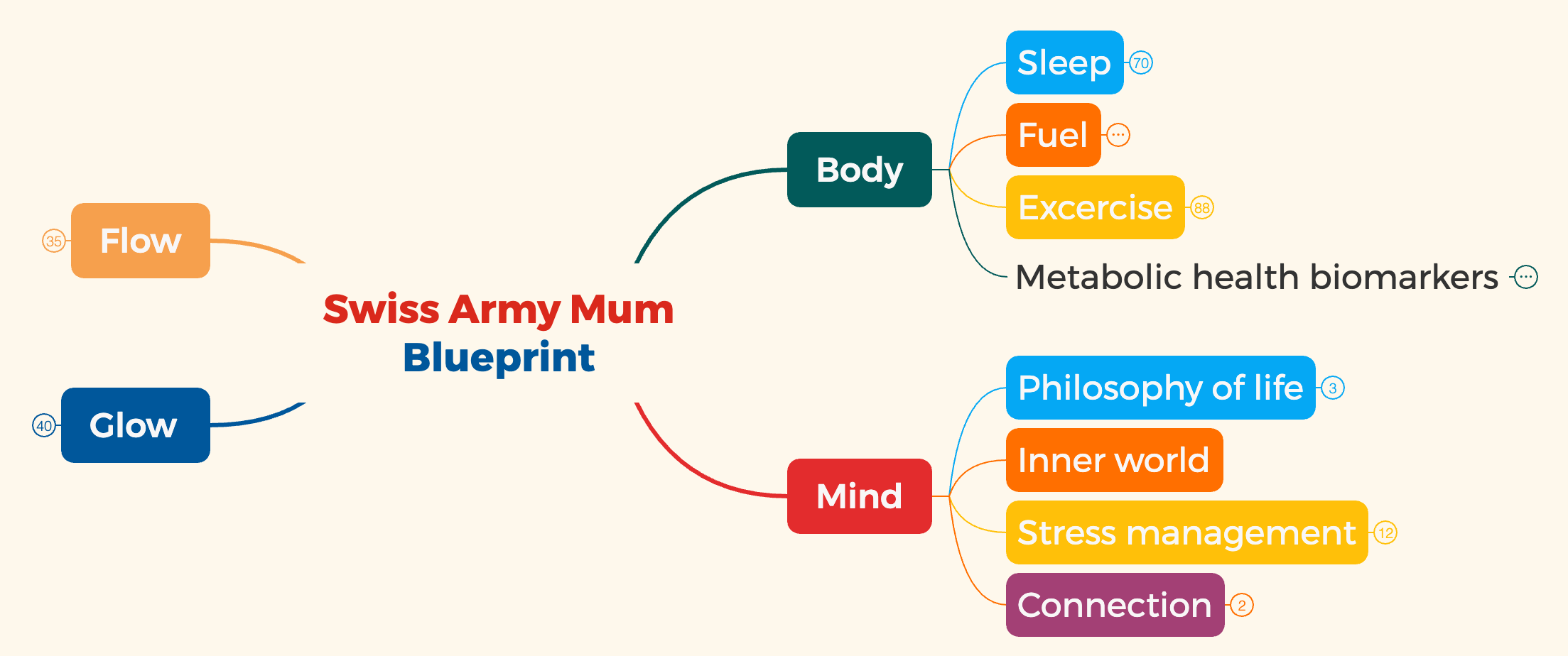
This post is the blueprint for the Mind Pillar, the second of the four pillars and the most personal to write. The Body Pillar covers the physical foundations: sleep, fuel, and movement, the infrastructure that keeps the machine running. The Mind Pillar picks up where the Body leaves off, covering the four areas of mental well-being that decades of research consistently identifies as most actionable: Purpose and Philosophy of Life, Inner World, Emotional Resilience and Stress Management, and Connection and Relationships.
New here? Start here:

Swiss Army Mum is a practical guide to long-term health for busy women, built on four pillars: Body, Mind, Glow, and Flow.
Not every tool. Just the right ones.
I Used to Think Taking Care of My Mental Health Meant Not Having a Breakdown
If I was functioning: working, showing up for people, getting through the week without anything catching fire, I was fine. Mental health was something you only needed to think about when something went wrong. And since nothing had gone catastrophically wrong, I didn’t think about it much.
Then I started building this framework and kept bumping into the same uncomfortable question: what about everything that isn’t the body?
Because there’s a version of me that sleeps eight hours, exercises regularly, eats well, and still feels vaguely lost. Still snaps at the people she loves. Still spends Sunday evenings with that low-grade hum of dread.

That version of me needs something the Body pillar can't fully give her. She needs the Mind pillar.
This post is the blueprint (the why and the what) before we go deep into each area. If you want the practical stuff, it’s coming. But the framework matters first. When you understand what mental well-being actually is, what it’s made of, what shapes it, and what you can and can’t control, the work starts to make a lot more sense.
What Does “Mental Well-being” Actually Mean?
Most of us grew up with a binary understanding of mental health: you either have a problem, or you’re fine. The absence of a diagnosis meant you were okay. “I’m not depressed” was the same thing as “I’m mentally healthy.”
The World Health Organisation draws a very different picture. Mental health, they say, is a state of well-being in which individuals can cope with life’s stresses, realise their abilities, and contribute to their community2.
It is not the absence of illness. It is the presence of something positive, something active, something that can grow or erode depending on how you tend to it.
That reframe matters. It shifts mental health from a threshold you either cross or don’t, into a landscape you actually live in. And it raises a much more interesting question than am I okay?
It raises: am I actually well?
Researchers have been trying to answer that question for over eighty years.
What the Research Says
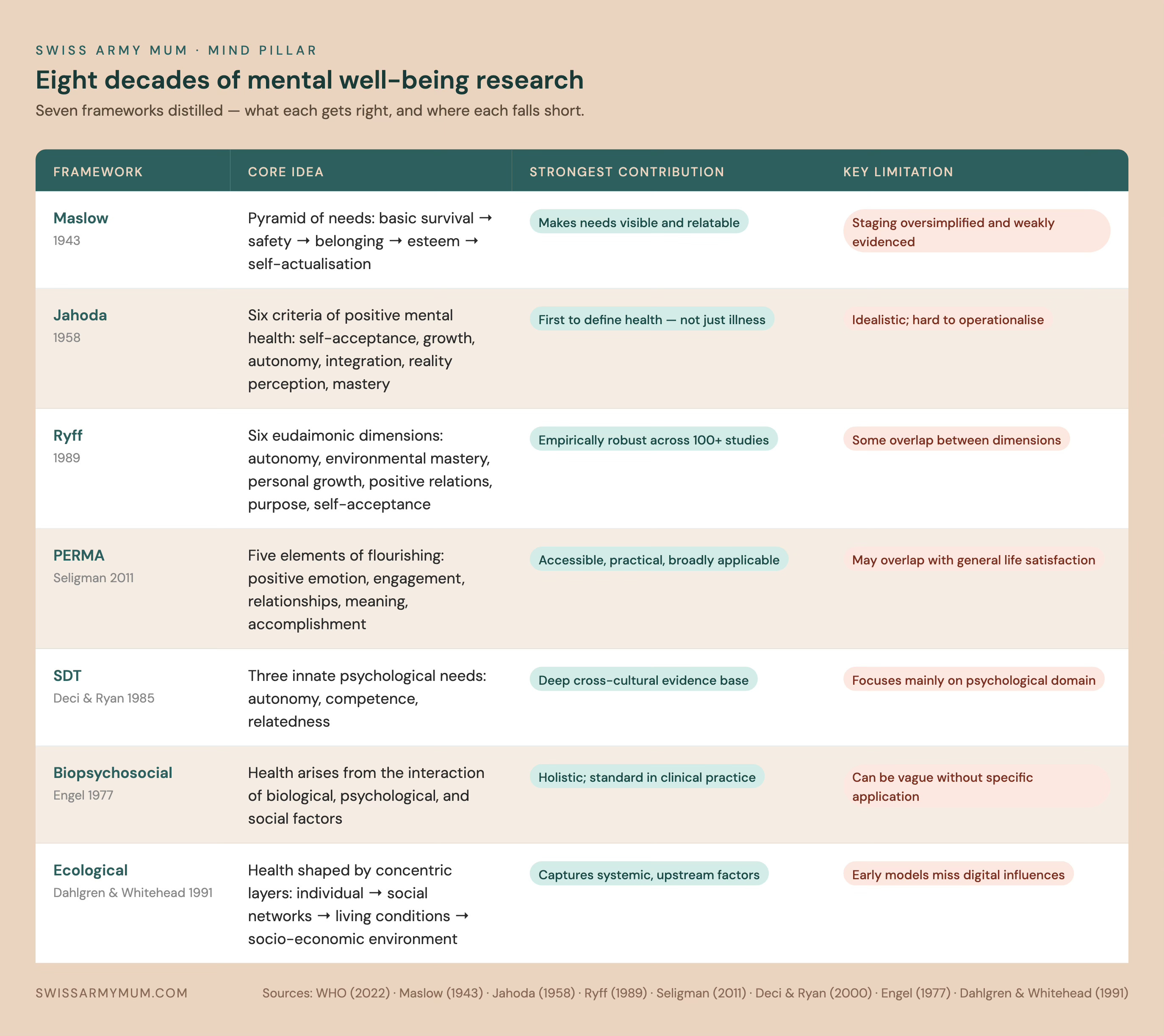
The science of mental well-being is richer and more converging than most people realise. Since the 1940s, psychologists, psychiatrists and public health researchers have been building frameworks for what a mentally healthy life looks like. They come from different traditions and emphasise different things. But when you lay them side by side, a remarkably coherent picture emerges.
Here are the major frameworks worth knowing.
Maslow’s Hierarchy of Needs (1943) is probably the one you’ve seen on a poster. A pyramid: physiological needs at the base, then safety, then love and belonging, then esteem, and finally self-actualisation at the top3. The intuition (that basic needs have to be met before you can pursue growth) is genuinely useful. The critique is that life is messier than a pyramid. Modern research finds weak empirical support for the strict prioritization4.
Jahoda’s Ideal Mental Health (1958) was the first serious attempt to define positive mental health: health itself, not just the absence of illness. She proposed six criteria: self-acceptance, personal growth, integration (the capacity to resist stress), autonomy, accurate perception of reality, and environmental mastery5. Ambitious, perhaps idealistic, but remarkably ahead of its time.
Ryff’s Psychological Well-Being model (1989) took Jahoda’s ideas and built something empirically robust out of them. Six dimensions: autonomy, environmental mastery, personal growth, positive relations with others, purpose in life, and self-acceptance6. Backed by over a hundred studies across cultures7. Of all the frameworks here, this is the one I find most useful as a map.
PERMA (Seligman, 2011) comes from positive psychology. Five elements: Positive Emotion, Engagement, Relationships, Meaning, and Accomplishment8. Widely used in schools and workplaces. Its critics argue it may overlap heavily with general life satisfaction, but as a practical lens, it holds up well. Seligman himself revisited the evidence in a 2018 paper9.
Self-Determination Theory (Deci and Ryan, 1985) argues that there are three fundamental psychological needs: autonomy (feeling like your choices are genuinely yours), competence (feeling effective), and relatedness (feeling connected to others)10. When these are met, people thrive. When they are chronically frustrated, they don’t. Ryan and Deci’s 2012 cross-cultural review confirmed this holds across very different societies11.
The Biopsychosocial Model (Engel, 1977) is the model that underpins modern medicine and psychiatry. Health, mental health included, arises from the interaction of biological, psychological and social factors12. Nothing exists in isolation. This is the same principle that makes the Body pillar and the Mind pillar inseparable, even when we treat them in different posts.
Ecological and Social Determinants Models (Dahlgren and Whitehead, 1991) zoom out the furthest. Think concentric rings: at the centre, the individual. Then social networks. Then living and working conditions. Then the broader socio-economic and cultural environment13. Mental health is shaped at all of these levels simultaneously, a framework now standard in public health policy worldwide.
The Frameworks Side by Side
What Keeps Coming Up
When you look across all of these frameworks, certain themes keep surfacing. Researchers label them differently, but the underlying clusters are consistent. They fall into seven broad domains:
Biological: physical health, sleep, stress physiology, nutrition
Psychological: self-awareness, emotional regulation, resilience, purpose, autonomy
Social: relationships, belonging, support networks
Environmental: safety, housing, access to resources and green space
Behavioural: movement, rest, constructive leisure, daily habits
Cultural and economic: identity, belonging, financial security, freedom from discrimination
This map aligns closely with the WHO’s characterization of mental health determinants14.
Seven domains. All real. All evidenced. Not all equally within reach, and that matters, so let’s be honest about it.
What the Mind Pillar Won’t Cover And Why
I want to be straightforward here, because wellness content often isn’t.
The biological domain is already handled in the Body pillar. Sleep, nutrition, movement, the biological stress response: those live there. The mind-body connection is constant and real, and I’ll come back to it throughout this series. If you haven’t read those posts yet, start here.
Two more domains are largely outside our personal control. The environmental domain (safe housing, stable neighbourhoods, access to nature) and the cultural and economic domain (income, employment, freedom from discrimination and inequality) are among the most powerful determinants of mental health in the research. The evidence is unambiguous. The 2018 Lancet Commission on Global Mental Health was explicit: socioeconomic conditions are upstream determinants that individual-level interventions cannot substitute for.
I’m not going to pretend otherwise, and I’m not going to offer you a journaling prompt as a solution to structural inequality. These factors matter enormously. They set the conditions in which everything else we talk about happens. If your circumstances are genuinely constrained in these ways, that is not a personal failure and it is not something a wellness framework can fix.
What the Mind pillar can offer is meaningful work on the dimensions that remain. That’s not nothing. For most of us living reasonably stable lives, it’s quite a lot.
The 4 Areas
Here’s where the research lands, distilled into four areas that are meaningful, actionable and deeply interconnected. The order matters: each one builds on the last.
1. Purpose and Philosophy of Life
Everything starts here.
Before you can manage stress well, or know yourself, or build meaningful relationships, it helps enormously to have some sense of why. What you value. What kind of life you’re trying to live. What you believe, loosely, about how a person should move through the world.
This isn’t about having a five-year plan. It’s about having an orientation.
Ryff’s research links purpose in life to measurable physical outcomes: immune function, cortisol levels, recovery from illness. Seligman places Meaning at the centre of his PERMA model. Self-Determination Theory identifies autonomy (the sense that your choices are genuinely an expression of your own values) as one of the three most fundamental human needs.
This is also where I want to introduce something that will thread through the entire series: Stoicism. Not as a philosophy degree. As a practical toolkit that is nearly 2,000 years old and still quietly radical.
sMore on this in the dedicated posts. Consider this the seed.
2. Inner World
If Purpose and Philosophy is your why, the Inner World is your who.
This is the quieter area, and harder to talk about without sliding into therapy-speak or generic mindfulness content. So let me try a different angle.
Every other area here requires some basic capacity to actually know what you’re feeling, thinking and needing. Without that inner awareness, stress management becomes distraction, purpose becomes performance, and connection stays surface-level. The inner world is the foundation everything else is built on.
Jahoda was among the first to name this: what she called self-acceptance and accurate reality perception. Ryff built an entire dimension around autonomy: not independence from others, but a stable internal reference point. The ability to know your own mind well enough that you’re not entirely at the mercy of every external signal.
Stoicism returns here too. Marcus Aurelius didn’t just have a philosophy of life. He practiced radical self-examination. His Meditations were never meant to be published. They were private notes he wrote to himself, holding his own thoughts up to scrutiny. That practice (turning inward with honesty and without judgment) is exactly what this area is about.
In practice, it looks less like formal meditation and more like: Do you know when you’re actually overwhelmed versus when you’re bored? Do you know what genuinely restores you versus what just numbs you? Can you sit quietly for ten minutes without reaching for your phone?
Most of the activities I’d put in the wholesome activities post, the slow, solitary, repetitive ones, are inner world work in disguise. Knitting is thinking. Walking without a podcast is processing. Baking from scratch is attention practice. You don’t have to call it mindfulness for it to function like mindfulness.
3. Emotional Resilience and Stress Management
This is the coping dimension, and I want to be careful not to flatten it.
Emotional resilience doesn’t mean not feeling hard things. The research on emotional suppression and avoidance is clear: it backfires, often badly. Resilience is not a wall you build against difficulty. It’s a capacity to move through difficulty (to feel it, process it, and return to equilibrium without getting permanently stuck).
Which brings me to something I want to address directly, even though I know it’s all over the internet right now: nervous system regulation.
The reason it’s everywhere is not because it’s trendy. It’s because the underlying biology is real. When you encounter stress, your autonomic nervous system activates a threat response. The problem isn’t a single stressful event. The problem is chronic activation: when the nervous system never fully returns to baseline, it quietly corrodes mood, cognition, sleep, relationships and physical health over time. Chronic stress is identified by the WHO as one of the primary risk factors for mental ill-health.
So yes, learning to actually regulate your stress response matters. But what does that look like in practice?
This is where restorative activities come in, and I want to make a serious case for them rather than just a cosy one. Knitting, baking, reading, walking the dog, tending a garden: these are not guilty pleasures you earn after being productive enough. The WHO identifies constructive leisure, alongside sleep, movement and diet, as a genuine protective factor for mental health. PERMA calls this Engagement: the flow state where you’re absorbed enough that the inner critic goes quiet. It is one of the most underrated stress regulation tools available, and it costs almost nothing.
I have a whole post coming on this including my own list of wholesome activities and why they actually work.
4. Connection and Relationships
Saving this one for last not because it’s least important (it may be the most) but because it’s the one most of us quietly underestimate in our own mental health accounting.
Loneliness is not a soft problem. A large-scale study published in JAMA Network Open found that loneliness was strongly associated with depressive symptoms, anxiety and suicidal ideation15. Ryff’s positive relations dimension is one of the strongest predictors of long-term well-being in her model. Self-Determination Theory names relatedness as one of the three fundamental human needs: not a nice-to-have, but a core driver of psychological health.
And yet this is the area most of us let erode most quietly. Friendships drift. We get busy. We tell ourselves we’re introverted. We mistake constant digital contact for actual connection.
The quality of your relationships, not the quantity, is one of the most powerful levers you have access to. That includes the relationship you have with yourself, which loops right back to the Inner World area. These four dimensions are not a checklist. They’re a system.
We’ll get into what good connection actually looks like to build and maintain, especially as busy adult women, which is a conversation that doesn’t get had nearly enough.
What’s Coming
Four areas. Four dedicated series. Here’s the road map:
Purpose and Philosophy of Life: values, meaning-making, an introduction to Stoicism as a practical tool, and what living deliberately actually looks like day-to-day
Inner World: self-awareness, solitude, and the quiet practices that build an internal reference point
Emotional Resilience and Stress Management: including a full post on wholesome activities and why the research backs them more than you’d think
Connection and Relationships: the quality of your bonds, and what it genuinely takes to maintain them
Thank You for Being Here
If you made it this far, genuinely, thank you. This series is something I’ve been building for a while, and the Mind pillar is the one that feels most personal to write. Not because I have it figured out, but because I really don’t, and I think that’s exactly why it’s worth going through together.
If this post resonated with you, the best thing you can do is share it with someone who might need it: a friend who’s been running on empty, or anyone quietly wondering if there’s more to mental health than just getting through the week.
And if you’re not subscribed yet, this is a good moment. The next posts in this series are going to get a lot more specific and a lot more honest.
See you in the next one.
Medical note: This is educational, not personal medical advice. Your biology, history, and context matter. Work with a qualified healthcare professional.
References
Engel, G L. “The need for a new medical model: a challenge for biomedicine.” Science (New York, N.Y.)vol. 196,4286 (1977): 129-36. https://doi.org/10.1126/science.847460
World Health Organization (2025). Mental Health Fact Sheet. who.int/news-room/fact-sheets/detail/mental-health-strengthening-our-response
Maslow, A. (1943). A theory of human motivation. Psychological Review, 50(4), 370-396. https://psycnet.apa.org/record/1943-03751-001
Kenrick DT, Griskevicius V, Neuberg SL, Schaller M. Renovating the Pyramid of Needs: Contemporary Extensions Built Upon Ancient Foundations. Perspect Psychol Sci. 2010 May;5(3):292-314. https://doi.org/0.1177/1745691610369469
Jahoda, M. (1958). Current Concepts of Positive Mental Health. Basic Books. https://psycnet.apa.org/record/2006-20880-000
Ryff, C.D. (1989). Happiness is everything, or is it? Journal of Personality and Social Psychology, 57(6), 1069-1081. https://psycnet.apa.org/record/1990-12288-001
Ryff CD. Psychological well-being revisited: advances in the science and practice of eudaimonia. Psychother Psychosom. 2014;83(1):10-28. https://doi.org/10.1159/000353263
Seligman, M.E.P. (2011). Flourish. Free Press. https://psycnet.apa.org/record/2010-25554-000
Seligman, M. (2018). PERMA and the building blocks of well-being. The Journal of Positive Psychology, 13(4), 333–335. https://doi.org/10.1080/17439760.2018.1437466
Deci, E. L., & Ryan, R. M. (2000). The "what" and "why" of goal pursuits: Human needs and the self-determination of behavior. Psychological Inquiry, 11(4), 227–268. https://doi.org/10.1207/S15327965PLI1104_01
Ryan, R. M., & Deci, E. L. (2000). Self-determination theory and the facilitation of intrinsic motivation, social development, and well-being. American Psychologist, 55(1), 68–78. https://doi.org/10.1037/0003-066X.55.1.68
Engel, G. L. (1977). The need for a new medical model: A challenge for biomedicine. Science, 196(4286), 129–136. https://doi.org/10.1126/science.847460
Dahlgren G., Whitehead M. (2021) The Dahlgren-Whitehead model of health determinants: 30 years on and still chasing rainbows. Public Health, 199, 20-24. https://doi.org/10.1016/j.puhe.2021.08.009
World Health Organization and Calouste Gulbenkian Foundation. Social determinants of mental health. Geneva, World Health Organization, 2014. https://www.who.int/publications/i/item/9789241506809
Musacchio Schafer K, Franklin J, Embí PJ, Walsh CG. Loneliness, Anxiety Symptoms, Depressive Symptoms, and Suicidal Ideation in the All of Us Dataset. JAMA Netw Open. 2026;9(3):e260596. https://doi.org/10.1001/jamanetworkopen.2026.0596
What a lovely piece! This especially resonated with me " it helps enormously to have some sense of why. What you value." - couldn't agree more, and it is so often buried down the pile of things to do in this exhausting world.