


You can know yourself quite well and still have a hard week.
The Inner World area (self-awareness, emotional granularity, solitude, knowing what you feel and why) is foundational. The Purpose and Philosophy area gave you a compass. Neither of them stops the Wednesday when three things go wrong at once and the body is already running at capacity. Knowing who you are does not automatically change what happens when the stress response fires.
That gap is what this area addresses.
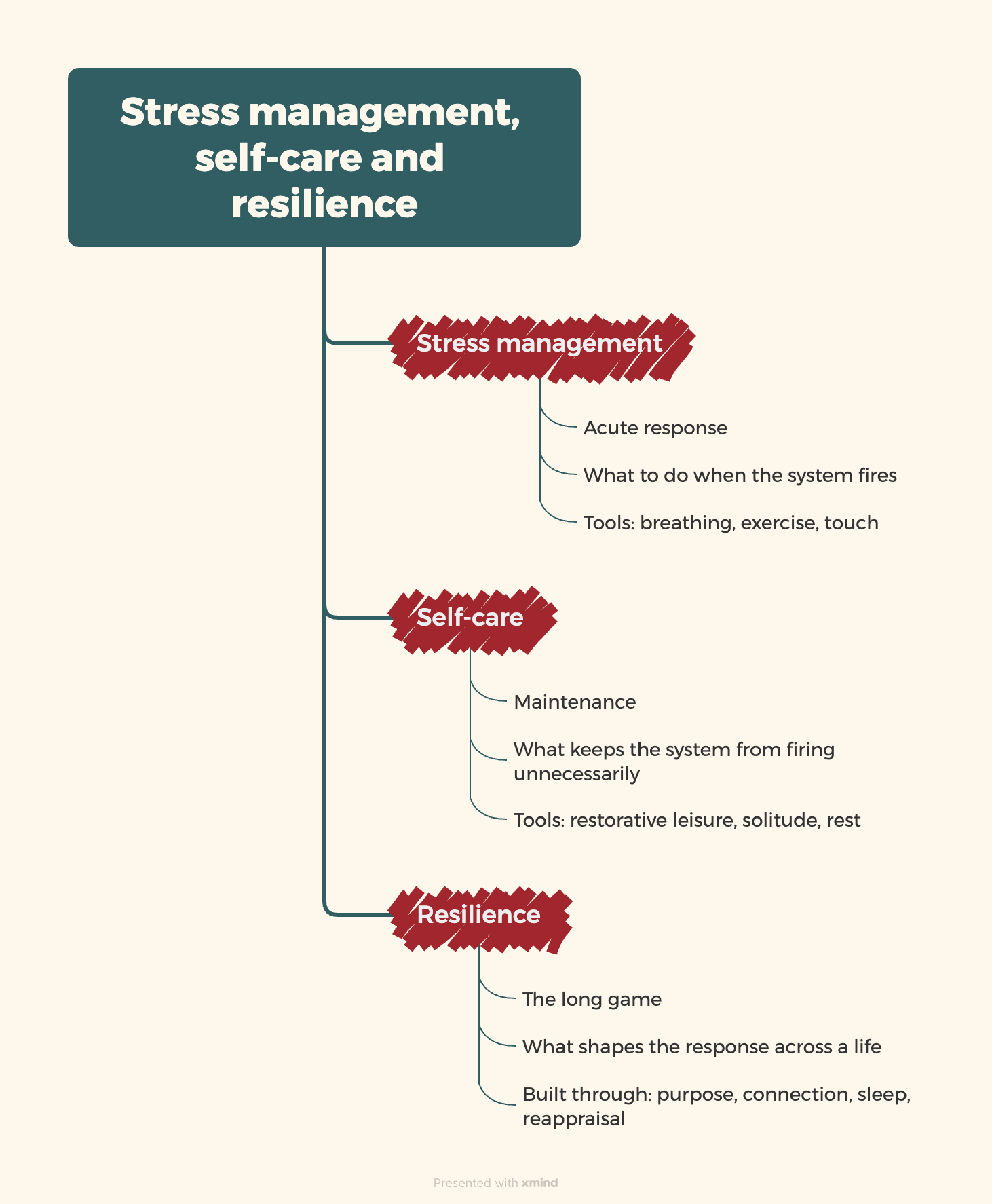
The third area of the Mind Pillar is called Stress Management, Resilience and Self-Care. The name is deliberately broader than most wellness categories because it covers three related but distinct things that are usually treated separately and work better understood together.
Stress management is about the acute situation: what you do when the system is already activated. Self-care is about maintenance: what keeps the system from activating unnecessarily. Resilience is the long game: what determines how the system responds to adversity across a life, and whether that response is something you can shape.
This post is the blueprint for the area. It explains the three sub-themes, how they connect to each other and to the rest of the Mind Pillar, and what is coming in the posts that follow. If you want to go straight to a specific tool, skip ahead. If you want to understand why these three sit together, stay here.
New here? Start here:

Swiss Army Mum is a practical guide to long-term health for busy women, built on four pillars: Body, Mind, Glow, and Flow.
Not every tool. Just the right ones.
Where This Sits in the SAM Framework
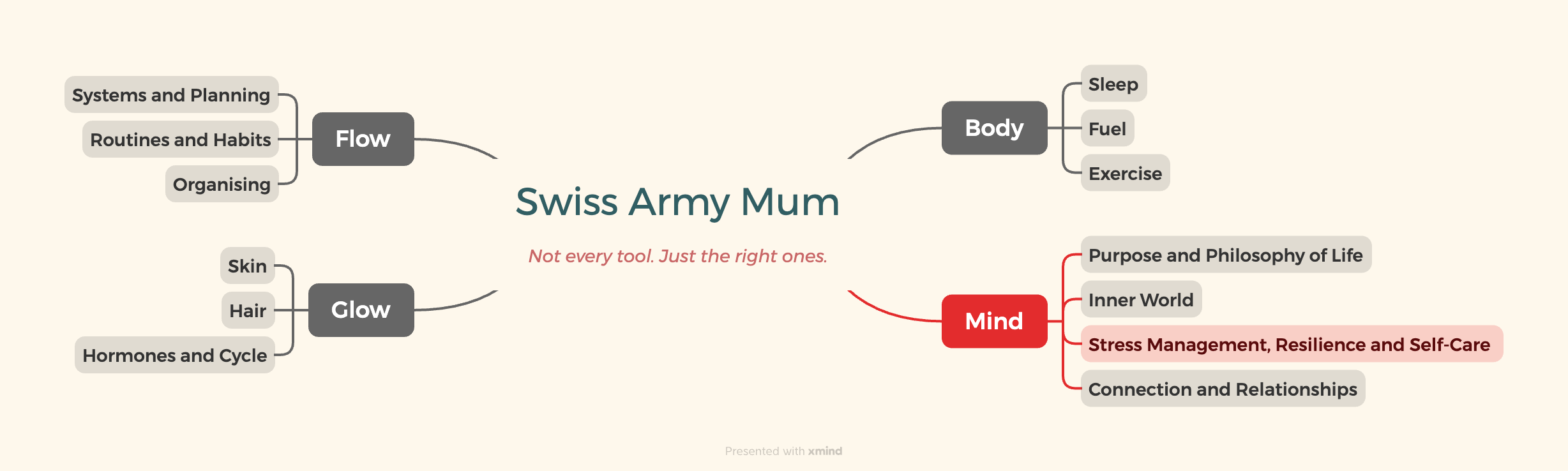
The Mind Pillar has four areas. Purpose and Philosophy gives you the framework for navigating the world. Inner World gives you the internal reference point. Stress Management, Resilience and Self-Care gives you the practical toolkit for the hard days, the cumulative load, and the long view. Connection and Relationships (the fourth area, still ahead) gives you the relational context in which all of it happens.
The Body Pillar and the Mind Pillar are not separate. Chronic stress disrupts sleep architecture, elevates fasting glucose, suppresses immune function, and reduces the accuracy of your emotional perception.1 Sleep deprivation makes the amygdala 60% more reactive to negative stimuli.2 You cannot fully address the Mind Pillar without having addressed the Body Pillar, and you cannot fully optimise the Body Pillar while the stress system is chronically activated. The two pillars are loops, not layers.
What changed in perimenopause, specifically, is that the hormonal buffering that was quietly dampening your stress reactivity becomes less reliable. Estrogen attenuates the HPA axis response. Progesterone metabolises into allopregnanolone, which activates GABA receptors, a direct anxiolytic mechanism. As these hormones fluctuate and eventually decline, the stress response is less buffered, more volatile, and more responsive to life events it would previously have absorbed without difficulty. Understanding this is not an excuse. It is a calibration.
The Three Areas
Stress Management: What You Do When the System Fires
Stress management is the most crowded category in wellness. It is also the most consistently overclaimed. Cold plunging is everywhere. So is cathartic screaming, which fifty years of research have shown reliably increases anger rather than reducing it. Adaptogens are marketed as cortisol-fixers despite the evidence showing they may lower serum cortisol without changing felt stress at all.
The posts in this section sort the evidence honestly. The tools with the strongest research backing for women specifically (moderate-intensity exercise, slow exhale breathing, social touch, in-person voice contact, restorative leisure) are not the ones that dominate the wellness conversation. That gap between what is widely recommended and what is well-evidenced is the editorial territory of this series.
Self-Care: The Maintenance That Makes Everything Else Work
Self-care arrived in public consciousness as a marketing category: bubble baths and face masks as a substitute for systemic change. That framing has done significant damage to a concept that the research takes considerably more seriously.
The WHO defines self-care as the ability of individuals to promote and maintain health, prevent disease, and cope with illness. Ryff’s six dimensions of psychological wellbeing include personal growth, autonomy, and purpose as functional necessities, not optional additions.3 The engagement dimension of Seligman’s PERMA model )the capacity for deep absorption in meaningful activity) is associated with lower depression rates and greater resilience across cultures.4
The self-care posts in this area make the case that deliberate restoration is not indulgence. It is maintenance. Directed attention (the cognitive resource that gets depleted by work, decisions, and managing other people) has a recovery mechanism, and that mechanism requires specific conditions to operate: absorbing, low-demand, low-stakes activity in a pleasant environment. Skipping it does not free up time. It depletes the resource that makes everything else function, which means it costs more than it saves, compounded over weeks and months.
Resilience: The Long Game
Resilience is probably the most misunderstood concept in this area. The popular version involves a person being knocked down by adversity and fighting back, stronger for the experience. The research version is considerably more nuanced, considerably more honest, and in at least one key finding, considerably more reassuring.
Resilience, in the research, is the modal outcome. It is not exceptional. It is what most people do, most of the time, when equipped with the ordinary adaptive systems that the research identifies: social connection, a sense of meaning, the capacity to reappraise rather than ruminate, adequate sleep, and physical activity.
The resilience post in this series does two things: it explains what the research actually says about how resilience works and what builds it, and it is honest about three popular claims that the evidence does not support: that trauma routinely produces growth, that resilience is a muscle you can simply train, and that what does not kill you makes you stronger.
What’s in This Series
Your Stress Toolkit: What Actually Works A taxonomy of evidence-based stress regulation tools, sorted honestly. What the research supports for women specifically, including the female stress response and the perimenopause angle. What the wellness industry has got wrong.
The Blood Pressure Experiment A personal n=1 experiment: does five minutes of slow breathing produce a measurable effect on blood pressure? The protocol, the data, and what it tells us about the responsiveness of the stress system.
Book Club: Three Books on Stress Why Zebras Don’t Get Ulcers (the mechanism), The Stress-Proof Brain (the toolkit), and The 5 Resets (the gateway), reviewed honestly. The reading order and what each does that the others do not.
My Wholesome Activities: And Why They Count as Healthcare A personal and warm post about the activities that genuinely restore me (knitting, gardening, walking, baking, reading) with the attentional restoration research woven in honestly, including where the evidence is thin.
What Resilience Actually Is: And How to Build It What the research says about resilience as a dynamic process rather than a fixed trait, what modifiable capacities reliably predict it, and what three popular resilience narratives the evidence does not support.
The 80/20 for This Area
The highest-leverage things across all three sub-themes, consistent with the evidence:
Sleep first. It is the upstream variable that affects stress reactivity, emotional regulation, and the capacity to do anything else on this list. CBT-I has the strongest effect size of any behavioural intervention in the relevant literature.
Moderate exercise three times a week. The most replicated stress and resilience tool in the literature. Not HIIT under conditions of high stress. Moderate intensity: walking, yoga, a run at a conversational pace.
One or two people you can reach by phone or in person when a period is hard. Social co-regulation is the most powerful acute cortisol buffer identified in the stress research. The voice, not the text message.
One absorbing, screen-free, low-stakes activity protected in the week. This is the self-care post in summary: find the one activity that meets the criteria and protect the time as you would anything else that matters to long-term function.
The resilience levers (purpose, cognitive reappraisal, optimism) are developed over time and covered in full in Post 3.5.
Thank You
Thank you for reading, sharing, and supporting this work. Whether you’ve been here since the beginning or just found Swiss Army Mum, I’m glad you’re here.
Building a life with more intention takes a village. If something resonated, I’d be grateful if you forwarded this to someone who might need it, or hit the ♥️ or ↻ Restack button. It helps more people find this space.
This is educational, not personal medical advice. Your biology, history, and context matter. Work with a qualified healthcare professional.
References
Sapolsky, R.M. (2004). Why Zebras Don’t Get Ulcers
Yoo, S.S. et al. (2007). The human emotional brain without sleep — a prefrontal amygdala disconnect. Current Biology, 17(20). https://doi.org/10.1016/j.cub.2007.08.007
Ryff, Carol D. Journal of Personality and Social Psychology: Personality Processes and Individual Differences Vol. 57, N° 6, (1989): 1069-1081. https://doi.org/10.1037/0022-3514.57.6.1069
Seligman, M.E.P. (2011). Flourish. Free Press.