


At some point in the last decade, self-care became a punchline. A bubble bath after a difficult day. A face mask that solves nothing. The concept got flattened into a marketing category, which made it easy to dismiss.
The research definition of self-care is considerably more serious than the commercial one. The World Health Organisation defines it as the ability of individuals to promote and maintain health, prevent disease, and cope with illness with or without professional support. Ryff’s six dimensions of psychological wellbeing, one of the most replicated frameworks in positive psychology, includes personal growth, autonomy, and environmental mastery as non-negotiable components of a functioning mental life.1 The engagement strand of Seligman’s PERMA model (the capacity for absorption in meaningful activity) is associated with lower depression rates and greater resilience across cultures.2 None of this looks like a bubble bath. All of it requires deliberate time.
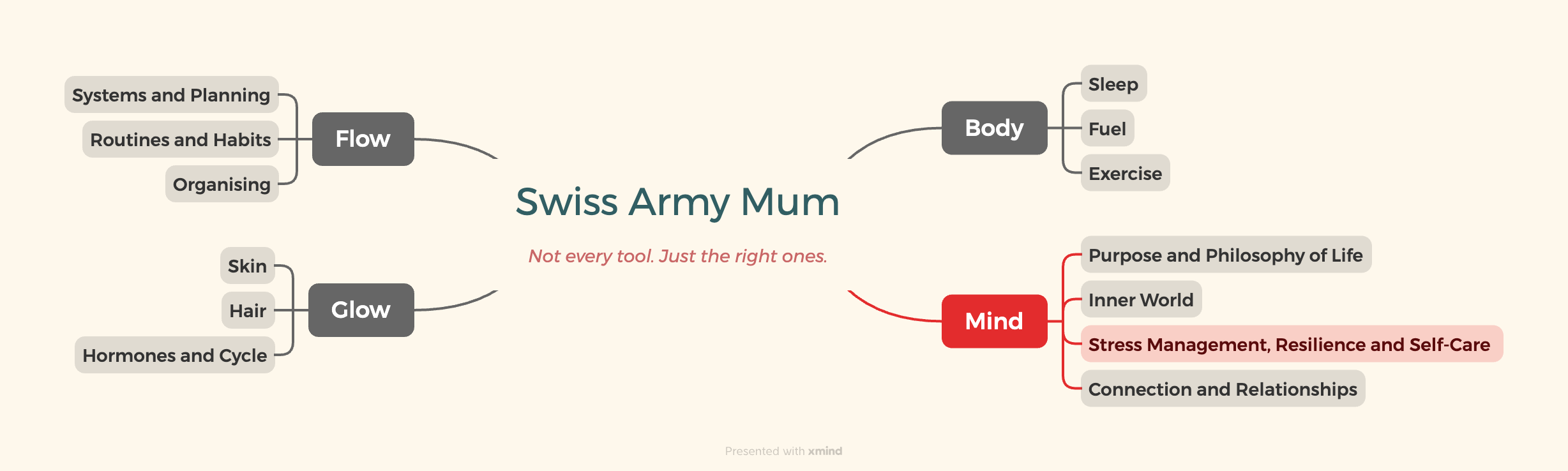
This post sits within the Stress Management, Resilience and Self-Care area of the Mind Pillar. It is a companion to my previous post, which covers the full stress toolkit sorted by evidence. This post goes somewhere deeper: the science behind why restorative activities qualify as genuine restoration, and the case for treating that time as non-negotiable rather than earned.
New here? Start here:

Swiss Army Mum is a practical guide to long-term health for busy women, built on four pillars: Body, Mind, Glow, and Flow.
Not every tool. Just the right ones.
Why Deliberate Rest Is Healthcare, Not Luxury
Think of directed attention (the cognitive resource used for decisions, planning, problem-solving, managing other people) as a non-renewable daily resource. Not infinite. Not rechargeable by sitting in front of the television. Actually finite, and actually depleted by the end of a full day of modern professional and domestic life.
Kaplan and Kaplan’s Attentional Restoration Theory, developed in 1989 and tested across three decades of subsequent research, proposes that directed attention recovers specifically when the environment asks something different of you.3 Not nothing: complete passivity is not restorative. Something low-demand, absorbing, and pleasant. An activity that engages what the Kaplans call “soft fascination”: involuntary attention drawn gently, without effort or performance stakes.
Ulrich’s parallel Stress Recovery Theory, from 1991, adds the physiological dimension.4 Natural and low-threat environments produce measurable reductions in heart rate, skin conductance, and cortisol within minutes of exposure. Minutes, not hours of meditation, not a 12-week protocol. Minutes. The nervous system is responsive to environment in ways that are faster and more automatic than most stress management advice accounts for.
Together, these frameworks make the case that restorative activities are not indulgence. They are maintenance. Skipping them does not free up time. It depletes the resource that makes everything else function, which means it costs more time than it saves, compounded over weeks.
The self-care case is not “you deserve a rest.” It is “your capacity to function, show up for the people who need you, and make good decisions over the next several decades depends on deliberate restoration. Treat it accordingly.”
The Science of Doing Nothing Useful
I want to be honest about something: the research on specific activities is thinner than the wellness content about them implies. Gardening has data. Walking has data. Knitting and baking have surveys and plausible mechanisms. I will be clear about the difference.
Gardening: the one with actual cortisol data
Van Den Berg and Custers (2011) ran a small but clean study: 30 participants exposed to a Stroop task (the kind of sustained cognitive stressor that reliably raises cortisol and irritates everyone) were then randomised to either 30 minutes of allotment gardening or 30 minutes of indoor reading.5
The gardening group showed significantly greater cortisol decline. Their positive mood was fully restored by the end of the 30 minutes.
That finding has not been replicated at scale. It is one study, 30 people, and I will not overstate it. But it is one study with physiological data, which puts it ahead of most activities in this category. The mechanisms are layered: physical activity (mild), nature exposure (consistent effect on HRV and cortisol in the broader literature), sensory engagement, and what the researchers call “contact with life”: something that grows and responds to your care, independent of any screen.
I garden badly and slowly. The tomatoes are inconsistent, the roses wither. None of that appears to matter.
Knitting: 3,545 people said so
Riley and colleagues surveyed 3,545 knitters in 2013.6 The majority reported relaxation and stress relief as primary effects. This is self-report data. Nobody measured their cortisol. But 3,545 people independently arriving at the same experience deserves some weight, and the mechanism the Kaplans would predict is there: repetitive, absorbing, proprioceptively engaging, produces a visible completed object, requires just enough attention to displace rumination.
The “just enough attention” is the key. You cannot knit and catastrophise at the same time. The activity takes up the space that the intrusive thought was using.
I knit slowly. I have frogged the same sleeve four times. It still works.
Baking: almost no controlled research, completely valid anyway
I cannot cite a study here. There is almost no controlled physiological research on baking as a stress regulation tool. The mechanism is plausible: absorbing, multi-sensory, time-structured, produces something tangible, involves the hands, but nobody has run the trial.
The Kaplans’ framework predicts that any absorbing, low-demand activity in a low-threat environment should produce some attentional restoration. Baking fits that description. The fact that the research has not caught up with the practice does not make the practice wrong. It makes the research incomplete.
The bread, incidentally, is often edible.
Walking: the clearest mind-body evidence
Bratman and colleagues compared a 90-minute nature walk to a 90-minute urban walk in a controlled study. The nature walk reduced rumination and reduced activity in the subgenual prefrontal cortex, the brain region associated with this kind of thinking.7
Walking in an urban environment produced neither effect.
This matters because walking is often recommended generically without the location caveat. The evidence is specifically for nature or low-stimulation environments. A park, a green space, a canal path. Not Oxford Street with headphones in. The headphones, incidentally, are worth considering: listening to a podcast keeps the directed attention system online, which may limit the restorative effect. Silence or ambient sound allows it to rest.
My walk is twenty minutes, in the morning, without my phone, with my dog. I do not always manage it. On the days I do, the rest of the day is different in a way I have stopped trying to quantify.
Reading: complicated
The University of Sussex study claiming that reading reduces heart rate by 68% in six minutes is the most widely cited piece of evidence in this category. It is a single small study, never robustly replicated, and the methodology has been questioned. I mention this because it circulates constantly in self-care content as though it were a settled finding. It is not.
What reading probably does: it requires just enough directed attention to displace rumination, engages a different kind of cognitive processing than the work day requires, and provides a reliable narrative structure that gives the mind something to follow rather than something to generate. Whether this produces measurable cortisol reductions is unclear. That it is restorative for many people is consistent with the Attentional Restoration framework even if the specific numbers are unreliable.
Read if it restores you. Like me.
Or read because it expands your horizons, lets you live a thousand lives, entertains, uplifts, moves you… like me. That’s reason enough.
The Pattern Across All of It
When I look across these activities the consistent features are:
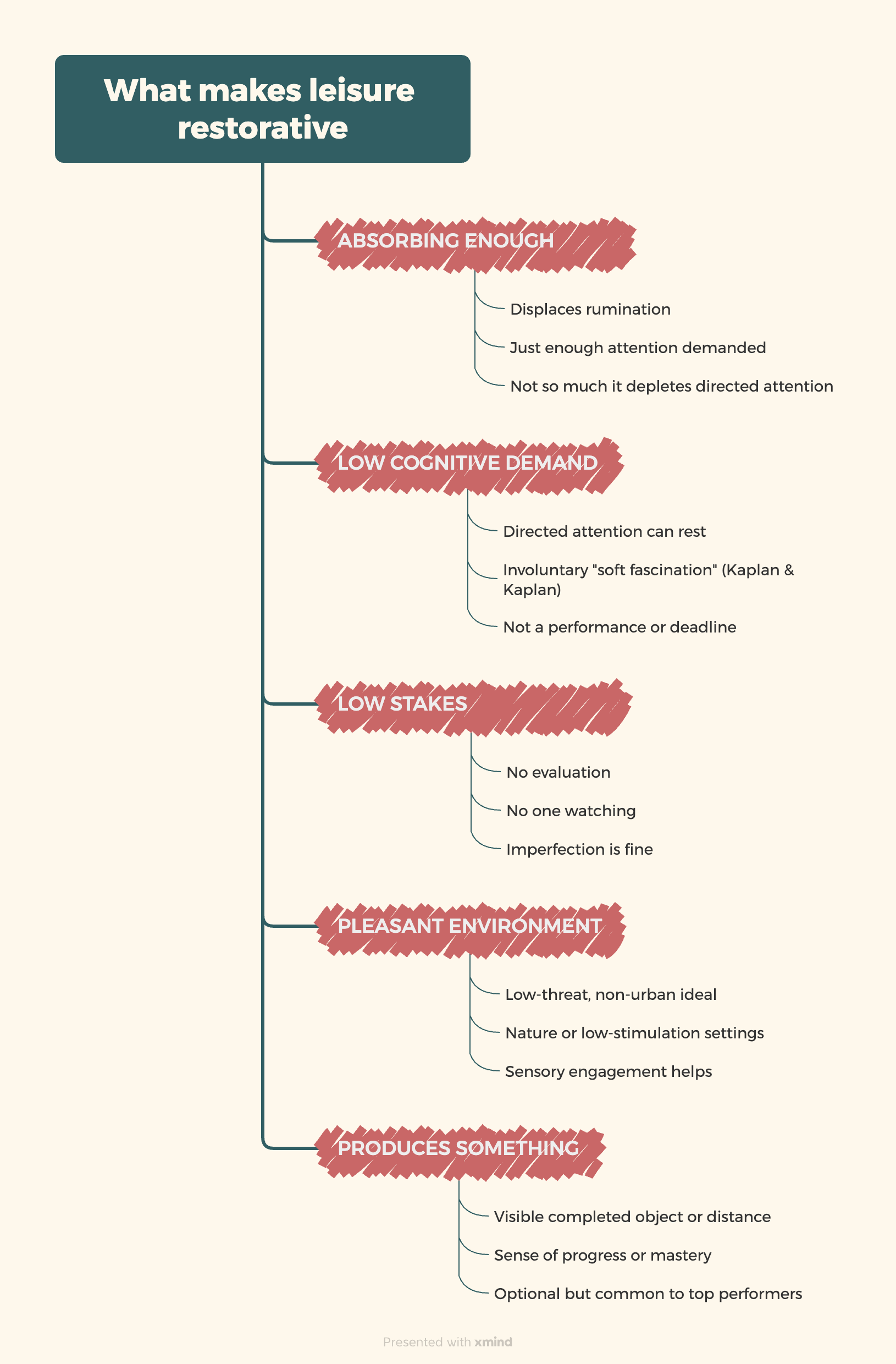
Absorbing enough to displace rumination. Low enough in cognitive demand that directed attention is not being depleted. Hands or body involved in some way. No performance stakes. Produces something: a completed row, a loaf, a mile, a chapter reached.
These are not the features of self-care as marketed. They are the features of activities that work as described by attentional restoration theory and stress recovery theory. The specific activity matters less than whether it meets these criteria for you. Some people reach this state through running. Some through cooking. Some through embroidery or woodwork or playing an instrument.
The bottom line is: absorbing, low-demand, pleasant, non-screen.
Flow state, which Csikszentmihalyi described as the condition of deep absorption in a skill-matched challenge, is theoretically nearby. The causal direction between flow and stress relief is not clearly established (high cortisol impairs flow more reliably than flow reduces cortisol) but the consistent finding from experience-sampling research is that passive media, particularly scrolling, almost never produces flow, while craft, movement, and skilled practice regularly do.
On the Pressure to Optimise Leisure
The wellness industry has found a way to make rest feel like a performance metric. Tracking your HRV during the walk. Rating your sleep restoration. Logging the meditation session.
This is approximately the opposite of what makes restorative leisure restorative. The Kaplans’ framework is specifically about activities without performance stakes. The moment the walk becomes a data collection exercise or the knitting becomes a productivity hack, something changes. Not necessarily wrong. Just different.
I do not track my walks. I do not log the knitting sessions. I just accumulate knitted garments and at the end of the year, I have plenty to gift for Christmas. The value is in the doing, not in the measurement of the doing. This is one area where the personal experience and the research framework are in agreement: the absence of stakes is part of the mechanism.
Protect the time. Do not gamify it.
The 80/20
Find one or two activities that meet the criteria: absorbing, low-demand, pleasant, no screen, no performance stakes and do them consistently rather than sporadically. Consistency matters more than duration.
The self-care reframe: this is not time off. It is the maintenance that keeps everything else running. Schedule it (if you need to) with the same intentionality as anything else that matters to your long-term function.
Thank you
Thank you for reading, sharing, and supporting this work. Whether you’ve been here since the beginning or just found Swiss Army Mum, I’m glad you’re here.
Building a life with more intention takes a village. If something resonated, I’d be grateful if you forwarded this to someone who might need it, or hit the ♥️ or ↻ Restack button. It helps more people find this space.
This is educational, not personal medical advice. Your biology, history, and context matter. Work with a qualified healthcare professional.
References
Ryff, C. D. (1989). Happiness is everything, or is it? Explorations on the meaning of psychological well-being. Journal of Personality and Social Psychology, 57(6), 1069–1081. https://doi.org/10.1037/0022-3514.57.6.1069
Seligman, M.E.P. (2011). Flourish. Free Press. https://psycnet.apa.org/record/2010-25554-000
Kaplan, R., & Kaplan, S. (1989). The experience of nature: A psychological perspective. Cambridge University Press. https://psycnet.apa.org/record/1989-98477-000
Ulrich, R. S., Simons, R. F., Losito, B. D., Fiorito, E., Miles, M. A., & Zelson, M. (1991). Stress recovery during exposure to natural and urban environments. Journal of Environmental Psychology, 11(3), 201–230. https://doi.org/10.1016/S0272-4944(05)80184-7
Van Den Berg AE, Custers MH. Gardening promotes neuroendocrine and affective restoration from stress. Journal of Health Psychology. 2011 Jan;16(1):3-11. https://doi.org/10.1177/1359105310365577
Riley, J., Corkhill, B., & Morris, C. (2013). The benefits of knitting for personal and social wellbeing in adulthood: Findings from an international survey. The British Journal of Occupational Therapy, 76(2), 50–57. https://doi.org/10.4276/030802213X13603244419077
Bratman, G. N., Hamilton, J. P., Hahn, K. S., Daily, G. C., & Gross, J. J. (2015). Nature experience reduces rumination and subgenual prefrontal cortex activation. PNAS Proceedings of the National Academy of Sciences of the United States of America, 112(28), 8567–8572. https://doi.org/10.1073/pnas.1510459112