


Last week, I introduced the Swiss Army Mum system: four pillars (Body, Mind, Glow, Flow) built on the 80/20 principle. Not every tool, just the essential ones that actually work.
This week, we’re diving into the first pillar: Body - and specifically, the foundation that everything else depends on: sleep.
Body has three components: Sleep, Exercise, and Fuel (nutrition). You could start anywhere, but sleep comes first for a reason. Without it, you won’t have the energy to work out, the willpower to eat well, or the mental clarity to build systems. Fix sleep, and everything else gets easier.
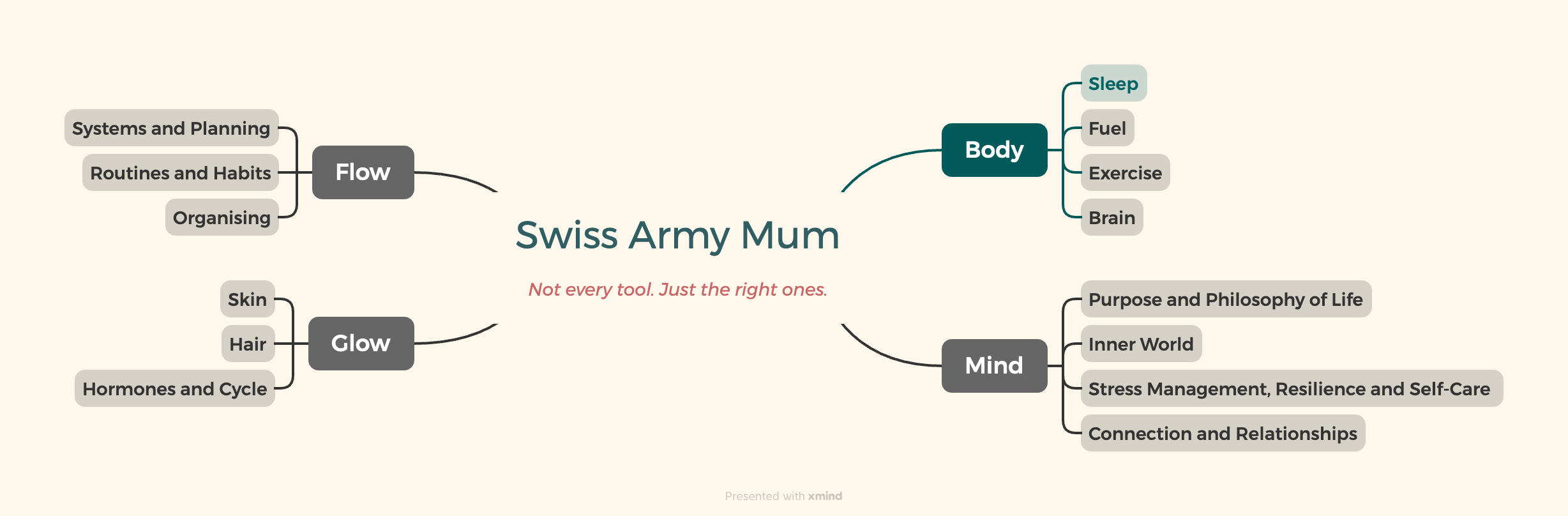
This post sits in the Sleep area of the Body Pillar. Of the three Body areas, Sleep is the one that sets the ceiling on everything else: Fuel gives your cells the right signals, and Exercise builds the architecture of strength, but both of them depend on sleep to do their job properly. Shortchange it, and the returns from the other two shrink fast. The Mind Pillar builds on this foundation too, since chronic sleep deprivation is one of the fastest ways to corrode emotional resilience and cognitive function.
So let’s start at the beginning.
The non negotiable foundation
Sleep isn’t recovery time. It’s when your body and brain do critical maintenance work that can’t happen while you’re awake.
Ask different experts what matters most for health, and you’ll get different answers. The exercise physiologist will say movement. The nutritionist will say food quality. The longevity researcher will say metabolic health. Each pillar of Swiss Army Mum - Body, Mind, Glow, Flow - has compelling science behind it.
But here’s the brutal truth: if you don’t sleep, everything else falls apart. Poor sleep makes you crave junk food. It saps your motivation to exercise. It impairs your decision-making so you skip the gym and reach for sugar. It’s a vicious cycle that undermines every other health intervention you attempt.
And here’s something worth considering: Why would sleep still exist if it weren’t absolutely critical? From a survival standpoint, being unconscious for 8 hours every day sounds like a terrible idea. You can’t hunt, gather, reproduce, or defend yourself while you’re asleep. You’re vulnerable to predators. Yet every mammal sleeps. Every bird sleeps. Even insects and worms have sleep-like states.
If sleep weren’t essential - if it were just “rest” - evolution would have selected it out millions of years ago. The fact that it persists despite making us defenseless tells you everything: the functions performed during sleep are so vital that the risk of being unconscious is worth it. You can survive weeks without food. Days without water. Minutes without oxygen.
You can only survive days without sleep before your body and brain start shutting down too. Sleep is as essential as water!
It’s simple enough, as Matthew Walker, neuroscientist and author of Why We Sleep, puts it :
The shorter your sleep, the shorter your life.
New here? Start here:

Swiss Army Mum is a practical guide to long-term health for busy women, built on four pillars: Body, Mind, Glow, and Flow.
Not every tool. Just the right ones.
Why Sleep Matters
Sleep isn’t recovery time. It’s when your body and brain do critical maintenance work that can’t happen while you’re awake.
Your brain clears waste. During sleep, your brain’s glymphatic system flushes out metabolic debris - including beta-amyloid proteins linked to Alzheimer’s disease. Miss sleep, and that garbage piles up1.
The glymphatic system is a recently discovered brain-wide waste-clearance network that helps clean your brain by moving fluid through tiny channels around blood vessels and carrying out metabolic waste and excess proteins. It’s named for its dependence on glial cells (the brain’s support cells) and its functional similarity to the lymphatic system in the rest of the body — but it’s distinct and specific to the central nervous system2.
Your memories consolidate. Sleep acts as a file-transfer system: NREM sleep moves information from short-term storage (hippocampus) to long-term vaults (cortex). Skip sleep, and you lose what you learned that day. This isn’t just “forgetting where you put your keys” - it’s impaired learning, creativity, and problem-solving3.
Your hormones recalibrate. Sleep regulates insulin sensitivity, cortisol, growth hormone, leptin, and ghrelin (your hunger hormones). Chronic sleep restriction makes you insulin-resistant, increases cortisol (stress hormone), and messes with hunger signals—making you crave sugar and store fat more easily4.
Growth hormone peaks during deep sleep. In adults, the most reproducible pulse of growth hormone (GH) secretion occurs shortly after sleep onset, during slow-wave sleep (the deepest stage of NREM). Growth hormone stimulates tissue repair, muscle growth, bone density, and metabolic function—critical processes for recovery and longevity. As we age, both deep sleep and GH secretion decline dramatically, which may contribute to age-related muscle loss and metabolic dysfunction5.
Your immune system rebuilds. Sleep deprivation weakens immune function and increases inflammation. You get sick more often, recover slower, and your body stays in a low-grade inflammatory state that accelerates aging and disease6.
Your emotions regulate. REM sleep recalibrates your emotional circuits. Without it, you’re more reactive, anxious, and prone to poor decision-making. Sleep deprivation is directly linked to depression, anxiety, and other psychiatric conditions7.
Sleep isn’t optional. It’s the foundation everything else rests on. You can’t out-exercise, out-supplement, or out-biohack chronic sleep deprivation.
How We Sleep: The Two-Factor Model
Two distinct forces control when you want to sleep and when you want to be awake.
Circadian rhythm (Your Internal Clock)
Your circadian rhythm is a 24-hour biological cycle governed by a tiny cluster of neurons in your brain called the suprachiasmatic nucleus. This internal clock regulates nearly every physiological process - body temperature, hormone release, alertness, metabolism.
The key player here is melatonin, often called the “hormone of darkness.” As evening approaches, your brain releases melatonin to signal that it’s time to sleep. But here’s the catch: sunlight blocks melatonin production. Bright light—especially blue light from screens—tells your brain it’s still daytime, delaying melatonin release and pushing your sleep later.
Your circadian rhythm also determines your chronotype—whether you’re naturally a morning person, night owl, or somewhere in between. You can’t fight your chronotype entirely, but you can work with it.
Sleep pressure (adenosine)
From the moment you wake up, a chemical called adenosine starts building up in your brain. The longer you’re awake, the more it accumulates. After 12-16 hours of wakefulness, adenosine levels peak, creating an overwhelming desire to sleep.
Once you fall asleep, your brain clears adenosine. By morning, it’s reset - which is why you (should) wake up feeling refreshed.
Here’s where caffeine comes in. Caffeine doesn’t give you energy - it blocks adenosine receptors in your brain, masking the signal that you’re tired. The adenosine is still there, building up. When the caffeine wears off, you crash hard because all that accumulated sleep pressure hits you at once.
This is why late-afternoon coffee sabotages your sleep. You’re blocking adenosine when your body needs to feel tired in order to fall asleep on time.
Sleep Stages: Light vs. Deep Sleep
Sleep isn’t one uniform state. You cycle through two main types of sleep every 90 minutes, and the ratio shifts across the night.
NREM sleep (Non-Rapid Eye Movement)
NREM sleep dominates the first half of the night. It’s the most restorative phase. It has four stages, ranging from light to deep:
Light sleep (Stages 1 and 2): Transitional phases. Stage 2 features “sleep spindles”—bursts of brain activity that shield your brain from external noise and help refresh memory.
Deep sleep (Stages 3 and 4): Also called “slow-wave sleep” because of the large, synchronized electrical waves your brain produces. This is where the heavy lifting happens.
What NREM does:
Memory consolidation: Acts as a file-transfer process, moving memories from short-term storage (hippocampus) to long-term storage (cortex).
Synaptic pruning: Weeds out unnecessary neural connections, streamlining your brain’s efficiency.
Physical restoration: Tissue repair, muscle growth, immune system strengthening.
Growth hormone release: The major GH pulse occurs during the first deep sleep episode of the night.
If you cut your sleep short, you lose deep sleep first - especially if you’re staying up late. This is why “catching up” on weekends doesn’t work. You can’t recover what you lost.
REM Sleep (Rapid Eye Movement)
REM sleep dominates the second half of the night, especially the early morning hours (4-7 AM). It’s called “paradoxical sleep” because your brain looks awake on scans, but your body is completely paralyzed - except for your eyes, which dart around rapidly.
What REM does:
Dreaming: This is when most vivid dreams occur.
Creativity and problem-solving: Your brain forges novel connections between unrelated pieces of information. This is why you sometimes wake up with solutions to problems you couldn’t crack the day before.
Emotional regulation: REM recalibrates your emotional circuits, processing difficult experiences and reducing emotional reactivity.
If you wake up early or drink alcohol before bed, you lose REM sleep. Alcohol might help you fall asleep faster, but it fragments REM throughout the night - leaving you emotionally dysregulated and cognitively sluggish the next day.
Both NREM and REM matter. You can’t choose one over the other. You need the full night to get both.
The 80/20: What Actually Moves the Needle
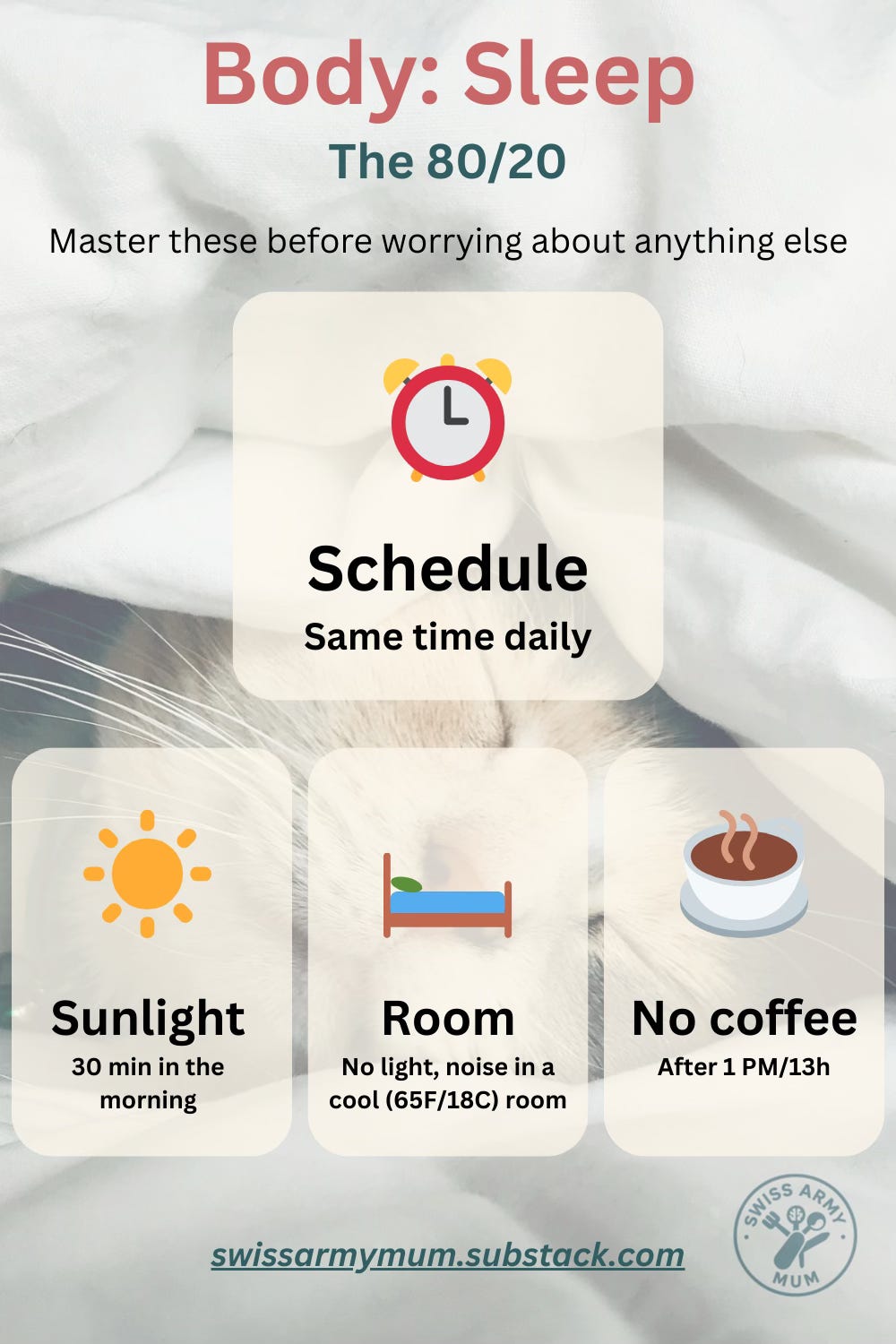
Research consistently shows four interventions have the largest impact on sleep quality. Master these before worrying about anything else.
Stick to a sleep schedule
Go to bed and wake up at the same time every day—even weekends. Even after a late night.
Matthew Walker calls this the single most effective way to improve your sleep. In Why We Sleep, he writes: “All twelve suggestions [from the NIH]8 are superb advice, but if you can only adhere to one of these each and every day, make it: going to bed and waking up at the same time of day no matter what.”
Consistency synchronizes your circadian rhythm, strengthens sleep pressure, and improves all six dimensions of sleep health (regularity, satisfaction, alertness, timing, efficiency, duration).
Pick your times. Set an alarm for both bedtime and wake time. Stick to it for at least two weeks before judging whether it’s working.
Get morning sunlight
Get 30 minutes of natural sunlight within two hours of waking. This resets your circadian rhythm and anchors your internal clock9.
Multiple studies demonstrate the powerful effects of morning light exposure on sleep:
If you live somewhere dark in winter, use a bright light box (10,000 lux) for 20-30 minutes in the morning.
Good sleeping environment
Get rid of anything in your bedroom that might distract you from sleep, such as noises, bright lights, an uncomfortable bed, or a TV or computer in the bedroom. Your bedroom should be around 60-67°F (15.6-19°C), with 65°F (18°C) being optimal for most adults. Your core body temperature needs to drop to fall asleep and stay asleep. A cool room facilitates this natural process.
Cut caffeine after 1 PM
No caffeine after early afternoon. Caffeine has a half-life of 5-7 hours in healthy adults, meaning half of it is still in your system six hours later. That afternoon espresso at 3 PM/15h? Still blocking adenosine receptors at 9 PM/21h when you should be winding down.
For most people, a 1 PM/13h cutoff is conservative enough to allow caffeine to clear before bedtime.
Start here. These four interventions give you 80% of the results. Once you’ve mastered them for at least two weeks, move to the next level.
Common mistakes
Alcohol as a sleep aid. Alcohol sedates you and makes you fall asleep more easily, but it’s not good restorative sleep. A nightcap might help you get to sleep, but alcohol keeps you in the lighter stages of sleep and you tend to wake up in the middle of the night when the sedating effects wear off. You’re unconscious, but you’re not resting.
Late exercise. Exercise is great for sleep—but not within 2-3 hours of bedtime. It raises your core temperature and activates your sympathetic nervous system (fight-or-flight), both of which delay sleep onset.
“Catching up” on weekends. Sleeping in on Saturday doesn’t erase sleep debt from the week. You can’t bank sleep. Worse, inconsistent wake times weaken your circadian rhythm, making it harder to fall asleep Sunday night—hello, Monday morning misery.
Lying in bed awake. If you can’t fall asleep after 20 minutes, get out of bed. Do something boring and relaxing (read a dull book, listen to a podcast) until you feel sleepy again. The anxiety of not being able to sleep can make it harder to fall asleep. Lying there stressing trains your brain to associate bed with anxiety.
SAM Brief
The compressed reference guide for everything in this post. Key mechanisms, practical levers, and what to prioritise, all in one page.
Self-Assessment: How to Know If You’re Actually Resting
The SAM Sleep Self-Assessment scores your sleep across the six dimensions that actually predict long-term health. You get a personalised radar chart, a score out of 24, and your single highest-leverage starting point. Takes under two minutes.
Sleep health isn’t just about hours - it’s a multidimensional pattern that adapts to your life while supporting your physical and mental well-being.
Research identifies five key dimensions that together determine whether you’re truly resting well:
Duration: Are you getting 7-9 hours of sleep per 24-hour period?
Efficiency: Do you fall asleep easily and return to sleep quickly if you wake during the night?
Timing: Does your sleep align with your natural rhythm—typically with the midpoint between 2-4 AM?
Alertness: Can you maintain attentive wakefulness throughout the day without needing naps or excessive caffeine?
Satisfaction: When you wake up, does your sleep feel restorative, or does it feel poor quality despite adequate hours?
These dimensions are interconnected. You can sleep 8 hours (duration) but still have poor sleep health if you’re waking repeatedly (low efficiency), going to bed at 3 AM (poor timing), or feeling groggy all day (low alertness).
Walker suggests you ask yourself these questions:
After waking up in the morning, could you fall back asleep at 10 or 11 AM?
Can you function optimally without caffeine before noon?
Do you need an alarm clock to wake up?
Do you find yourself rereading sentences or forgetting simple details during the day?
If you answered “yes” to any of these, you’re not getting enough quality sleep.
For a more structured assessment, use the Ru-SATED framework10 - a research-backed model that evaluates sleep health across six dimensions:
Regularity: Same bedtime and wake time every day
Satisfaction: Do you feel your sleep is good quality?
Alertness: Can you stay awake all day without dozing?
Timing: Is the middle of your sleep period between 2-4 AM?
Efficiency: Are you awake less than 30 minutes while in bed?
Duration: Are you sleeping 7-9 hours per night?
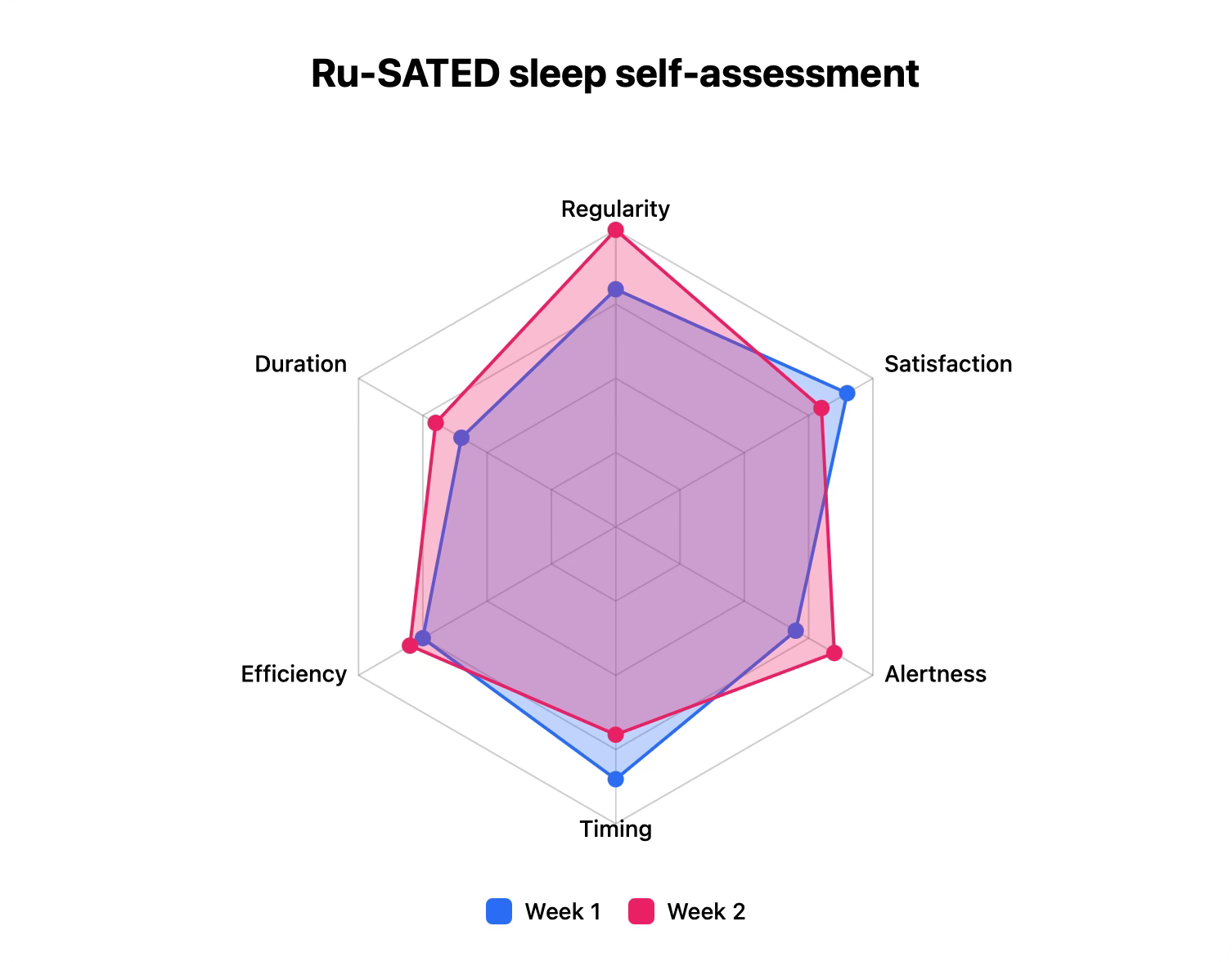
Each dimension matters. You can sleep 8 hours but still have poor sleep health if your schedule is inconsistent or you’re waking up repeatedly during the night.
The Next Level
Once you’ve nailed the four fundamentals - consistent schedule, morning light, cool bedroom, caffeine cutoff - you can add more strategies systematically.
The 12 Recommendations for Healthy Sleep
These evidence-based recommendations come from the National Heart, Lung, and Blood Institute (NIH), and are the same ones cited in Matthew Walker’s Why We Sleep:
Stick to a sleep schedule. Go to bed and wake up at the same time each day—even on weekends.
Exercise is great, but not too late in the day. Try to exercise at least 30 minutes on most days but not later than 2-3 hours before your bedtime.
Avoid caffeine and nicotine. The stimulating effects of caffeine in coffee, colas, certain teas, and chocolate can take as long as 8 hours to wear off fully. Nicotine is also a stimulant.
Avoid alcoholic drinks before bed. A nightcap might help you get to sleep, but alcohol keeps you in the lighter stages of sleep. You also tend to wake up in the middle of the night when the sedating effects have worn off.
Avoid large meals and beverages late at night. A large meal can cause indigestion that interferes with sleep. Drinking too many fluids at night can cause you to awaken frequently to urinate.
Avoid medicines that delay or disrupt your sleep, if possible. Some commonly prescribed heart, blood pressure, or asthma medications, as well as some over-the-counter and herbal remedies for coughs, colds, or allergies, can disrupt sleep patterns.
Don’t take naps after 3 p.m. Naps can boost your brain power, but late afternoon naps can make it harder to fall asleep at night. Also, keep naps to under an hour.
Relax before bed. Take time to unwind. A relaxing activity, such as reading or listening to music, should be part of your bedtime ritual.
Take a hot bath before bed. The drop in body temperature after the bath may help you feel sleepy, and the bath can help you relax.
Have a good sleeping environment. Get rid of anything in your bedroom that might distract you from sleep, such as noises, bright lights, an uncomfortable bed, or a TV or computer in the bedroom. Also, keeping the temperature in your bedroom on the cool side can help you sleep better.
Have the right sunlight exposure. Daylight is key to regulating daily sleep patterns. Try to get outside in natural sunlight for at least 30 minutes each day.
Don’t lie in bed awake. If you find yourself still awake after staying in bed for more than 20 minutes, get up and do some relaxing activity until you feel sleepy. The anxiety of not being able to sleep can make it harder to fall asleep.
Track Your Sleep
Tools like Oura, Whoop, or free apps like Sleep Cycle can give you data on sleep stages, efficiency, and trends over time. The goal isn’t perfection—it’s awareness. If you see your deep sleep tanking on nights you drink alcohol, you have actionable feedback.
The low-tech alternative
If you don’t feel like buying these gadgets, or using them, which I get. You can simply evaluate your sleep weekly after the introducing a change. I do this with my Google Sheet tracker. You can see how the interventions impact your sleep health and adjust accordingly!
Test strategies one at a time. Don’t change five things at once. Implement one change (e.g., no caffeine after 1 PM), stick with it for a week, then assess. Did it move the needle? If yes, keep it. If no, try something else.
What’s Next
Next week: Exercise: muscle as the longevity organ. Why strength training matters, how much is enough, and the workout protocol that fits real life.
Right now, everything on Swiss Army Mum is free while I build the content library. In a few months, I’ll launch a paid tier with trackers, templates, meal plans, and protocols—the full implementation toolkit. Subscribe (free) so you don’t miss it.
Your turn: What’s your biggest sleep challenge right now? Consistency? Waking up at night? Can’t fall asleep? Comment below - read every one.
Reiter RJ, Sharma R, Cucielo MS, Tan DX, Rosales-Corral S, Gancitano G, de Almeida Chuffa LG. Brain washing and neural health: role of age, sleep, and the cerebrospinal fluid melatonin rhythm. Cell Mol Life Sci. 80, 4 (2023). https://10.1007/s00018-023-04736-5.
Diekelmann, S., Born, J. The memory function of sleep. Nat Rev Neurosci 11, 114–126 (2010). https://doi.org/10.1038/nrn2762.
Jiao, Y., Butoyi, C., Zhang, Q. et al. Sleep disorders impact hormonal regulation: unravelling the relationship among sleep disorders, hormones and metabolic diseases. Diabetol Metab Syndr 17, 305 (2025). https://doi.org/10.1186/s13098-025-01871-w.
Van Cauter, E, and L Plat. “Physiology of growth hormone secretion during sleep.” The Journal of pediatrics 128, 5 (1996): S32-7. https://10.1016/s0022-3476(96)70008-2.
Tan, HL., Kheirandish-Gozal, L., Gozal, D. (2019). Sleep, Sleep Disorders, and Immune Function. In: Fishbein, A., Sheldon, S. (eds) Allergy and Sleep. Springer, Cham. https://doi.org/10.1007/978-3-030-14738-9_1.
Andrea N. Goldstein, Matthew P. Walker. The Role of Sleep in Emotional Brain Function. Annual Review Clinical Psychology 10 (2014.).https://doi.org/10.1146/annurev-clinpsy-032813-153716.
National Heart, Lung, and Blood Institute. . Your Guide to Healthy Sleep. NIH Publication No. 11-5800 (2011). https://www.nhlbi.nih.gov/sites/default/files/publications/11-5800.pdf
de Menezes-Júnior, Luiz Antônio Alves et al. “The role of sunlight in sleep regulation: analysis of morning, evening and late exposure.” BMC public health 25, 1 (2025) https://10.1186/s12889-025-24618-8.
The Ru-SATED scale is a self-assessment, and as such, is a useful screening tools. However, self-assessment tools rely on people’s memory and perceptions over long recall periods, they often diverge from objective sleep measures, are influenced by mood and personality, and may miss night-to-night variation or physiological details. They are nonetheless validated and are very useful to evaluate variations over time for the same individual.
I also didn’t realize that always having a set bedtime/wake up would improve my sleep overall! DEFINITELY going to work on that moving forward
the caffeine and adenosine was news to me, and makes so much sense!! thank you!!