


We started with the Body pillar, because without physical foundations, nothing else sticks. First up was Sleep - the non-negotiable foundation, followed by Fuel - the master lever for metabolic health.
This week: Exercise. Not for aesthetics. For metabolic health and functional independence.
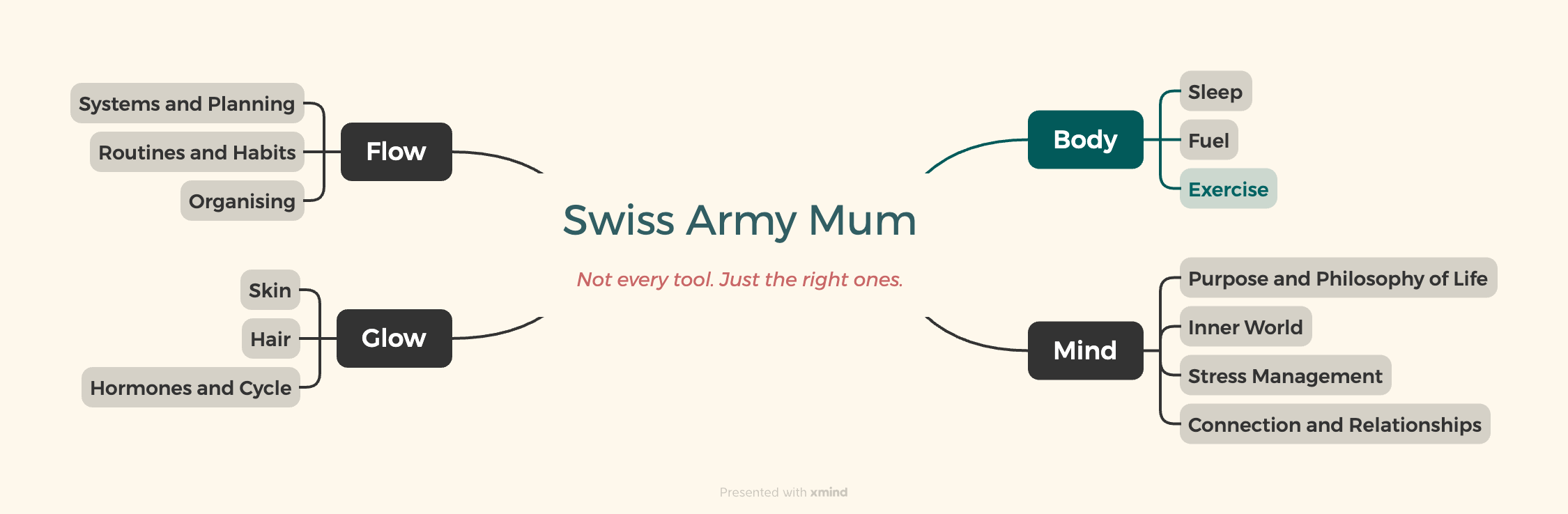
This post sits in the Exercise area of the Body Pillar. Exercise is the third leg of the Body triad: Sleep sets the conditions, Fuel sends the signals, and Exercise builds the structure. This is the blueprint for the whole Exercise area, making the case for why muscle is a metabolic organ long before it is an aesthetic one, and why that matters specifically for women over 35. The detailed posts on Strength training, Cardio, and Balance and Mobility follow from here.
I Used to Think Exercise Was About Losing Weight
I used to think exercise was about losing weight. Burn calories. Get smaller. Look better.
Then I read the research.
Exercise isn’t about aesthetics. It’s medicine. The single best intervention for metabolic health, disease prevention, and functional independence.
And here’s the part that surprised me: you need less than you think.
Large prospective studies show that ~75 min/week of moderate-intensity activity is already associated with meaningfully lower risk of premature death (compared to being inactive). ~150 min/week achieves near-maximal risk reduction for all-cause mortality, and further gains from ~300 min/week are smaller. That’s 1.5% of your week for most of the benefit1.
Fat loss might happen as a side effect if you sleep well, eat for glucose stability, and move consistently. But that’s not the main goal. The goal is staying functional at 75. Getting off the floor without using your hands at 80. Carrying groceries, hiking, playing with grandkids.
This post breaks down the types of exercise that matter, how much you actually need, and the 80/20 that gives you the most bang for your buck.
New here? Start here:

Swiss Army Mum is a practical guide to long-term health for busy women, built on four pillars: Body, Mind, Glow, and Flow.
Not every tool. Just the right ones.
Why It Matters
"If exercise could be packed into a pill, it would be the single most widely prescribed, and beneficial, medicine in the nation."
— Robert Butler, MD
Exercise is Metabolic Medicine
Most women associate exercise with weight loss. The fitness industry has drilled this into us: burn calories, shrink your body, fit into smaller clothes.
But exercise doesn’t work that way. You can’t outrun a bad diet. A 30-minute run burns ~300 calories. One muffin and a latte = 500 calories. The math doesn’t add up, and chasing weight loss through exercise alone is exhausting and demoralizing.
Here’s what exercise actually does:
Regulates glucose: Muscle acts as a glucose sink. When you move, your muscles pull glucose out of your bloodstream without needing insulin. Strength training improves insulin sensitivity, meaning your body needs less insulin to manage blood sugar. This matters for metabolic health, energy stability, and disease prevention.
Protects against chronic disease: Regular exercise reduces your risk of type 2 diabetes, cardiovascular disease, dementia, and certain cancers. Not because you’re thinner. Because your mitochondria work better, your inflammation is lower, and your metabolic pathways are healthier.
Supports bone density: Weight-bearing exercise signals your bones to stay strong. After menopause, when estrogen drops, bone density declines rapidly. Strength training and plyometrics counter this. The LIFTMOR trial2 in postmenopausal women with osteopenia/osteoporosis showed that twice-weekly heavy resistance training plus impact loading improved bone mineral density in controls over 8 months. Functional measures also improved significantly: timed-up-and-go and leg strength.
Maintains muscle mass: After 30, you lose 3-8% of muscle mass per decade (sarcopenia3). By 80, you’ve lost 30-50% unless you lift. Muscle isn’t vanity: it’s your metabolic engine, your glucose regulator, and your structural support.
Exercise is Functional Independence
Forget the scale. Here’s what matters:
Can you get off the floor without using your hands?
Can you carry a suitcase up stairs?
Can you play with your grandkids without getting winded?
Can you hike, garden, travel, and live on your own terms at 75? 80? 85?
Sedentary aging means losing independence. You can’t climb stairs. You can’t lift a bag of groceries. You need help getting dressed. Falls become life-threatening.
A Cochrane systematic review4 found that exercise reduces fall rate by ~23% overall in older adults, with the strongest evidence for balance/functional training and multicomponent programs.
Exercise is insurance against that future.
The Longevity Connection
People in the top 20% for VO₂ max live significantly longer than those in the bottom 20%.
Body Recomposition: The Side Effect, Not the Goal
If you sleep well, eat for glucose stability, and move consistently (strength training + cardio + daily steps) body recomposition will happen. You’ll build muscle, lose fat, and change your body composition.
But it happens as a side effect of metabolic health, not as the primary goal.
Focus on the metrics that matter: strength gains, improved endurance, stable energy, better sleep, functional fitness. The aesthetics follow.
Key Science-Based Takeaways
Daily Steps: The Foundation
10,000 steps/day is not required for most health benefits.
The evidence: A study of 16,741 older women5 (mean age 72) found that mortality risk decreased progressively with higher step counts until ~7,500 steps/day, where the curve leveled. Importantly, ~4,400 steps/day was already associated with substantially lower mortality compared to ~2,700 steps/day.
A newer systematic review/meta-analysis6 (57 studies, device-measured steps) found that 7,000 vs 2,000 steps/day was associated with markedly lower risk for all-cause mortality, cardiovascular mortality, type 2 diabetes, dementia, falls.
The inflection point across multiple outcomes was around ~ 7,000-8,000 steps/day.
Practical thresholds:
Moving from ~2,000-3,000 steps/day toward ~4,000-5,000 steps/day = meaningful risk reductions
~7,000-8,000 steps/day is where many curves flatten
10,000 steps/day is beneficial if you enjoy it, but not required for most mortality/morbidity benefit
Some days, you just won’t be able to hit your target steps, and it’s OK. Don’t beat yourself about it. Rather than aiming at 7,500 steps a day and losing motivation when you can’t hit them, aim for a weekly average of, say 50,000 steps.
Strength Training: Build Muscle or Lose It
Muscle mass starts declining after 30. This isn’t just about looking strong - it’s about metabolic function and independence.
Why it matters:
Muscle regulates glucose. More muscle = better insulin sensitivity.
Muscle protects bones. Strength training increases bone density, especially critical after menopause. The LIFTMOR trial showed that progressive heavy loading with impact can actually reverse bone loss in postmenopausal women.
Muscle supports joints. Strong muscles take load off vulnerable joints (knees, hips, shoulders).
Muscle maintains metabolic rate. More muscle tissue means your body burns more energy at rest.
How to do it:
Compound lifts: Squat, deadlift, chest press, overhead press, rows. These work multiple large muscle groups at once.
Lift heavy: 6 reps or less per set, with as much weight as you can handle safely. Heavy resistance signals your body to keep (or build) muscle and bone.
Frequency: 2-3x/week. Full recovery between sessions (48-72 hours).
Progressive overload: Gradually increase weight, reps, or sets over time. Your body adapts only when challenged.
Critical: Proper bracing is non-negotiable. Lifting without core stability = injury risk.
Moderate Cardio: Aerobic Efficiency
In this kind of activity you’re working, but you can still hold a conversation. Think brisk walking, easy cycling, swimming at a steady pace.
Why it matters:
Builds mitochondrial density. More mitochondria = better energy production, fat oxidation, and endurance.
Improves cardiovascular health. Moderate cardio strengthens your heart without overloading your system.
Supports metabolic flexibility. Your body gets better at using fat for fuel, which stabilizes energy and reduces glucose spikes.
How much you need: 150 minutes/week is the sweet spot.
Heart rate target: ~60-70% of your max heart rate (220 - your age).
Example: 40 years old → (220 - 40) x 0.6 / (220 - 40) × 0.7 = 108 - 126 bpm.
Good news: this will already build towards your step count!
HIIT: Peak Aerobic Capacity + Hormonal Advantages for Women
High-Intensity Interval Training (HIIT) or Sprint Interval Training (SIT) = short bursts of maximum effort followed by rest.
Why it matters, especially for women in perimenopause and menopause:
A women-only systematic review and meta-analysis7 found that HIIT and moderate-to-vigorous continuous training produce similar VO₂max improvements in women. So HIIT’s main advantage isn’t superior cardio gains - it’s time-efficiency and hormonal benefits.
For perimenopausal and postmenopausal women, HIIT provides metabolic stimulus that declining hormones no longer provide. This is why HIIT is particularly valuable for women navigating hormonal changes: it “picks up the slack” for declining estrogen and progesterone.
How to do it:
2x/week, 10-15 minutes each
Example: Tabata protocol - 20 seconds all-out effort, 10 seconds rest, 8 rounds (4 minutes total). Repeat 2-3 times with 1-2 min rest between rounds.
Exercises: Sprints, cycling, rowing, jump squats, burpees
Go as hard as you can go during work intervals
Critical: HIIT is strong medicine. 2x/week max. Overdoing it = cortisol spike, burnout, injury. If you’re exhausted and sore all the time, you’re doing too much.
Plyometrics: Bone Remodeling
Plyometrics = jumping exercises. Squat jumps, box jumps, jumping jacks, skipping.
Why it matters:
Jumping creates impact forces that signal bones to remodel and strengthen. This is especially important for preventing osteoporosis.
Improves power, reaction time, and balance.
Boosts mitochondrial function and insulin sensitivity.
The key is that impact creates multidirectional stress on bones, which is more effective than steady-state running.
How much you need:
10 minutes, 3x/week
Examples: Squat jumps, side hops, skipping, tuck jumps, mountain climbers, box jumps
Note: If you have joint issues or low bone density, start with low-impact options (mini trampoline/rebounder) or get medical clearance first. The LIFTMOR researchers specifically caution against unsupervised replication of high-impact programs in women with osteoporosis - supervision and proper progression matter.
Stability & Mobility: Stay Functional, Prevent Falls
Stability = core strength, balance, joint integrity.
Mobility = range of motion, flexibility, fascia health.
Why it matters:
Falls are a leading cause of injury and loss of independence in older adults. The Cochrane review found that balance/functional training and multicomponent programs show the strongest effect for falls prevention.
Mobility keeps you functional - bending, reaching, twisting, getting up from the floor.
Fascia care (foam rolling, stretching) reduces stiffness, improves recovery, and prevents injury.
Core strength protects joints and helps prevent urinary incontinence (common after menopause).
What to do:
Core work: Planks, dead bugs, bird dogs, pelvic floor exercises, diaphragmatic breathing
Balance drills: Single-leg stands, balance board, yoga, Tai Chi
Fascia rolling: Foam roller or lacrosse balls on hips, lower back, feet - 5-10 min, 2-3x/week
Mobility flows: Yoga, stretching, hip openers, shoulder mobility drills, “toe yoga”
Time commitment: 10-15 minutes, 2-3x/week
How Little Exercise You Actually Need
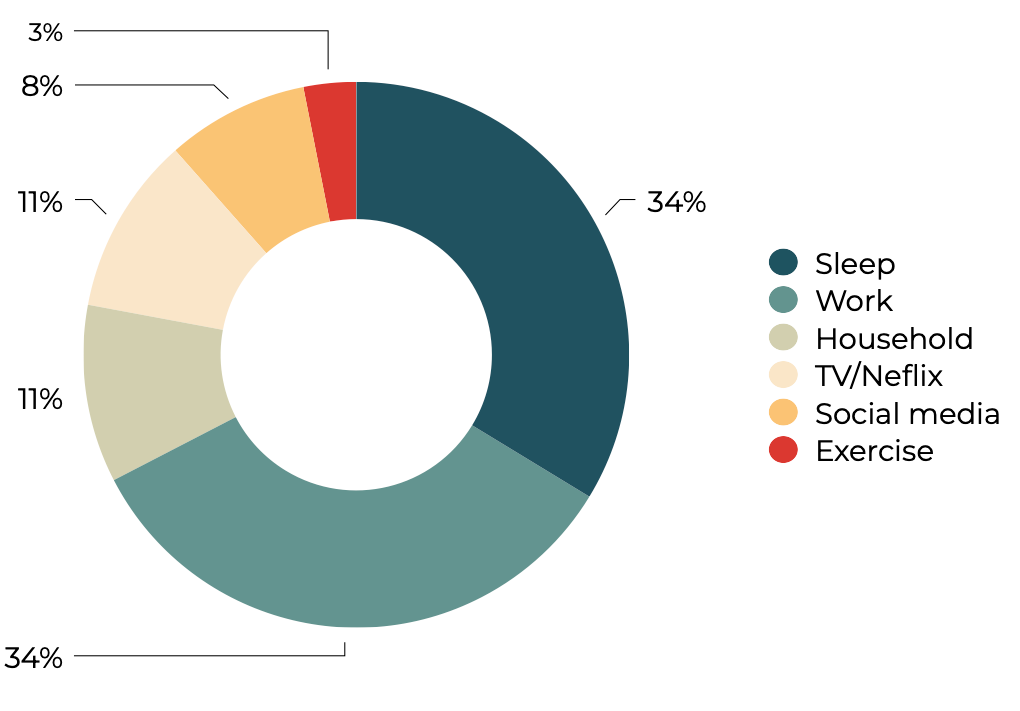
You really don’t need that much exercise to reap the most benefits. Let me put this in perspective. The average woman spends8:
2.5 hours a day watching TV/Netflix
2 hours a day on social media
8 hours a day sleeping (if you’re lucky!)
2.5 hours a day doing household activities
8 hours a day working (if you work)
Even the complete routine with strength 3x/week, Zone 2 cardio, HIIT, plyometrics, and mobility - is about 5 hours per week of structured exercise.
That’s 3% of your week!
I’m not saying delete Instagram or never watch Netflix. I’m saying: you have time. We all have time. It’s just buried under habits we don’t even enjoy that much.
Maybe you’re a visual person, well here’s a graph that shows you how little exercise you need per week (it’s the little red sliver):
I promise, even a busy mum like us can find 3% of their time to invest in their long-time health.
The 80/20: Start Here
This is the bare minimum that gives you most of the benefit. Start here. Build slowly. Consistency beats intensity.
1. Move More: 7,000-10,000 Steps/Day
Start with 7,000-8,000 steps/day (or 50,000 a week) if you’re currently sedentary. Build toward 10,000 steps/day if you can sustain it.
Daily movement improves insulin sensitivity, cardiovascular health, and mental clarity. Break up sitting every hour - stand up and move intentionally for at least 2 minutes.
Why this works: The dose-response data is clear—moving from very low steps (~2,000-3,000/day) to moderate steps (~7,000/day) captures most of the mortality benefit. Every additional 1,000 steps matters, especially from a low baseline.
2. Strength Train 2-3x/Week (30 Minutes Each)
Focus on compound lifts: squat, deadlift, chest press, overhead press, rows. Lift heavy (6 reps or less). Full recovery between sessions (48-72 hours).
Prioritize lower-body patterns (squat/hinge/lunge), pushing, pulling, and loaded carries.
Why this works: research in older women consistently show that 2x/week produces substantial strength and functional improvements. This is the minimum frequency that reliably improves strength when done progressively. Adding a third session can help, but 2x/week is the evidence-based minimum.
Don’t Try to Do Everything at Once
Add one thing at a time:
Weeks 1-4: Add 7,000-8,000 steps/day
Weeks 5-8: Add 2x strength training
Weeks 9-12: Reassess and add more if desired (see “Next Level”)
Consistency beats intensity. Small steps compound over decades.
Common Mistakes
Mistake 1: Exercising for Weight Loss
Exercise for metabolic health, functional fitness, and longevity. Weight loss might happen as a side effect, but it’s not the goal. If you’re chasing weight loss through exercise alone, you’ll burn out.
The research is clear: exercise improves metabolic markers, cardiovascular fitness, and functional capacity independent of weight change. Focus on what your body can do, not what it looks like.
Mistake 2: Cardio-Only Approach
Running won’t save you from sarcopenia. You need to lift. Cardio + strength = long-term health.
After 30, you lose muscle every year unless you actively resist it with progressive strength training. Aerobic exercise is important, but it won’t maintain muscle mass or bone density.
Mistake 3: Skipping Mobility Work
“I don’t have time” is the excuse. Falls and injuries cost more time.
Fascia care and mobility are non-negotiable after 40. Your joints need range of motion, your fascia needs movement, and your balance needs practice. 10 minutes twice a week is enough to maintain capacity.
Mistake 4: Overdoing HIIT
HIIT is strong medicine. 2x/week max for most women. More = cortisol spike, burnout, injury, and diminishing returns.
If you’re exhausted, constantly sore, or your sleep is suffering, you’re doing too much high-intensity work. Scale back.
Mistake 5: Not Bracing Properly
Lifting without core bracing = injury risk, especially as connective tissue changes with hormonal fluctuations.
We’ll cover the 6-step bracing protocol in next week’s Strength Training deep dive. This is foundational for safe, effective lifting.
Mistake 6: Thinking You Need a Gym
You don’t. Bodyweight exercises, dumbbells, resistance bands, and a rebounder cover everything you need.
The Next Level
For those who’ve nailed the 80/20 (steps + strength 2x/week) and want more.
Once you’ve built the foundation - consistent daily steps and 2x/week strength training for at least 8-12 weeks - you can tackle the comprehensive routine:
Moderate Cardio: 150 min/week
5x 30-minute brisk walks or 3x 50-minute sessions
Heart rate at ~60-70 % max (conversational pace, 220 - your age)
HIIT: 2x/week, 10-15 min each
Tabata protocol (20 sec on / 10 sec off, 8 rounds)
For hormonal benefits in perimenopause/menopause
Time-efficient VO₂ max booster
Plyometrics: 2x/week, 10 min each
Squat jumps, side hops, skipping, box jumps
Bone remodeling stimulus
Can be done on a rebounder for joint-friendly option
Stability/Mobility: 2x/week, 10-15 min
Foam rolling, yoga, balance drills
Falls prevention, injury prevention
Resources Coming in This Series
Strength Training: the 6-step bracing protocol, how to lift heavy safely, the hard truth about muscle loss
Cardio: Zone 2 + HIIT explained, how to calculate your zones
Plyometrics, Balance & Mobility: falls prevention, fascia care, functional movement
Book Club: Next Level by Stacy Sims (THE exercise book for women)
BTS: My rebounder setup (HIIT + plyometrics + balance in 10 minutes)
Resources: My second-hand home gym + free YouTube channels I use
Subscribe (free) so you don’t miss it.
Your Turn
Which of the two 80/20 strategies are you starting with - daily steps or strength training?
Have you been doing cardio-only and skipping strength? What’s holding you back from lifting?
Drop a comment. I read every one.
Thank you!
If you made it this far, congratulations! You now have an understanding of why metabolic health is important and how to tweak your eating habits to get there.
Thank you for reading, sharing, and supporting this work. Whether you’ve been here since the beginning or just found Swiss Army Mum, I’m glad you’re here.
Building sustainable health without overwhelm takes a village. If something resonated with you, I’d be grateful if you forwarded this to someone who might benefit or hit the ♥️ or ↻ Restack button. It helps more people discover this space and build sustainable health without the overwhelm.
Garcia, Leandro et al. “Non-occupational physical activity and risk of cardiovascular disease, cancer and mortality outcomes: a dose-response meta-analysis of large prospective studies.” British journal of sports medicine vol. 57,15 (2023): 979-989. https://doi.org/10.1136/bjsports-2022-105669.
Watson, Steven L et al. “High-Intensity Resistance and Impact Training Improves Bone Mineral Density and Physical Function in Postmenopausal Women With Osteopenia and Osteoporosis: The LIFTMOR Randomized Controlled Trial.” Journal of bone and mineral research : the official journal of the American Society for Bone and Mineral Researchvol. 33,2 (2018): 211-220. https://doi.org/10.1002/jbmr.3284.
Cruz-Jentoft, Alfonso J et al. “Sarcopenia: revised European consensus on definition and diagnosis.” Age and ageing vol. 48,1 (2019): 16-31. https://doi.org/10.1093/ageing/afy169
Sherrington C, Fairhall NJ, Wallbank GK, Tiedemann A, Michaleff ZA, Howard K, Clemson L, Hopewell S, Lamb SE. Exercise for preventing falls in older people living in the community. Cochrane Database of Systematic Reviews 2019, Issue 1. Art. No.: CD012424. https://doi.org/10.1002/14651858.CD012424.pub2.
Lee, I-Min et al. “Association of Step Volume and Intensity With All-Cause Mortality in Older Women.” JAMA internal medicine vol. 179,8 (2019): 1105-1112. https://doi.org/10.1001/jamainternmed.2019.0899.
Ding, Ding et al. “Daily steps and health outcomes in adults: a systematic review and dose-response meta-analysis.” The Lancet. Public health vol. 10,8 (2025): e668-e681. https://doi.org/10.1016/S2468-2667(25)00164-1.
Lindner, Robert et al. “Moderate to Vigorous-intensity Continuous Training versus Highintensity Interval Training for Improving VO2max in Women: A Systematic Review and Meta-analysis.” International journal of sports medicine vol. 44,7 (2023): 484-495. https://doi.org/10.1055/a-2044-8952.