


We opened the Mind Pillar last week. Today we go deep into the first area: Purpose and Philosophy of Life. It is the one I have been building toward since the beginning, and the one that, for me, changed everything else.
The Body Pillar addresses the physiological foundation (sleep, fuel, movement). The Mind Pillar addresses what sits above it. And it turns out the two are less separate than we tend to assume. Ryff's research links purpose in life directly to lower cortisol, better immune function, and faster recovery from adversity. A philosophy of life is not a luxury for the well-resourced. It is a measurable protective factor for long-term health.
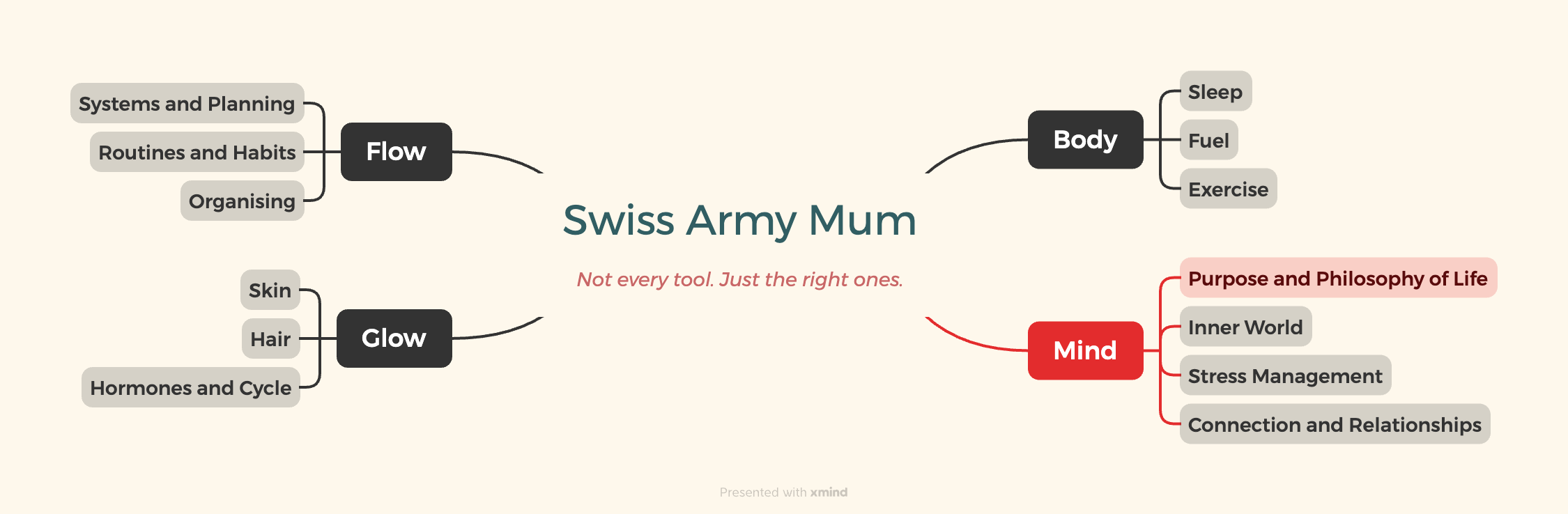
This post sits in the Purpose and Philosophy of Life area of the Mind Pillar. If the Mind Pillar is the floor of the building you actually live in, Purpose and Philosophy is the room where you decide what the building is for: what you value, how you want to move through the world, and the framework that lets you filter competing demands without just reacting to whichever is loudest. The Inner World area builds directly from here, because knowing yourself well enough to actually live by a philosophy you have chosen is itself a skill that has to be developed.
The Body Pillar Wasn’t Enough
I spent months building out the Body Pillar, sleep, fuel, exercise, metabolic health. I tracked my glucose. I restructured my training. I fixed my sleep. I did all of it, and I felt physically better than I had in years.
And I still felt off.
Still snapping at the people I loved. Still getting to the end of a packed day and not being able to name a single thing that felt genuinely mine. Still making decisions on autopilot, defaulting to whatever was most urgent rather than whatever actually mattered, and then wondering, at 10pm when the house was finally quiet, why I felt vaguely hollow despite having been busy every minute.
The Body Pillar gave me energy. It didn’t give me a why.
Here is what I didn’t fully appreciate until I started researching the Mind Pillar: this gap, between functioning well physically and feeling well in a deeper sense, is not unique to any particular life stage. It shows up at 36, exhausted after a second maternity leave and not sure who she is outside of work and children. It shows up at 42, watching the career she built no longer feeling like it fits. It shows up at 47, when the hormonal transition adds its own particular chaos to a life that was already at capacity.
The physical changes of perimenopause do sharpen this gap, estrogen was doing a remarkable amount of cognitive and emotional administrative work behind the scenes, modulating serotonin, supporting memory, regulating the stress response, and when it starts to decline it takes some of that scaffolding with it. But the deeper thing, the feeling of reacting rather than choosing, of running without a map, that is not a hormonal symptom. It is a human one. And the Body Pillar, however solid, cannot fix it.
That is what a philosophy of life addresses.
New here? Start here:

Swiss Army Mum is a practical guide to long-term health for busy women, built on four pillars: Body, Mind, Glow, and Flow.
Not every tool. Just the right ones.
What a Philosophy of Life Actually Is
Most of us live by default. We absorb values from our culture, from our parents, from whoever shouts loudest on social media, without ever consciously deciding whether those values are actually ours. We optimise for a life we never deliberately designed, and wonder why it doesn’t fit quite right.
We usually don’t worry about one specific thing. We worry about everything, because when you don’t have a clear internal compass telling you what actually matters, every demand has equal urgency. The work inbox and the permission slip and the conversation with your mother and the thing you said to your partner three weeks ago and whether you are raising your children well enough all compete at the same volume. There is no framework for filtering. You have no working system for deciding what actually matters.
A philosophy of life is that framework. Not an abstract set of beliefs for academics to argue about. A working system for what is worth wanting, what is worth pursuing, and how to behave when things go wrong.
The philosopher William Irvine defines it as a coherent set of values that functions as both a map and a compass1. The map tells you where you are going. The compass keeps you oriented when the weather closes in and the path disappears.
Without one, you are not directionless by accident. You are directionless by design. Our culture has a vested interest in keeping you uncertain about what you actually want. Dissatisfied people consume more. People who don’t know their values can be convinced to want almost anything, including a new supplement stack, a different exercise programme, a course that promises to fix the thing that doesn’t actually need fixing.
A philosophy of life is, among other things, an act of resistance.
The ancient Greeks had a word for what we are actually after: eudaimonia. Usually translated as happiness, but the translation misleads. A closer rendering is flourishing: the condition of a life lived well, in accordance with what you actually are and what you are actually capable of. Not a feeling that arrives and departs. A way of living.
The research consistently identifies purpose in life as one of the strongest predictors of psychological well-being, and specifically links it to better outcomes on the exact metrics that matter most to women in midlife: lower cortisol, better immune function, faster recovery from adversity2.
The question is which framework to choose.
Why Stoicism
There are many philosophies of life worth considering. The question is which ones hold up under real conditions, including the conditions most of us are actually living in.
A woman managing a full-time job, a family, ageing parents, and a body that is renegotiating its terms with her does not need a philosophy that works in quiet. She needs one that works in the school run, in the meeting she is dreading, in the moment she realises she has snapped again and doesn’t know why.
Stoicism fits that description better than almost anything I have found. It has been tested not in university seminars but across 2,000 years of actual human difficulty: grief, loss, political chaos, the impossible behaviour of other people, the fear of death, the feeling that time is running out faster than expected. Its practitioners were not people writing from positions of ease.
Three of them have shaped my thinking above all others. Not because they are the most academically important Stoics, but because together they demonstrate something essential: this philosophy works across every condition of human life.
Epictetus was born a slave. He had no property, no freedom, no political power, and every external reason to despair. He developed one of the sharpest practical philosophies in history anyway3. What moves me about Epictetus is not the philosophy itself. It is that he arrived at it from a starting point of absolute deprivation, and that his insights are no less sharp for it. The fact that his philosophy survived at all is a kind of proof of concept.
Marcus Aurelius was a Roman emperor who kept a private journal of his attempts to apply Stoic principles to the impossible demands of governing an empire while managing his health, watching his children die, and sitting with his own mortality. He never intended it to be published. We call it the Meditations, and it reads, two thousand years later, like someone talking to themselves in the early hours of the morning, trying to remember what they actually believe4. Every time I read it I think: this is a person who is tired and overwhelmed and still choosing, deliberately, to try to be better than circumstances require (all of this while being arguably the most powerful person in the world at the time. He could’ve done what he wanted).
Seneca was a statesman who operated at the centre of Roman imperial power. He was brilliant, politically compromised, and entirely clear-eyed about the gap between how he lived and how he believed one ought to live. His Letters to Lucilius are among the most honest documents in the history of moral philosophy: a thinker genuinely trying to do better, in public, without pretending to have already arrived5. He wrote about anger, about grief, about the way we squander time as though we have unlimited supplies of it. Two thousand years on, he sounds like someone you might know.
A slave. An emperor. A statesman who questioned himself constantly. The same philosophy, applied to radically different lives.
This Is Not About Cold Stoicism
I want to address the thing that puts people off.
The word stoic, in modern use, has drifted so far from its origins that it now means something like emotionally unavailable. The stiff upper lip. The person who doesn’t cry at funerals. That is not what this philosophy is.
What Stoicism actually teaches is not the suppression of emotion. It is a different relationship with emotion, specifically, with the emotions that arise from false beliefs about what is truly good and bad. Fear of things that are not actually threatening. Rage at things that were always outside our control. Craving for things whose acquisition would not make us whole.
In practice, this shows up constantly in the life of a busy woman with children. The rage at the school run when you are already running late and someone has forgotten their bag, again. The anxiety about the email from your manager that probably means nothing but that you have re-read six times. The resentment that builds when you are doing the invisible work that no one notices and you cannot even fully articulate without feeling like you are complaining. None of these feelings are irrational. But most of them are being driven by an interpretation of events that deserves examination before you act on it.
Having a sorting tool, a framework for distinguishing what is genuinely worth your emotional energy from what is not, is not a luxury.
Compatible With What You Already Believe
One practical note before we go further. Stoicism does not require any particular set of metaphysical beliefs. You do not need to believe in God, or reject the idea of God, to use it.
The Stoic concept of the Logos, the rational order underlying the universe, maps naturally onto providence for a believer, and onto the rational laws of cause and effect for an atheist or agnostic. The philosopher Massimo Pigliucci makes this point clearly6. The Stoics themselves held a range of views on the theological question and considered it, ultimately, less important than the practical one: how to live.
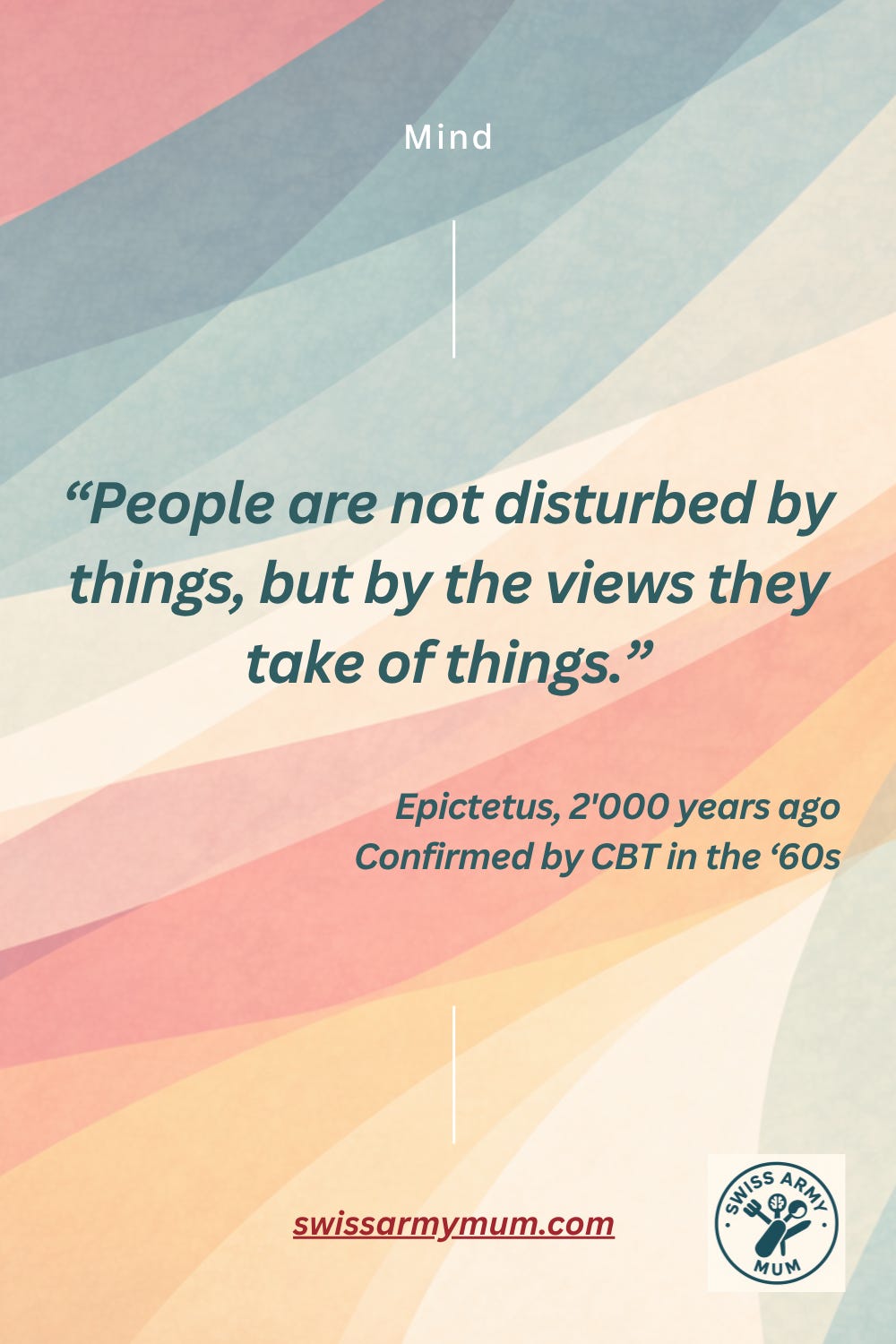
Modern psychology arrived at the same place by a different route. In the 1950s and 60s, Aaron Beck developed Cognitive Behavioural Therapy, now one of the most evidence-backed psychological treatments in existence7. Its central insight: it is not events that cause our distress, but the interpretations we place on them. Epictetus said exactly this two thousand years earlier: “People are not disturbed by things, but by the views which they take of things.” CBT was built, in part, on Stoic foundations. When you use CBT techniques, you are using ancient philosophy that has been clinically validated.
Why This Matters Specifically After 35
The 35-to-55 window is, for most women, a period of compounding demands and shifting identity. The small children who absorbed everything now have opinions and schedules of their own. The career is either pulling hard or asking you to question whether it’s what you actually wanted. The relationships that felt solid are being tested by years of putting everything else first. And often, somewhere in the background of all of it, a quieter question is starting to form: is this the life I actually chose, or just the one that accumulated?
That question is not a crisis. It is an invitation. But without a framework to meet it, it tends to become background noise: present enough to drain you, not specific enough to act on.
Women in midlife also often find themselves in what the researchers call the sandwich generation, children still needing them, parents beginning to need them too, with their own needs somewhere near the bottom of the list. Having a clear sense of your own values does not make that structural pressure disappear. But it does mean you make better decisions inside it, instead of just reacting to whoever needs you loudest right now.
The goal is not peak performance. It is feeling like yourself again. A philosophy of life is, at its best, the most direct route there.
Thank You
Thank you for reading, sharing, and supporting this work. Whether you’ve been here since the beginning or just found Swiss Army Mum, I’m glad you’re here.
Building a life with more intention takes a village. If something resonated, I’d be grateful if you forwarded this to someone who might need it, or hit the ♥️ or ↻ Restack button. It helps more people find this space.
Medical note: This is educational, not personal medical advice. Your biology, history, and context matter. Work with a qualified healthcare professional.
References
Irvine, William B, A Guide to the Good Life: The Ancient Art of Stoic Joy (New York, NY, 2008), https://doi.org/10.1093/oso/9780195374612.001.0001
Ryff, C. D. (1989). Happiness is everything, or is it? Explorations on the meaning of psychological well-being. Journal of Personality and Social Psychology, 57(6), 1069–1081. https://doi.org/10.1037/0022-3514.57.6.1069
Epictetus. Enchiridion, c. 125 CE, trans. Public domain translations. https://www.gutenberg.org/ebooks/45109
Marcus Aurelius. Meditations, c. 161-180 CE. Public domain translations. https://www.gutenberg.org/ebooks/2680
Seneca. Letters to Lucilius, c. 65 CE. Public domain translations.
Pigliucci, M. (2017). How to Be a Stoic: Using Ancient Philosophy to Live a Modern Life. Basic Books. https://www.goodreads.com/book/show/31423245-how-to-be-a-stoic
Beck, A. T. (1976). Cognitive therapy and the emotional disorders. International Universities Press. https://psycnet.apa.org/record/1976-28303-000