


Last week we established why a philosophy of life matters and why Stoicism earns its place in that conversation. Today: what Stoics actually believed, and the instrument that makes the whole system navigable in real time, in the specific moments that will not wait for you to recall a chapter of philosophy class before you respond.
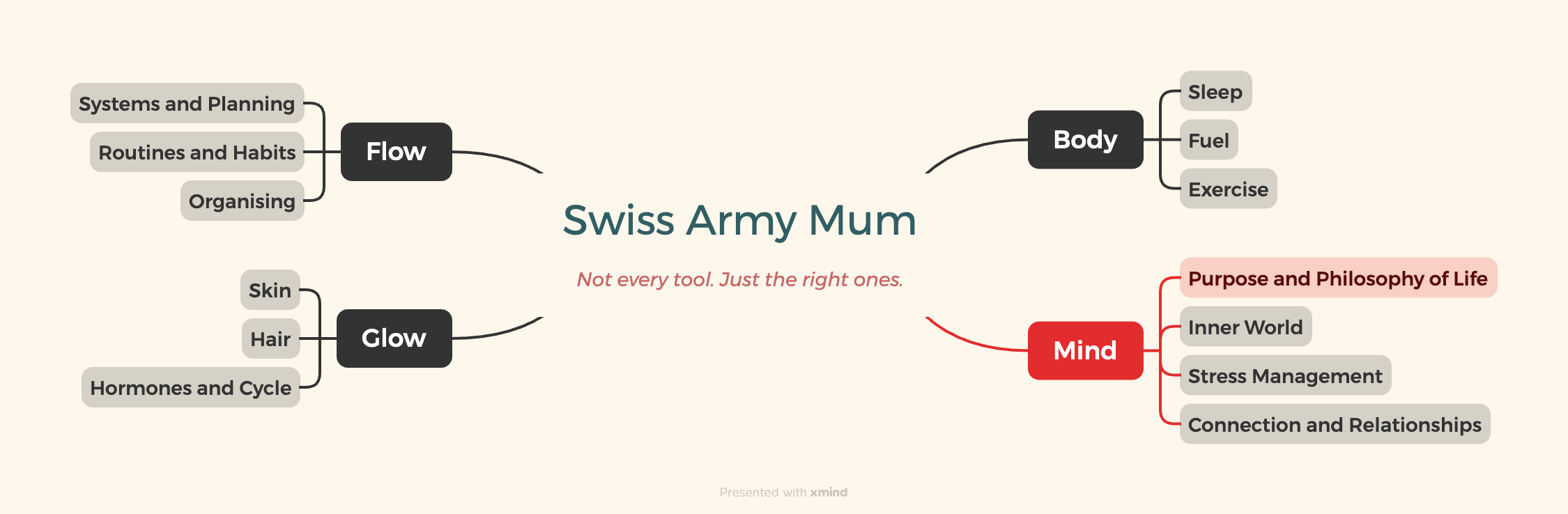
This post sits in the Purpose and Philosophy of Life area of the Mind Pillar. The previous post established why a philosophy of life matters and why Stoicism earns its place in that conversation; this one gives you the architecture of the system: the four virtues, the dichotomy of control, and the eight-point Stoic Compass that makes the whole framework navigable in real time. The Inner World area, which comes next in the series, is where you develop the self-awareness needed to actually use it.
The First Line That Stopped Me
The first line of Epictetus’s Enchiridion is ten words1.
”Some things are within our power, while others are not.”
No preamble, no scene-setting. Just the observation that changed the architecture of how I think about almost everything. I have been reading around those ten words for years and I am still not done.
Let me tell you why they matter so specifically right now, for the women this platform is built for.
The mental load that lands disproportionately on women, the noticing, the remembering, the coordination, the emotional labour of keeping a household and a family and a career moving simultaneously, is not evenly distributed across what is within your control and what is not.
Most of us are expending enormous energy on things we cannot change: other people’s moods, outcomes we cannot guarantee, standards we have absorbed without choosing. We are running hot on the wrong fuel.
And for women in perimenopause or postmenopause, this is compounded by a physiological reality. As we covered in the Body Pillar series, estrogen’s decline removes a key modulator of the stress response. The result is that things that would not have rattled you at 32 can feel genuinely destabilising at 44. The emotional volume dial is stuck slightly too high. The gap between trigger and reaction has shortened.
Whether you are 37 with two children under five, or 46 navigating perimenopause and an ageing parent at the same time, the first tool is the same: learn to sort what is yours from what is not. Everything else in the Stoic system builds from that.
The Destination: Eudaimonia Is Virtue
The Stoics had a precise answer to what a good life consists of. Eudaimonia, the flourishing life, is not a feeling you chase. It is a condition: the quality of the walking itself, not a reward at the end of the road. And the Stoics were unambiguous about what it consists of: virtue. Not virtue as a means toward happiness. Living virtuously and living well are, in the Stoic account, the same thing described from two different angles2.
This might sound abstract, but it has a very practical implication. It means that the quality of your life is not primarily determined by your circumstances, your job, your relationship, your hormone levels, your age.
It is primarily determined by how you show up inside whatever circumstances you have. That is a genuinely radical claim, and it is also a deeply reassuring one, because it relocates agency somewhere no one can take it from you.
The Four Virtues
The Stoics identified four virtues, inherited from Socrates and developed into a unified system. They are not four separate admirable qualities. They are four aspects of a single integrated character, the Stoics believed you could not truly have one without the others.
Wisdom is the capacity to see clearly: to understand a situation as it actually is, rather than as fear, desire, or exhaustion would have you believe. It is the foundational virtue. Courage without wisdom becomes recklessness. Justice without wisdom becomes rigidity. In daily life it is the pause before the reply. The moment of asking, when your child says something that lands wrong: is this about them, or am I already at the end of my rope? For any woman whose cognitive load is already at capacity, wisdom is the single most valuable thing you can add, because it prevents the worst version of reactions that you will spend tomorrow regretting.
Courage is not the absence of fear. It is the willingness to act rightly when acting rightly costs you something. Most of the time this is not physical courage. It is the courage to say the true thing when the easier thing is available. To say I can’t take that on right now when every instinct is telling you to say yes. To ask for help when you have been performing fine for so long that asking feels like failure. To let your child fail at something when stepping in would be so much easier. Women who have spent years accommodating, absorbing, making things work, often find this the most difficult virtue and the most necessary one.
Justice is your conduct toward others in the daily sense. Treating every person you encounter with fairness and dignity, regardless of their status or your mood or what you stand to gain. Epictetus was direct: we are all citizens of a single human community, and our obligations do not stop at the edges of what is convenient. This includes the child who pushed every button before school. It includes the colleague who takes up more space than they should. It includes yourself, which is where most of us fail the test most consistently.
Temperance is the art of enough. The capacity to act from reason rather than from impulse. What keeps you from being governed by your appetites, for food, for comfort, for the scroll when you should be sleeping, for the yes that buys you goodwill you do not have the energy to back up. Marcus Aurelius wrote about this in relation to the smallest temptations: staying in bed longer than he needed to, seeking approval he knew should not matter3. The battles in his journals were ordinary. That was the point. Temperance is not called for in the great renunciations. It is called for in the moment you open Instagram instead of going to bed, or say yes to something you will dread in a fortnight.
These four are not a checklist. They are a living orientation, practiced imperfectly and daily, and the practicing is the point.
New here? Start here:

Swiss Army Mum is a practical guide to long-term health for busy women, built on four pillars: Body, Mind, Glow, and Flow.
Not every tool. Just the right ones.
The Sharpest Tool: The Dichotomy of Control
From everything the Stoics built, one insight sits above all others in everyday usefulness. Epictetus placed it at the very beginning of the Enchiridion because he understood that everything else in the system depends on it.
Everything in your life falls into one of two categories: within your power, or not.
Within your power: your judgements, your responses, your values, your effort, your character. Outside your power: other people’s choices, outcomes, your body’s behaviour, the hormonal transition happening whether you invited it or not, what the future will bring.
Between the event and your response sits a gap. Sometimes only seconds wide. Between the permission slip that was not in the bag and the tone of voice you are about to use. Between the email from your manager and the catastrophic story you are already building around it. Between the thing your partner did not do and the resentment that is deciding to become a fight. Between the diagnosis and the fear.
That gap, the Stoics argued, is where all your freedom lives. And most of us never notice it is there.
You have power over your mind, not outside events. Realise this, and you will find strength.
For women in perimenopause or menopause, there is an added dimension worth naming: the heightened emotional reactivity of this transition can make the gap feel like it has disappeared entirely. The reaction arrives before you have chosen it. This is, partly, neurologically accurate, the estrogen buffer that was slowing the threat response has reduced. But the gap is still there. It is just shorter and harder to find without practice. Which is precisely why you build the practice before the crisis, not during it.
William Irvine refines this into a trichotomy worth keeping in your back pocket: things fully within your control, things you can partially influence, and things entirely outside your control4. For what is fully yours: invest completely. For what is partially yours: put in your best effort and accept the outcome. For what is not yours at all: practice acceptance without resistance, not because resistance is weak, but because it is wasteful. It costs you twice: once in the futile effort, and again in the suffering that follows.
When you use these instruments consistently, something begins to develop that no single tool can produce on its own. The Stoics called it apatheia, not apathy, but freedom from the destructive emotions that arise when we make false judgements about what is truly good and bad. Inner steadiness that does not depend on circumstances being comfortable. The keel that holds regardless of the weather outside. It is not installed. It is grown, through practice, over time.
The Stoic Compass
Here is the practical problem with most philosophy: you can read an entire book on managing anger and still, in the moment when someone says the thing, the dismissive colleague, the teenager who knows exactly where to push, the appointment that went badly, none of the reading surfaces. What surfaces is the reaction.
The Stoic system does not have this problem, if you use it right. The beauty of Stoicism as a philosophy of life is that it is eminently practical. However, at least for me, the concepts need a spatial home. Something visual enough to reach for in real time, without having to hold the whole architecture in your head.
That is what the Stoic Compass is.
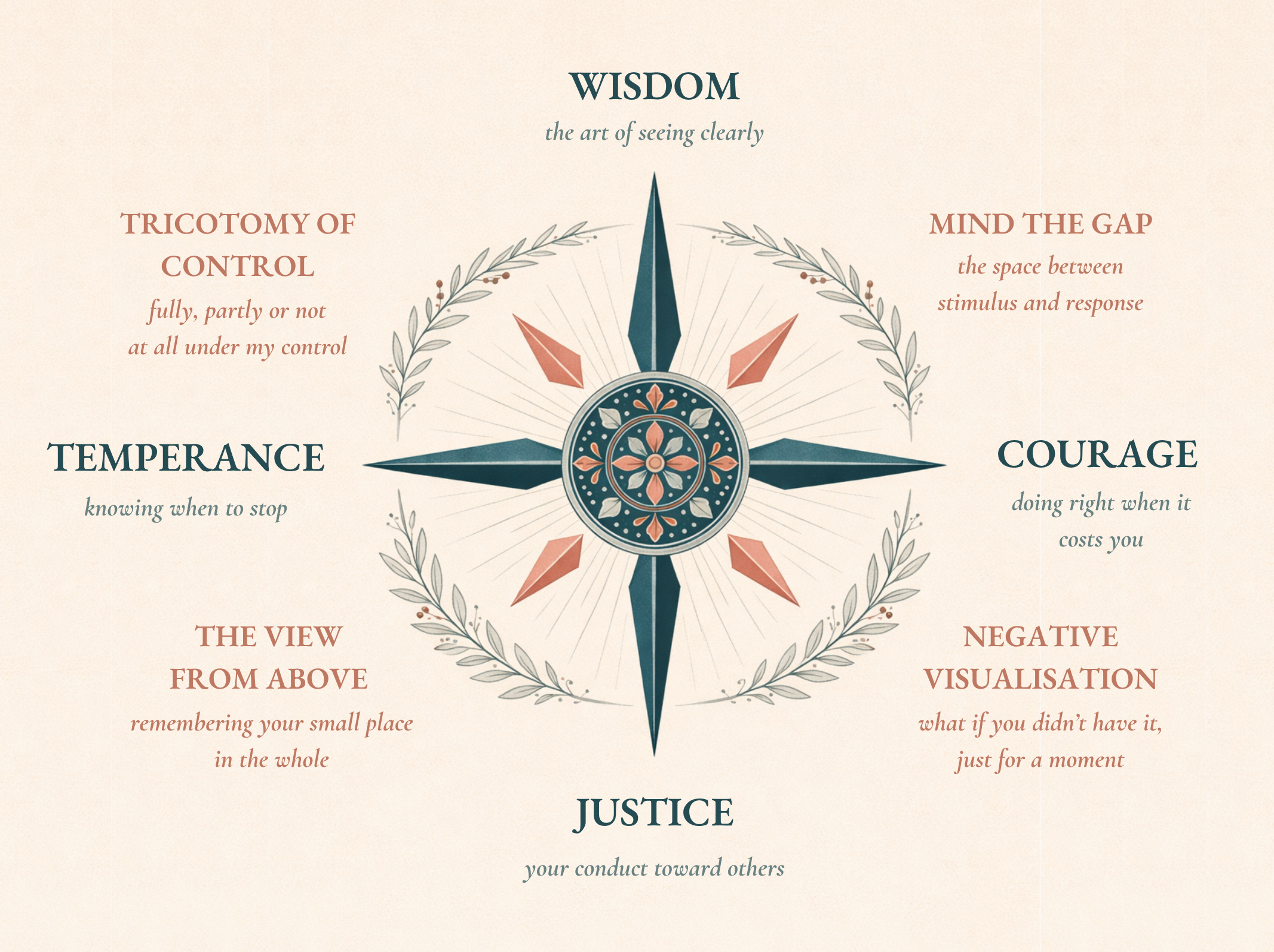
The visual at the heart of this series is a wind rose: the eight-pointed navigational instrument that has guided sailors for centuries. The idea of giving the Stoic concepts a spatial, visual home was inspired by the work of Stephen Dewitt, a cognitive psychologist whose wristwatch framework showed how powerfully these tools hold together when anchored to a structure you can reach for instinctively5. The compass builds that insight into the wind rose.
Eight points. Two groups.
The four cardinal points are the virtues: Wisdom, Courage, Justice, Temperance. The destinations, what you are aiming to embody. There are no compass letters on this wind rose. No prescribed N, E, S, W. Which virtue is your true north at any given moment is something only you can determine. The compass does not prescribe. It orients.
I also come from the southern hemisphere, so I am particularly sensitive to the South as a cardinal point. You may come from the East. The tool is yours to use.
The four intercardinal points are the practical tools (only four out of a plethora coming from Stoicism), what you reach for when a specific situation demands a specific response.
Mind the Gap sits between Wisdom and Courage. The space between what happens and how you respond. This is the first tool you reach for in any difficult moment. Pause. Notice what you are telling yourself. Ask whether it is accurate before you act on it. This is the gap where your freedom lives, even when the gap feels very small.
The Trichotomy of Control sits between Wisdom and Temperance. After the gap has created space to think: is this fully mine, partially mine, or not mine at all? The answer determines where to direct your energy. Fully mine: invest completely. Partially mine: best effort, release the outcome. Not mine: practice acceptance.
Negative Visualisation sits between Courage and Justice. The deliberate practice of imagining the loss of what you value, a relationship, your health, an ordinary Tuesday evening that, if you stopped to notice, contains more than enough. Not pessimism. A deepened gratitude for what is present, and an honest preparation for difficulty before it arrives. A proactive tool, built into the day before the crisis hits.
The View from Above sits between Justice and Temperance. The deliberate act of zooming out, from the room to the city, from the city to the planet, from the planet to the arc of time. Reach for this tool when a situation has grown larger inside your head than it is in the world. The sleepless night that felt catastrophic at 3am looks different in the morning light. The argument that consumed a week looks different from the perspective of a year. Most of what presses on us is, from the long view, small.
How to Use the Compass
You do not need all eight points at once. Most situations call for one or two.
The forgotten permission slip, the tone escalating before school: Mind the Gap first, then Justice, am I treating this child as a full person or as the source of this morning’s problem? The project at work that depends on a colleague who keeps dropping the ball: Trichotomy of Control, what is fully mine here, what is partially mine, and what do I need to release? The sleepless night: Trichotomy again, some of the wakefulness is partially mine (the late screen, the wine, the unfinished conversation); some of it is the hormonal transition and is simply not mine. The relationship you realise you have been taking for granted: Negative Visualisation, today, before you need it. The anxiety that has expanded to fill a week: View from Above.
The compass gets more instinctive the more you reach for it. Small situations are the right place to start, that is where the habit forms.
One practice worth adding: Seneca described a nightly habit of self-examination, three questions before sleep: where did I fall short today, where did I act well, what will I do differently tomorrow. Two minutes. No journal required. This is not a crisis tool. It is what makes the compass yours over time.
The 80/20
Pick one intercardinal tool this week and use it once a day. The Trichotomy of Control is the easiest starting point, it requires no particular calm to apply, and it gives you something concrete to do with anxiety rather than just sitting in it. When something presses on you today, sort it before you do anything else: fully mine, partially mine, not mine at all. The answer tells you where to put your energy. Everything else in the compass deepens from there.
A Note on Learning Stoicism
One post is not nearly enough. What you have here is the skeleton: the destination, the four virtues, the sharpest daily tool, and the compass to navigate by. But the Stoic system has been tested across every imaginable human situation, and the real depth comes from applying it to specific moments, not just understanding it in the abstract. If this landed for you and you want to go further, William Irvine's A Guide to the Good Life is the best first book, full stop. It is readable, practical, and written by someone who actually lives by these ideas rather than just studying them. Massimo Pigliucci's How to Be a Stoic goes deeper into the philosophical machinery for anyone who wants to understand not just what the Stoics said but why it holds up under scrutiny.
Thank You
Thank you for reading, sharing, and supporting this work. Whether you’ve been here since the beginning or just found Swiss Army Mum, I’m glad you’re here.
If the compass landed for you, I’d be grateful if you forwarded this to someone who might need it, or hit the ♥️ or ↻ Restack button. It helps more people find this space.
Medical note: This is educational, not personal medical advice. Your biology, history, and context matter. Work with a qualified healthcare professional.
References
Epictetus. Enchiridion, c. 125 CE, trans. Public domain translations. https://www.gutenberg.org/ebooks/45109
Pigliucci, M. (2017). How to Be a Stoic: Using Ancient Philosophy to Live a Modern Life. Basic Books. https://www.goodreads.com/book/show/31423245-how-to-be-a-stoic
Marcus Aurelius. Meditations, c. 161-180 CE. Public domain translations. https://www.gutenberg.org/ebooks/2680
Irvine, William B, A Guide to the Good Life: The Ancient Art of Stoic Joy (New York, NY, 2008), https://doi.org/10.1093/oso/9780195374612.001.0001
Dewitt, S. (2026). Wristwatch Stoicism: A Visual for Key Stoic Ideas. Stoicism Today, Substack, January 24, 2026.