


If you’re new here, hi!
Swiss Army Mum is a simple, science-based wellness system for busy women. Four pillars. No overwhelm.
Not every tool. Just the right ones.

Over the last few weeks, I’ve been breaking down the exercise pillar: the overview blueprint, then deep dives into strength training, cardio, as well as balance, mobility and plyometrics. The science is solid. But one question kept surfacing: why does standard exercise advice so often fail women in perimenopause and beyond? This week, I’m pulling back the curtain on the book that answers that question most honestly: Stacy Sims’ Next Level.
This isn’t a summary. It’s my take on what hit me hardest, what felt off, and how I distilled 300 pages into the SAM exercise framework so you get the protocols without needing to stress about remembering everything.
Welcome to the SAM Book Club
Here’s how this works: I don’t write summaries. I share critical reads from a busy woman’s perspective (and a mum!) - what surprised me, what I’d challenge, and how it fits into the SAM system.
Why books, not just studies?
Books - especially from trained specialists like Sims - are pre-curated syntheses of hundreds of scientific publications. She has already read the literature and kept the most relevant findings (though probably with a bias toward her own research). I use primary studies sparingly, either when I want to go deeper on a specific mechanism or to fact-check.
SAM is the synthesis layer
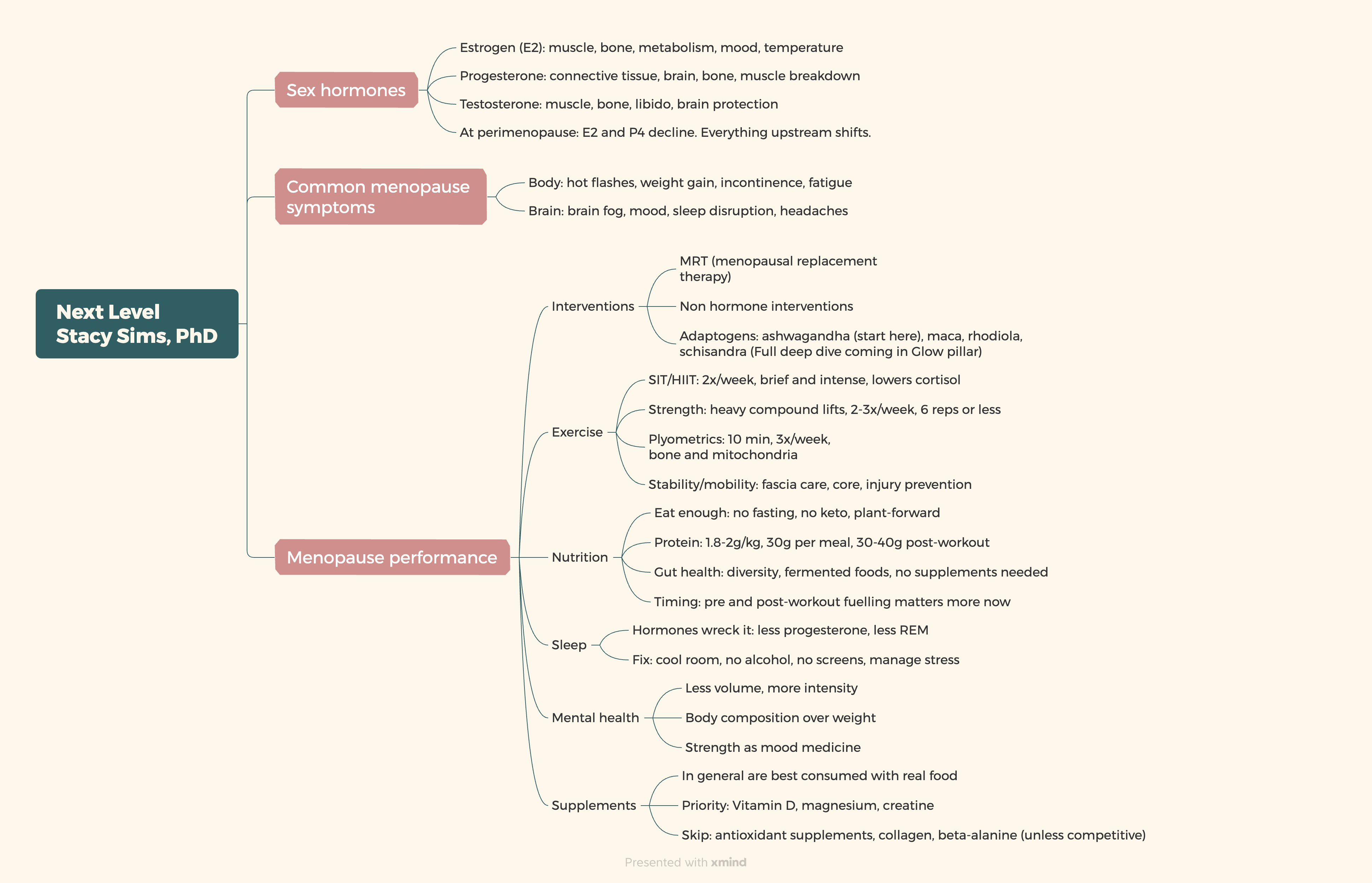
I make thorough mindmaps of the books I read (or listen to), then pull what’s most impactful and actionable into the overall SAM blueprint.
You get the protocols without needing to take notes or stress about implementation. Read the books for enjoyment, context, and conviction - not as homework.
Time investment?
Next Level is around 300 pages, roughly 8 to 9 hours of reading or listening. As always, audiobooks are the best thing since sliced bread for nonfiction. Stack it onto a long walk or your commute and it becomes entirely manageable. That’s how I got through it.
In a nutshell
Why I Recommend Next Level for Women Over 40
Stacy Sims is an exercise physiologist and nutrition scientist who has spent her career studying how female physiology responds to training and nutrition. Her central thesis is one of the most important ideas in women’s health right now: women are not small men.
This is not rhetoric. It reflects a long-standing structural bias in biomedical research.
In 1977, the U.S. Food and Drug Administration issued guidance recommending the exclusion of women of childbearing potential from early-phase clinical trials. The policy emerged after the thalidomide and diethylstilbestrol (DES) tragedies and was intended to protect potential pregnancies from drug exposure. The practical result, however, was that for more than a decade early clinical research was conducted largely in men.
Although the policy was reversed in 1993 with the NIH Revitalization Act1, which required the inclusion of women in NIH-funded research, the legacy persisted. Large analyses of clinical trials continue to show that women are somewhat underrepresented. A review of clinical trials published between 2000 and 2020 found that sex differences in clinical trials varied by clinical trial disease category, with male and female participants underrepresented in different medical fields. Although sex equity has progressed, these findings suggest that sex bias in clinical trials persists within medical fields, with negative consequences for the health of all individuals.2 Early-phase trials still tend to include fewer women, often around 30% of participants, reflecting probably ongoing caution around pregnancy risk and reproductive safety.3
The picture in exercise science is even more skewed. A large review of sport and exercise medicine publications between 2014 and 2020 (covering millions of participants) found that roughly two-thirds of participants were men, while women accounted for only about one-third. More strikingly, just 6% of studies investigated women exclusively, whereas male-only studies were far more common.4
Even when women are included, they are often treated as a secondary group rather than the primary subject of investigation. Many studies recruit young adults (often university students or athletes) and do not control for menstrual cycle phase, hormonal contraception, or menopause status. As a result, post-menopausal women, whose physiology differs substantially from both younger women and men, remain relatively understudied in exercise research, despite being one of the populations most likely to benefit from tailored exercise guidance.
The imbalance appears even earlier in the scientific pipeline. For decades, preclinical biomedical research relied heavily on male animals and male cells. A highly cited study found that single-sex studies of male animals outnumbering those of females 5.5 to 1, largely because researchers assumed female hormonal cycles would introduce unwanted variability.5
The irony is that this assumption turned out to be wrong. When researchers finally tested it directly, they found that female animals are not more variable than males.6 In fact, male physiology fluctuates substantially due to pulsatile testosterone secretion and environmental factors. The supposed “female variability problem” was largely a myth, yet it shaped decades of experimental design.
This bias has had real consequences. Several experimental stroke drugs that showed strong neuroprotective effects in male rodents ultimately failed in human trials. Later analyses suggested the drugs interacted differently with estrogen signaling pathways, meaning the preclinical evidence had been biased from the start. When female animals were included, the protective effect often disappeared.
Taken together, these patterns illustrate a broader problem: biomedical science has historically treated the male body as the default template. The result is a research literature that often tells us how men respond to drugs, exercise, and nutrition and then assumes women will respond the same way.
Stacy Sims’ argument challenges that assumption directly. If we want evidence-based guidance for women, we need research that actually studies female physiology.
It’s also worth knowing how Next Level sits relative to Sims’ earlier book, ROAR, which I started and stopped halfway through. ROAR is about optimising athletic performance around the menstrual cycle for younger women who are actively competing. Excellent science, wrong audience for me. I was never an athlete at 20. I’m not one at 40. I don’t need race-day protocols. I need to understand what’s actually happening in my body and what to do about it.
Next Level is for that woman. Normal, active, not trying to podium, just trying to age well.
What makes it worth reading
The female-specific framing, sustained throughout. Not a chapter on “women’s considerations” tucked in at the back. The whole book is built around female physiology, which is still, in 2025, rarer than it should be.
The hormonal context for everything. Once Sims explains what estrogen was doing behind the scenes, every protocol recommendation clicks into place. You stop following instructions and start understanding the reasoning.
The honest acknowledgment of research gaps. She doesn’t pretend the literature on women over 40 is complete. She’s contributing to building it.
The SAM angle
Read this for the “why.” Get the “how” from the blueprint.
You don’t need to remember every detail from 300 pages. I’ve already pulled the 80/20 into the exercise framework - so you can read this book for conviction and context without the pressure of implementing it all yourself.
The Busy Woman’s Perspective
Time investment: 300 pages, around 8 to 9 hours. Manageable, especially on audio.
Tone: Sims is direct and no-nonsense, which I appreciated. No hand-holding, no wellness-speak. She talks to you like an adult who can handle science and deserves a straight answer.
Emotional weight: Lighter than Why We Sleep. Sims is motivating rather than alarming. The message is: your biology has changed, here is what to do about it. That feels empowering rather than anxiety-inducing.
One honest caveat: both Next Level and ROAR can tip into overwhelm. Specific meal composition before training. Exact salt and glucose grams per litre for your hydration mix. Precise post-workout timing windows that close after 30 minutes.
If you’re in full biohacking mode and love fine-tuning every variable, this is heaven.
If you’re a busy woman trying to move consistently and not overthink it, some of this detail is noise.
A note on supplements and adaptogens: the relevant sections are genuinely interesting, and I’ll come back to them properly in the Glow pillar. For now, I’m not personally using any of them, so I’ll leave that thread for later.
Habit stack reminder: don’t let the page count intimidate you. I got through it on long dog walks and weekend mornings. Audiobook, headphones, done.
Bottom line: worth reading for conviction and context - but don’t stress about implementing every protocol. That’s what SAM is for.
What Hit Me Hardest: Key Takeaways
Estrogen Was Doing Far More Than You Knew
Most of us grew up thinking of estrogen as the hormone that runs the reproductive system and then causes trouble at menopause. That framing undersells it by an enormous margin.
Estrogen - your primary female sex hormone - is also metabolically active, anti-inflammatory, and neuroprotective. It regulates insulin sensitivity, supports muscle protein synthesis (the process of building and repairing muscle tissue), maintains bone density, modulates inflammation, and plays a role in how your brain consolidates memory and manages mood. It was, quietly, doing a lot of the administrative work your body relies on.
Think of estrogen as a systems manager, running in the background, keeping multiple departments coordinated. When it declines during perimenopause, those departments don’t just slow down. Some of them start running without their usual oversight.
This is why the physiology of perimenopause matters so much to understand. It is not a cosmetic inconvenience. It is a full organisational restructure.
Responding to it with the same tools you used in your 20s and 30s - eating less, doing more cardio, pushing through fatigue - is a bit like telling an understaffed factory to increase production. The inputs haven’t changed. The infrastructure has. The strategy needs to change with it.
What stuck with me: once I understood what estrogen was actually doing, the specific protocol shifts Sims recommends stopped feeling arbitrary. They’re not preferences. They’re logical responses to a real biological shift. That distinction matters for motivation.
The Three Hormones Behind the Shift
Estrogen gets most of the attention when perimenopause comes up, but the full picture involves three hormones working together - and understanding all three makes the “why” behind every training and nutrition adjustment much clearer.
Estrogen exists in three forms. Estradiol (E2), produced by the ovaries, is the dominant sex hormone during your reproductive years and the one you feel the loss of most sharply at perimenopause. Estrone (E1), produced by fat tissue, becomes the main circulating form after menopause. Estriol (E3) is produced during pregnancy. When people talk about declining estrogen, they mostly mean the drop in E2.
And E2 was doing an extraordinary amount of work. It promotes muscle growth and strength, supports mitochondrial function (the energy-producing machinery inside your cells), regulates inflammation, manages blood sugar, controls appetite, influences mood, regulates body temperature and blood pressure, and builds bone. If this list feels surprisingly long, that’s the point. Estrogen was not just a reproductive hormone. It was a systems hormone, with a hand in almost every physiological process that keeps you feeling well.
Progesterone is less discussed but equally important. It increases connective tissue stability, protects the brain, provides some pain relief, builds bone alongside estrogen, and supports heart rate variability - your cardiovascular system’s ability to adapt to stress. It also plays a role in cooling inflammation and regulating immune response. One function worth noting specifically: progesterone actively breaks down muscle tissue (catabolism). This is counterbalanced during reproductive years by estrogen’s anabolic (muscle creation) effects. When both decline together, that balance shifts.
Testosterone is the supporting actor. Women produce far less of it than men, but it matters. It works in concert with estrogen and progesterone to maintain healthy bones and muscles, supports libido, and helps protect the brain. Unlike estrogen and progesterone, your ovaries and adrenal glands continue producing testosterone even as the other hormones decline - but that doesn’t fully compensate. As Sims explains, the loss of estrogen and progesterone makes your body less sensitive to the muscle-building stimulus of exercise and protein. Muscle tissue begins to be threaded with fat tissue during this transition, which is why your muscle tone, power, and recovery can change even when you haven’t changed anything about how you train. It isn’t a failure of effort. It’s a shift in the hormonal environment that effort alone can’t override.
This is the biological backdrop to everything that follows. These three hormones were maintaining more than most of us realised - and their decline is why the strategies that worked before need to be updated, not abandoned.
Long, Steady Cardio Is the Wrong Tool for This Stage
This was the most counterintuitive shift for me, and Sims earns it with clear mechanistic reasoning.
The default response to weight gain and metabolic changes at perimenopause is usually more cardio. Run more. Cycle more. Burn more. It feels logical. The problem is that chronic steady-state cardio keeps cortisol - your primary stress and mobilisation hormone - elevated. And cortisol is already harder to regulate when estrogen is declining.
In short bursts, cortisol is essential: it releases stored energy to fuel sustained effort. Chronically elevated, it becomes counterproductive. It accelerates muscle breakdown (catabolism, or the process of breaking tissues down for fuel), shifts fat storage toward the abdomen, and impairs recovery. You’re adding more of a stress signal to a system that’s already struggling to manage it.
Sims’ prescription is almost the inverse of conventional wisdom: brief, intense effort followed by complete recovery. Short, hard intervals that provoke a strong adaptation signal, then rest. The intensity is the stimulus. The recovery is where the adaptation actually happens.
What stuck with me: I covered the cardio science in the exercise series, but this was the hormonal context that made it click. It’s not that cardio is bad. It’s that the dose, the intensity, and the recovery ratio matter enormously at this stage - and most of us have been getting the ratio wrong for years.
Your Muscles Are Less Forgiving Now, So You Have to Be More Deliberate
This one requires a concept: anabolic resistance.
Anabolic refers to the biological processes that build and repair tissue. Anabolic resistance means your muscles have become less sensitive to the signals that trigger growth and repair. The same protein intake that maintained muscle in your 30s may no longer be sufficient. The same training stimulus that built strength before may now require a stronger signal to produce a comparable result.
Think of it as a dimmer switch that has been turned down. The signal is still there, but the response is quieter. You need to turn the volume up.
Sims argues two things follow from this. First, protein targets for women over 40 need to increase - most women are eating well below what current evidence suggests is needed for muscle maintenance at this stage. Second, training needs to include genuinely heavy loads, because light resistance work no longer provides a strong enough signal for muscle to respond and rebuild.
This isn’t about extremes. It’s about recognising that what worked at 30 is no longer the right calibration - and that adjusting is not defeat. It’s just good biology.
What stuck with me: I had already covered the loading science in the strength training post - lifting heavy, progressive overload, compound movements. But this is the biological explanation for why it matters more after 40, not just for aesthetics or performance, but for preserving the metabolic machinery that keeps you well for decades.
What Sims Gets Right (And What Felt Off)
What She Nails
The female-specific lens, applied consistently across exercise, nutrition, and recovery. This is the book’s greatest strength and what makes it genuinely different from almost everything else in the fitness space.
Her sections on how visceral fat distribution shifts in peri and post-menopause, and the hormonal mechanisms behind it, are clarifying in a way I hadn’t encountered elsewhere. The HIIT protocols for menopausal women are well-evidenced and practical. And the honest acknowledgment that research on women over 40 is historically sparse is refreshing - she’s not just synthesising existing literature. She’s contributing to building it.
What Felt Off
The hydration chapter. Sims gets into exact grams of sodium per litre for training drinks, with formulas adjusted for different conditions and intensity levels. For a competitive athlete preparing for a long race, that precision matters. For a woman doing three exercise sessions a week and living a normal life, water is genuinely fine. We evolved to hydrate with it (while eating foods which delivered the electrolytes along with it).
The post-workout eating window also received more emphasis than it deserves for a general audience. Sims frames it as a narrow, time-sensitive opportunity that closes after 30 minutes. For performance athletes, the window matters. For everyday health? The principle is what counts: eat protein after training and in general. I exercise, and then I eat. I don’t track the exact time frame. Most women reading this don’t need to either. It adds friction.
Why Read It Anyway
Because even where Sims occasionally tips into over-specification, the core framework is rock-solid: female physiology at perimenopause and beyond requires a different approach, and the approach she lays out is evidence-based, practical, and designed for the right person.
The female-specific framing also makes the science stick in a way that generic exercise advice never does. You stop reading about “people” and start reading about yourself.
If you want conviction and context for why the SAM approach is structured the way it is, this book delivers.
How This Became the SAM Exercise Blueprint
After reading Next Level, I pulled the 80/20 - the interventions that actually move the needle - and built them into the exercise framework.
What made the cut:
The biological case for brief, intense work over chronic steady-state cardio, given the cortisol-estrogen interaction.
Heavy compound lifts as non-negotiable for bone density, metabolic health, and anabolic signaling.
The importance of plyometrics, stability and mobility.
Upward recalibration of protein targets for women over 40 Recovery as a training variable, not an optional extra.
The “women are not small men” framing as the lens for all exercise and nutrition decisions at this stage
What I left out:
The performance athlete protocols and race-day nutrition strategies.
The precise nutrient timing windows (the 30-minute post-workout rule).
The electrolyte formulas for training drinks.
The supplement and adaptogen protocols (coming in the Glow pillar)
The result: you get the actionable version, calibrated for a normal, active woman who wants to age well - without needing to remember 300 pages.
If you want to go deeper on the science, the context, and the conviction behind the framework, here’s the book.
Your Turn
Have you read Next Level or ROAR? Did the “women are not small men” framing land for you the way it did for me - or did parts of it feel like too much to act on? Drop a comment below. I read every one.
See you there.
Subscribe so you don’t miss it.
Thank you!
Thank you for reading, sharing, and supporting this work. Whether you’ve been here since the beginning or just found Swiss Army Mum, I’m glad you’re here.
Building sustainable health without overwhelm takes a village. If something resonated with you, I’d be grateful if you forwarded this to someone who might benefit or hit the ♥️ or ↻ Restack button. It helps more people discover this space and build sustainable health without the overwhelm.
Medical note: This is educational, not personal medical advice. Your biology, history, and context matter. Work with a qualified healthcare professional.
Steinberg, Jecca R et al. “Analysis of Female Enrollment and Participant Sex by Burden of Disease in US Clinical Trials Between 2000 and 2020.” JAMA network open vol. 4,6 e2113749. 1 Jun. 2021, https://doi.org/10.1001/jamanetworkopen.2021.13749
Pinnow, Ellen et al. “Increasing participation of women in early phase clinical trials approved by the FDA.” Women's health issues : official publication of the Jacobs Institute of Women's Health vol. 19,2 (2009): 89-93. https://doi.org/10.1016/j.whi.2008.09.009
Cowley, E. S., Olenick, A. A., McNulty, K. L., & Ross, E. Z. (2021). “Invisible Sportswomen”: The Sex Data Gap in Sport and Exercise Science Research. Women in Sport and Physical Activity Journal, 29(2), 146-151 (2026) https://doi.org/10.1123/wspaj.2021-0028
Beery, Annaliese K, and Irving Zucker. “Sex bias in neuroscience and biomedical research.” Neuroscience and biobehavioral reviews vol. 35,3 (2011): 565-72. https://doi.org/10.1016/j.neubiorev.2010.07.002
Becker JB, Prendergast BJ, Liang JW. Female rats are not more variable than male rats: a meta-analysis of neuroscience studies. Biol Sex Differ. 2016 Jul 26;7:34. https://doi.org/10.1186/s13293-016-0087-5