



This is Part 4 of a 4-part deep-dive series on the brain.
We started with Brain Health: An Owner’s Manual, then zoomed in on perimenopause brain fog, the lifestyle levers that protect your brain, and your brain’s messengers.
This mini-series breaks down the parts of brain health that deserve more than a paragraph:
Part 1: Perimenopause Brain Fog. Whether it’s real, whether it lasts, the Alzheimer’s question, and HRT
Part 2: Lifestyle Levers. The evidence behind each lever, and how to actually do it
Part 3: Your Brain’s Messengers. Dopamine, serotonin and their colleagues, and why “boosting” them misses the point
Part 4 (this post): Brain Training. What two weeks of brain games taught me, and what they can and can’t do for you
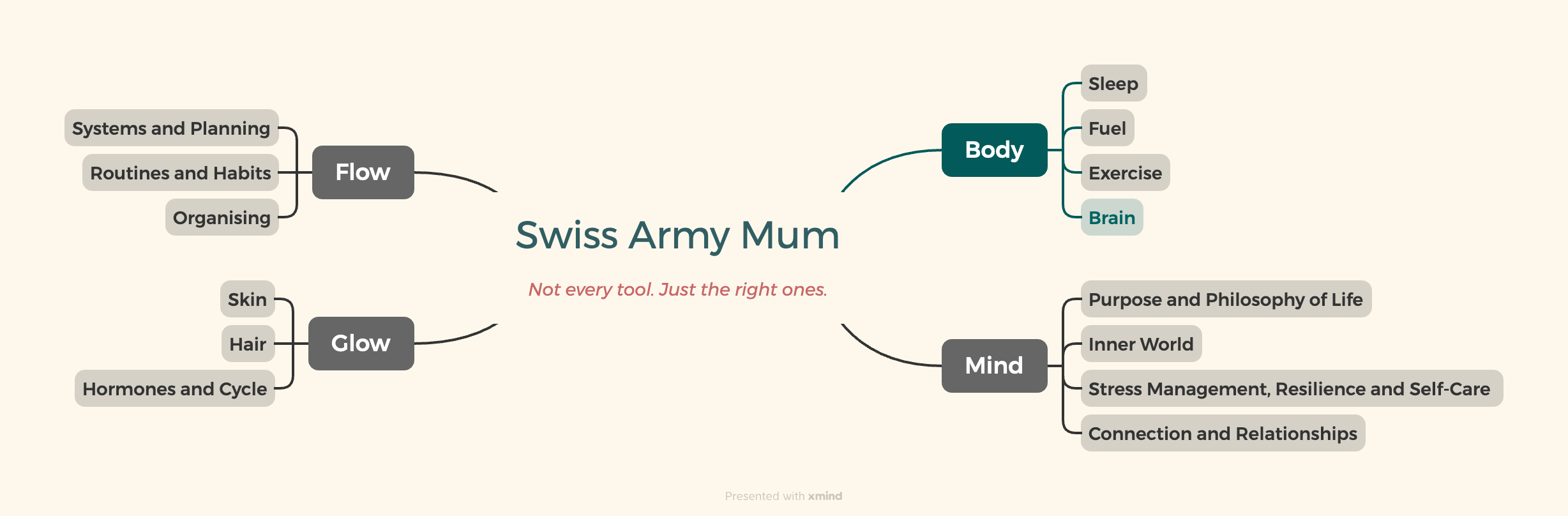
This post sits in the Brain area of the Body Pillar, and it closes the series with an experiment instead of a review. The Blueprint and the zooms told you what the evidence says. This one shows what happens when you try to measure your own brain at home, and why the numbers can fool you. I wrote it with Eleni from The Brain Brief, a researcher in neuroscience who knows far more than I do about what these games actually measure. She writes about the science of the brain, memory and aging. Thanks so much for your knowledge and insight. It’s so great to be able to collaborate with so many knowledgeable people here on Substack!
Eleni writes in purple, I write in teal.
The experiment: Eat, Play, Repeat
I joined a study to find out whether how I eat impacts my cognitive skills.
It’s the latest in my growing collection of experiments where I’m my own guinea pig. This time it was Food & You Cognitive, a citizen-science study from the Swiss Federal Institute of Technology in Lausanne that wanted to know whether what you eat shapes how sharp you are afterwards.
For two weeks I logged every meal and played four brain games after each one. By the end, my scores had jumped. One game went up 82%. If you believed the dashboard, I was building a better brain one chia bowl at a time.
So, can I confidently say it was the food?
Not really. The best clue came from my worst day. I felt unwell, barely ate, and logged 322 calories from morning to night. By every rule of “fuel your brain” I should have bombed. It turned out to be one of my best days on the games.
This post breaks down what actually happened: what the games measure, why my scores climbed, whether brain training makes you sharper in real life, and what food had to do with any of it.
What it entailed
The setup was simple, which is what made it tempting.
Fourteen days. Three meals a day, no snacks, everything logged in an app. After each meal, four Lumosity games. About 118 plays in total.
At the end, I got two PDF reports, one on nutrition and one on cognition. They looked slick: charts, rankings, a diet score, a short AI-written summary.
The chemical engineer in me got stubborn. I wanted numbers, not pictures, so I pulled them out of the charts dot by dot: every play, every hour of eating, every day’s macros.
What cognitive skills do the four games measure?
Each Lumosity game was designed to challenge a somewhat different cognitive skill:
Memory Match challenges working memory. Cards appear one after another and the goal is to decide whether each one matches the one shown two cards earlier. Working memory is our ability to hold information in mind and update it, like remembering a phone number while you dial it.
Brain Shift challenges task switching. The goal in this game is to answer one question about a card if it appears at the top of the screen and a different question if it appears at the bottom. Task switching is our ability to switch between different tasks or mental rules.
Ebb and Flow challenges flexible attention. Depending on the colour, the goal is to swipe either in the direction the leaves are pointing or the direction they’re moving. This means shifting between different aspects of the same information.
Lost in Migration challenges selective attention and processing speed. The goal is to swipe in the direction of the bird in the middle while ignoring the birds around it. This requires focusing on relevant information, while filtering out distractions and responding quickly, like spotting an exit sign on a busy motorway.
Brain training and learning
Did Mica’s scores improve?
One of the most interesting aspects about Mica’s n=1 (a sample of one) experiment is that her performance improved across all four games, but at very different rates.
Specifically, the Memory Match (working memory) showed the largest estimated improvement in scores (82%), followed by Brain Shift (task switching) with 65% improvement in scores, Ebb and Flow (flexible attention) with 22% improvement, and finally Lost in Migration (selective attention and processing speed) showed a 12% improvement. These percentages, though, aren’t directly comparable as each game has its own scoring system. They also do not show how much Mica’s underlying cognitive abilities improved.
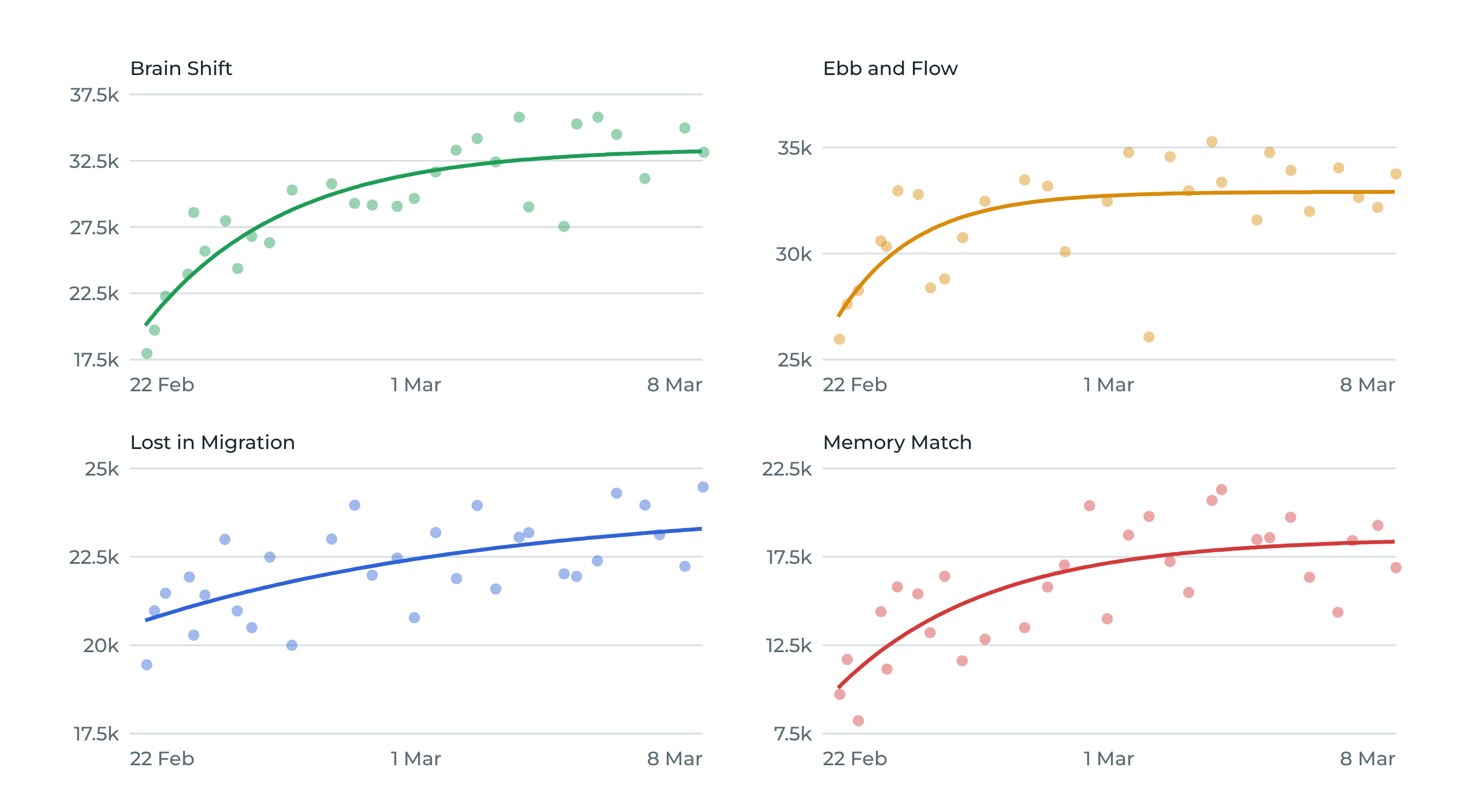
But the size of the improvements wasn’t the only difference. Mica also improved much faster at some games than others. To compare them, each game’s scores were rescaled so that 0 represents its estimated starting level and 1 its estimated ceiling. This way the performance improvement can be compared across games, regardless of the size of the improvement.
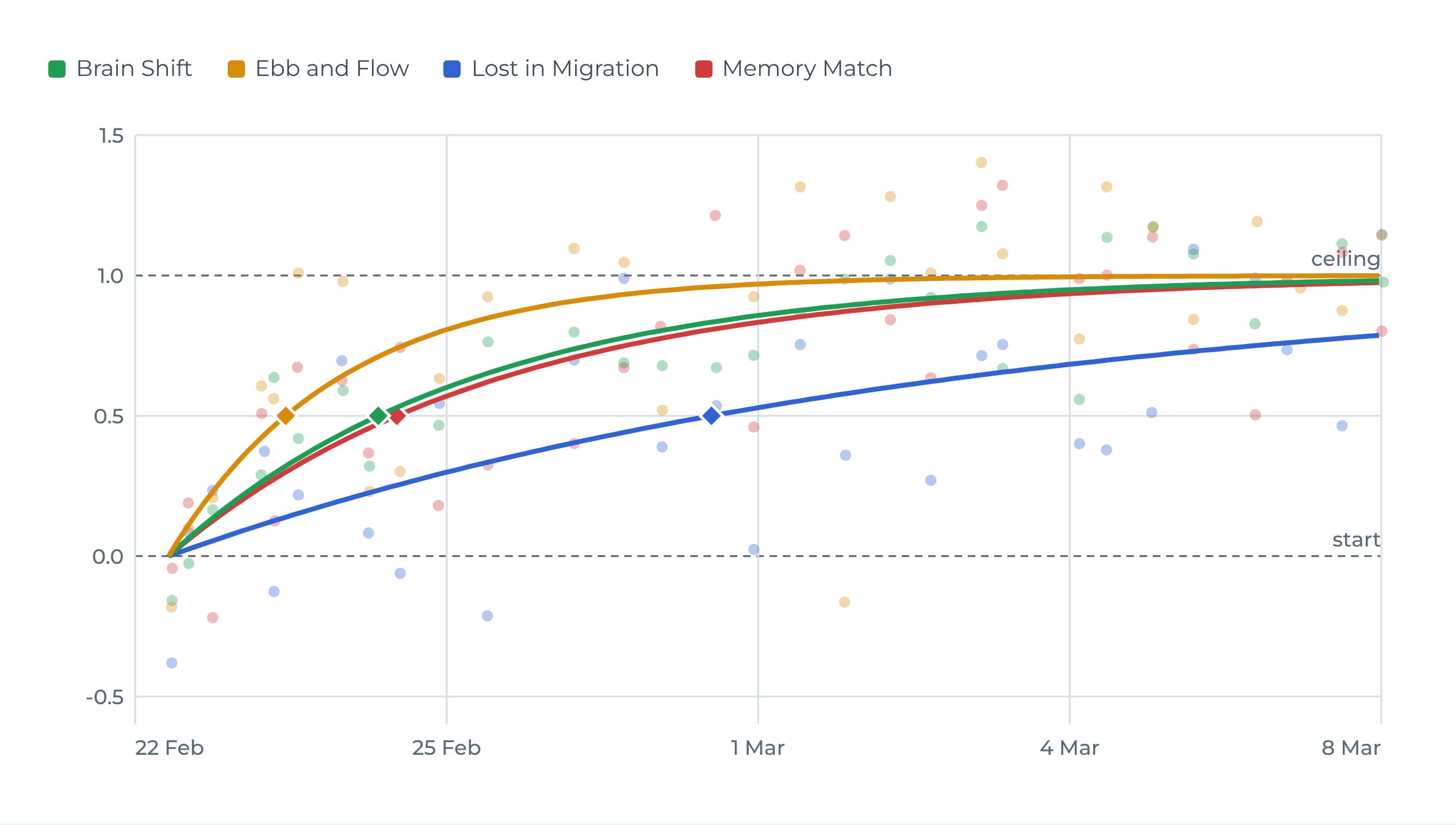
Ebb and Flow (flexible attention) improved particularly quickly. Mica got halfway to her best level after only about a day of playing. Brain Shift (task switching) and Memory Match (working memory) took about 2.5 days to get halfway and a bit longer to level off. Lost in Migration (selective attention and processing speed) was the slowest, which took around 6 days to get halfway and was still improving at the end of the experiment.
Why did the scores improve?
When we repeat a certain cognitive task, we don’t just exercise the ability it’s designed to test. We also get used to the task itself.
In everyday life, if we are learning to play a new board game, for example, we initially need more time to understand the rules, figure out what information matters and decide how to respond. But after playing several times, we no longer need to think through every step. We might also develop strategies to help us respond faster or make fewer mistakes.
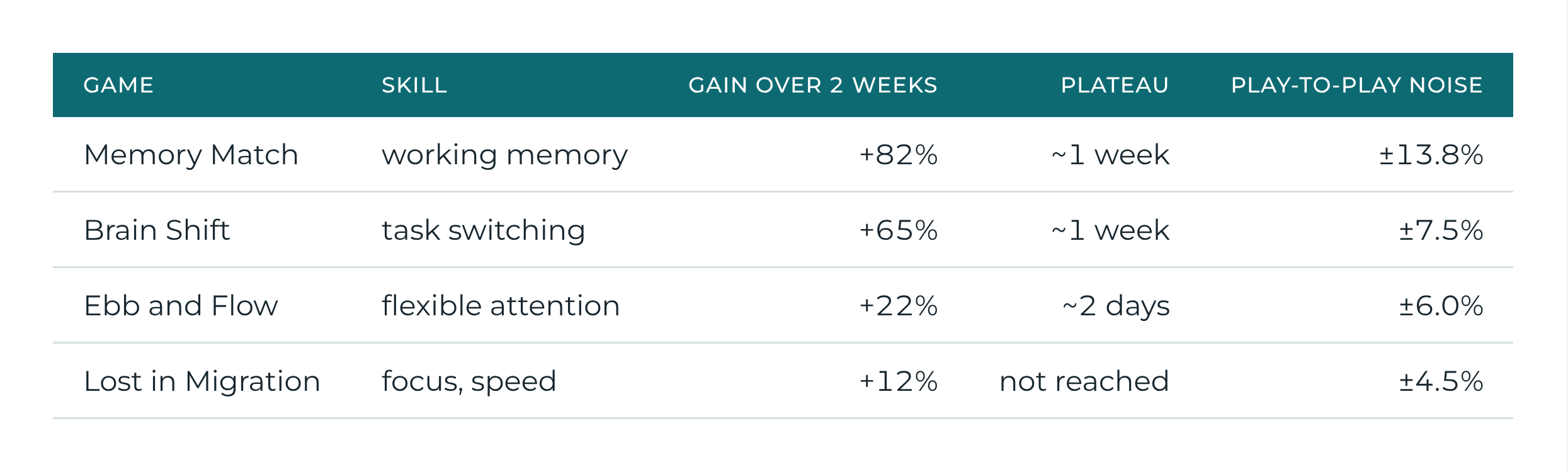
In cognitive research, these improvements that result from repeated exposure to the same tasks are called practice effects. These are especially important when we are interpreting repeated cognitive assessments, because scores can improve even without any actual improvement in cognitive abilities.
What are practice effects?
Practice effects are the score gains you get from repeating the same test. You learn the rules, find shortcuts and get faster. Your scores can rise a lot even when the underlying skill, like memory or attention, hasn’t changed. That’s why the first week of any self-test mostly measures learning the test.
Why did some games improve faster than others?
There are many possible explanations.
Some games might simply have been easier for Mica to learn. When we first practice a new task or learn something new, we often improve quickly as we figure out the rules and develop strategies.
As the task becomes familiar, improvement tends to slow down and performance can become more automatic. Some games may have rules that are easier to learn, while other games may require more complex combinations of attention, memory and response selection.
Research on working memory training suggests that a large part of the improvement can come from developing task-specific strategies, sometimes from the first sessions.
Mica might have also been better at certain types of tasks to begin with, leaving less room for improvement. Also, the learning curves can be shaped by differences in how the games calculate the scores and adjust difficulty. We can’t tell exactly which of these explanations mattered most.
What we can say is that Mica got better at these particular games with practice.
Does getting better at brain-training games improve cognitive abilities?
So, we established that Mica got better at the games she practised. But does that mean that her memory, attention or thinking also improved outside the games?
That is the interesting question.
We can distinguish between two types of transfer.
Near transfer happens when practising one task improves performance on another similar task. For example, training on one working-memory task might help you do better on a different working-memory task.
Far transfer happens when those improvements extend to more distant abilities or everyday life, like remembering things day to day or reasoning or making decisions.
Unfortunately, the evidence for far transfer is weak.
Research consistently shows that people improve on the specific cognitive tasks that they practise. Some studies also find improvements on closely related tasks, although these effects are generally smaller and less consistent.1
But improvements in broader cognitive abilities are difficult to demonstrate. Large reviews of cognitive-training studies have generally found little convincing evidence that brain-training games lead to meaningful improvements in unrelated cognitive skills or everyday functioning.2
For example, in one large study, including more than 11,000 adults found that after six weeks of online brain training, the participants improved on the training tasks they practised, but not on other cognitive tests, even those that assessed similar skills.3
In fact, in 2016, Lumosity paid $2 million to settle charges from the US Federal Trade Commission over its misleading advertising claims about the benefits of its games.4
The improvements, including Mica’s, are still real. She did learn the games, perhaps developed strategies and got faster or more accurate. But getting better at a brain-training game is not the same as improving your memory or attention in everyday life. And so far, the evidence that these benefits extend beyond the games is limited.
Can brain training protect against cognitive decline?
What about longer-term? Even if these games don’t make us noticeably sharper in everyday life, could certain types of cognitive training help protect against dementia?
A recent study suggests that some might. For example, a 2026 follow-up of the ACTIVE trial found that older adults who received a specific type of cognitive training focused on processing speed, and who also completed later booster sessions, had a lower risk of receiving a dementia diagnosis over the following 20 years.5 However, similar benefits were not seen for memory or reasoning training.
These findings are promising, but they come from a single study. And the benefit was seen only in people who completed the extra boost sessions and those people may differ in other ways, for example in their health or motivation. These findings also don’t mean that all brain training prevents dementia. In particular, we can’t assume that the benefits of a specific, structured cognitive-training programme also extend to commercial games like Lumosity.
Can brain training prevent dementia?
One long-term trial found that older adults who did speed-of-processing training, plus later booster sessions, were less likely to be diagnosed with dementia over 20 years. Memory and reasoning training showed no such benefit. It’s a single study, and it doesn’t mean commercial games like Lumosity protect your brain.
So, was it the food?
Think of my learning curve as a wave. Any food effect is a ripple on top of it. To see the ripple, you have to subtract the wave first.
So for every play, I asked a different question: was this score above or below where I’d expect to be at this point in the study? Raw scores from day 2 and day 12 can’t be compared. Scores relative to my own learning curve can. Here’s what was left.
What didn’t matter
Diet quality and total calories: no link. My good-diet days and my meh-diet days scored the same once learning was taken out. Neither did what I ate the day before.
The near-fast day didn’t hurt. That 322-calorie Monday was my best day relative to my curve. To be fair, it was day 2, when scores were climbing fastest, so the curve flatters it. But there’s no sign that one very light day dented anything. A short energy dip seems to be something my brain can absorb.
The weekend dip that wasn’t
The report flagged that I did worse on weekends. It’s a tempting story: bigger meals, a glass of wine, later nights. My weekend calories really were 28% higher and I drank the occasional glass of red wine.
But day 1 was a Sunday. My very first play, when I barely knew the rules, got filed under “weekend”. Once we set aside each game’s learning phase, the weekend gap disappeared. Weekends and weekdays came out level.
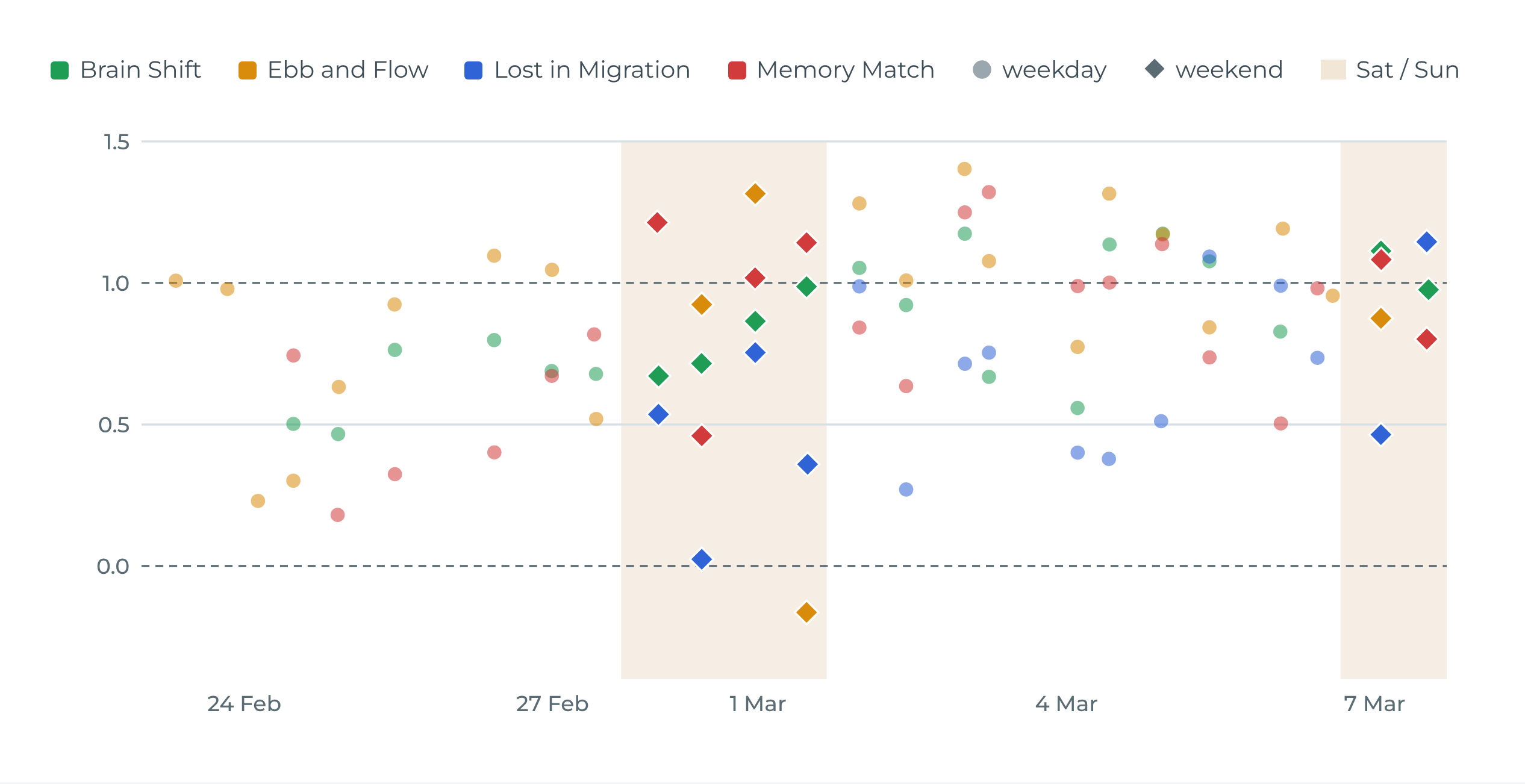
That surprised us both. We figured that adjusting for learning would make the weekend gap bigger, since most weekend days came later in the study. The opposite happened, because the one weekend day that came first was also my worst day of the whole experiment. With only three weekend days left after the adjustment, we can’t rule out a small weekend effect. We just can’t see one.
The one faint signal
One pattern wouldn’t go away: big, late dinners. Plays after a meal of 700 calories or more sat a little below my curve. Plays at 10 pm or later sat about 3 to 4% below. Working memory showed it most: Memory Match ran about 5% above my curve after breakfast and 4% below after dinner.
Before you move your dinner to 6 pm, meal size and clock time travel together in my data. My two biggest dinners were also my latest, on a Friday and a Saturday at the end of a long fortnight. Was it the food? The hour? Plain end-of-day tiredness? I can’t separate them.
Why food and focus are so hard to link
Here’s the honest problem with my experiment, and with most home experiments like it. Food was only one of the things changing from meal to meal.
Sleep. I didn’t log it. Losing sleep hits attention and working memory harder than almost anything, and a sandwich doesn’t come close.6
Stress and mood. A tense afternoon at work and a relaxed Saturday morning are different brains, whatever is on the plate.
Cycle stage. I didn’t log that either. Fourteen days covers about half a cycle, so I can’t tell a hormone effect from a food effect.
Illness. My best day relative to my curve was a day I felt unwell. Go figure.
Time of day. Breakfast always came in the morning and dinner always came at night. Any meal effect is tangled up with the clock.
How we’d run it ourselves
If we wanted a real answer to “does food change my cognitive abilities?”, here’s what we’d change:
A practice week first. Play the games for a week before measuring anything, so the learning curve is out of the way.
Alternate the conditions. For example, a light dinner one evening and a full dinner the next, repeated several times, at the same clock time. Swapping back and forth stops the learning curve or a stressful week from posing as a food effect.
A fixed gap after meals. Play at the same delay after every meal, say 45 to 60 minutes.
Log the usual suspects. Sleep, mood, stress and cycle stage, so they can be accounted for.
Even then, one person is one person. That’s where large studies come in. Food & You collects data from many participants. Pooled together, individual quirks like one bad night or one stressful week tend to average out, and there’s enough data to adjust statistically for things like time of day, learning and sleep. An observational study still can’t prove that food causes a change in cognition, but it can show which patterns may be worth testing in a proper trial.
What actually works for your brain
So if brain games mostly make us better at brain games, then what can we do to support our cognitive health?
The research points to the things that keep the rest of our body healthy too (I covered it recently in the brain lifestyle levers post):
Move your body. Regular exercise is one of the best-supported ways to support brain health both in the short- and long-term.
Keep learning. Learning a language, playing an instrument or taking up dancing challenges many abilities at once.
Stay socially connected. Social engagement is consistently linked to better brain health as we age. Activities like dancing or joining a walking group can combine movement, learning and social interaction.
Don’t forget the basics. Getting enough sleep, managing blood pressure and conditions like diabetes, looking after your hearing, and avoiding smoking, are among the things that matter for long-term brain health and dementia risk.
Think about your overall diet. Eating patterns like the Mediterranean diet are linked to better cognitive health over time. But as Mica’s experiment showed, figuring out whether a particular meal makes us sharper is much more difficult.
There’s also something else worth thinking about: opportunity cost. If spending 30 minutes on a brain-training app means less time for walking, learning or catching up with a friend, is it really the best use of that time?
Of course, there’s nothing wrong with playing brain games if you enjoy them.
But for your brain, staying curious, active and connected to people over the years probably does a lot more.
My brain got better at brain games. Yours deserves better. Next up: the Body Blueprint, the boring basics that actually work. And thanks to Eleni from The Brain Brief again, for sharing your expertise!
Medical note: This is educational, not personal medical advice. Your biology, history, and context matter. Work with a qualified healthcare professional.
References
Simons, D. J., Boot, W. R., Charness, N., Gathercole, S. E., Chabris, C. F., Hambrick, D. Z., & Stine-Morrow, E. A. L. (2016). Do “Brain-Training” Programs Work? Psychological Science in the Public Interest, 17(3), 103-186. https://doi.org/10.1177/1529100616661983
Giovanni Sala, N. Deniz Aksayli, K. Semir Tatlidil, Tomoko Tatsumi, Yasuyuki Gondo, Fernand Gobet; Near and Far Transfer in Cognitive Training: A Second-Order Meta-Analysis. Collabra: Psychology 1 January 2019; 5 (1): 18. doi: https://doi.org/10.1525/collabra.203
Owen, A., Hampshire, A., Grahn, J. et al. Putting brain training to the test. Nature 465, 775–778 (2010). https://doi.org/10.1038/nature09042
US Federal Trade Commission. Lumosity to pay $2 million to settle FTC deceptive advertising charges for its “brain training” program. Press release (5 January 2016). https://www.ftc.gov/news-events/news/press-releases/2016/01/lumosity-pay-2-million-settle-ftc-deceptive-advertising-charges-its-brain-training-program
Coe NB, Miller KEM, Sun C, et al. Impact of cognitive training on claims-based diagnosed dementia over 20 years: evidence from the ACTIVE study. Alzheimer’s Dement. 2026; 12:e70197. https://doi.org/10.1002/trc2.70197
Lim, J., & Dinges, D. F. (2010). A meta-analysis of the impact of short-term sleep deprivation on cognitive variables. Psychological Bulletin, 136(3), 375–389. https://doi.org/10.1037/a0018883