


This is Part 1 of a 4-part deep-dive series on the brain.
We have covered the Brain Blueprint: the four systems that keep your brain running, and the five levers that carry most of the weight.
Now we’re zooming in. This mini-series breaks down the parts of brain health that deserve more than a paragraph:
Part 1 (this post): Perimenopause Brain Fog. Whether it’s real, what’s happening, whether it lasts, the Alzheimer’s question, and what HRT does and doesn’t do
Part 2: Lifestyle Levers. The evidence behind each lever, ranked, and how to actually do it
Part 3: Your Brain’s Messengers. The main neurotransmitters, what they do, and some common myths behind them
Part 4: Brain Training. A collaboration on what those brain games can and can’t tell you
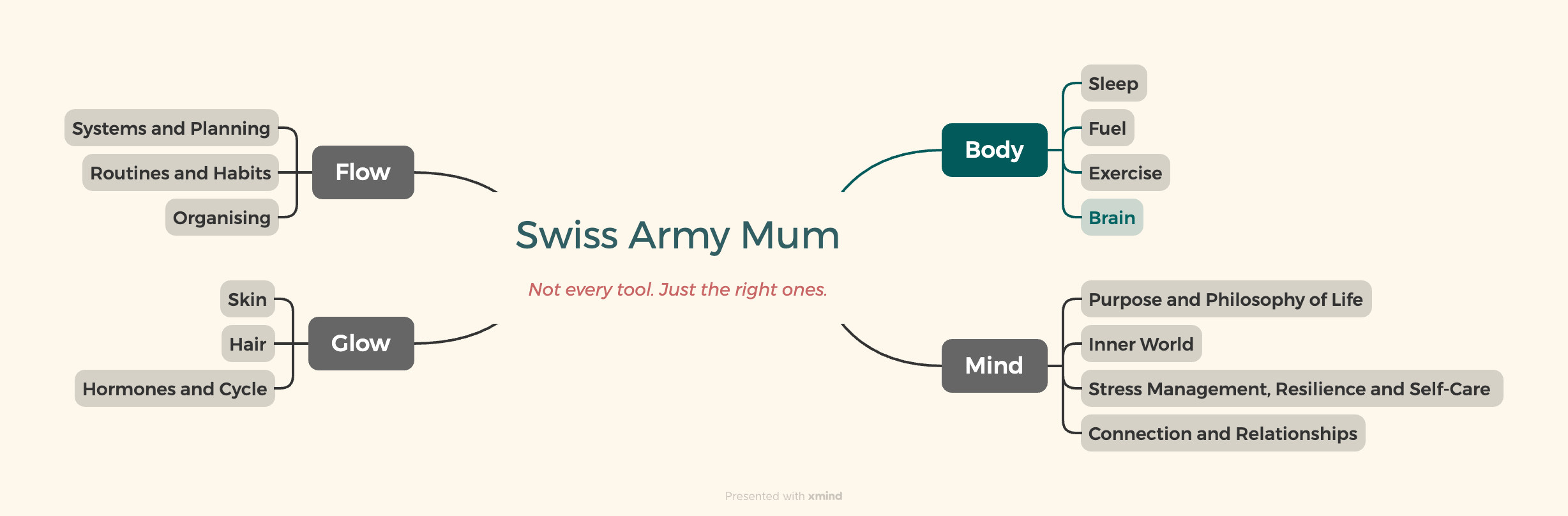
This post sits in the Brain area of the Body Pillar, zooming in on perimenopause. In the Blueprint, estrogen was the manager running your brain’s power grid, roads and construction crews. Perimenopause is when that manager’s schedule goes most erratic. Understanding what’s actually happening here changes how you read every other post in this series, from the lifestyle levers to the hormone therapy question.
The Question Under the Jokes
There’s a question underneath the brain fog jokes that nobody says out loud at the dinner table: is this permanent? Is this the start of something?
You laugh about forgetting the word for colander. You blame the kids, the inbox, the lack of sleep. But somewhere underneath, you’re asking whether your brain has started a decline it won’t come back from.
Mine is a six-digit PIN. The one for the card I’ve used for years. One day I’m standing at the keypad and it simply isn’t there. Not fuzzy. Gone. So I try harder, and the harder I try, the less I have to go on. Was there a 4 in it? A 7? Any of these numbers at all?
Then, another day, I’m not even thinking about it, and my fingers punch it in on their own, as if nothing ever happened.
So, is this the start of something? That question deserves a real answer, not a pat on the head. So this post is going to earn its reassurance rather than hand it to you upfront. It breaks down whether perimenopause brain fog is real, what’s going on in your brain, whether it lasts, how worried to be about Alzheimer’s, and what hormone therapy actually does for your memory.
New here? Start here:

Swiss Army Mum is a practical guide to long-term health for busy women, built on four pillars: Body, Mind, Glow, and Flow.
Not every tool. Just the right ones.
Why It Matters
It’s common
More than six in ten women notice changes in their ability to think clearly, concentrate and remember during the menopause transition. Most describe being 15 to 20% more forgetful than before1. Word-finding trouble. Losing the thread mid-meeting. Reading the same paragraph twice. If this is you, you are in the majority, not the exception.
It’s measurable
Self-report can be shaped by mood, sleep and plain exhaustion, so researchers check it against actual testing. A large 2025 review pooling 26 studies found that perimenopausal women perform measurably worse than premenopausal women on cognitive tests, most consistently on verbal learning and verbal memory2.
It’s not the same as dementia
Most women stay cognitively normal throughout the transition. A minority show clearer weaknesses in verbal learning and memory. Research reviews conclude that perimenopausal cognitive symptoms are typically temporary and do not themselves indicate dementia.
Is perimenopause brain fog real or just stress and poor sleep?
It’s real, and stress and poor sleep make it worse. The 2025 meta-analysis of 26 studies found perimenopausal women score measurably lower than premenopausal women on verbal learning and memory tests. Sleep problems, hot flashes and low mood are each independently linked to cognitive symptoms, which points to both direct hormonal effects and indirect ones. Addressing sleep and hot flashes helps, but it isn’t the whole story.
What’s Actually Happening In There
Think of your brain as running on mains power, with estrogen managing the grid. During perimenopause, the grid doesn’t switch off. It starts running on a temporary generator. The lights stay on. They just flicker.
Three things are going on behind the flicker.
The power supply gets less reliable. Estrogen helps govern how glucose gets into brain cells and how efficiently mitochondria, the cells’ power plants, turn it into energy, including in memory-heavy regions. During perimenopause, brain glucose metabolism declines. Imagine the fuel still arriving, but on an unpredictable schedule: some days plenty, some days a shortfall.
The roads carry less traffic. Estrogen loss also reduces blood flow to the brain, so oxygen and fuel deliveries slow down.
The construction crew shrinks and the fires multiply. As estradiol falls, levels of BDNF, brain-derived neurotrophic factor, drop too. Think of BDNF as fertiliser for the connections between neurons. At the same time, inflammatory signals rise. A 2026 study found these two shifts together explain about 38% of the link between falling estradiol and memory problems3.
Here’s the part that matters most: the brain adapts. Imaging studies tracking women across the stages of menopause show grey matter declining during perimenopause, then partly recovering afterward, while energy use settles at a new, lower level and the brain’s wiring returns to its usual organised pattern. Researchers think this kind of adaptation may explain why the symptoms are temporary for most women. One honest caveat: no one yet knows exactly how much of what shows up on scans directly causes what you feel.
Does It Get Better?
The same 26-study review that confirmed the dip is real found no significant cognitive difference between perimenopausal and postmenopausal women. Long-term studies that follow the same women over years back this up: verbal memory and processing speed decrease during the transition, then rebound to near their earlier levels after menopause.
It’s not universal. Some studies report memory weaknesses that persist into postmenopause, and the women with clearer verbal memory problems during the transition tend to be the ones with more disturbed sleep. There’s also a slow thread of ordinary age-related change running underneath it all, menopause or not.
But for most women, this lifts.
The Alzheimer’s Question, Handled Carefully
What’s established. Carrying a particular risk gene, APOE4, raises Alzheimer’s risk more in women than in men4. That’s one of the most solid pieces of the sex-difference puzzle. Women who carry APOE4, and women who go through menopause early, face a higher risk of Alzheimer’s-related brain changes. In one large study, earlier menopause combined with vascular risk factors like high blood pressure predicted lower cognitive scores three years later.
What’s being studied. Brain imaging shows that some Alzheimer’s-related changes, including amyloid deposits and lower brain glucose use, can appear during the menopause transition, more so in APOE4 carriers. But in that research, the extra amyloid was not linked to worse cognitive performance. Researchers describe it as a possible early, silent phase worth tracking, not a diagnosis. Some reviews also note that memory complaints at menopause may, in some women, be an early signal worth following over time.
What it means for you. Ordinary brain fog during perimenopause is not, by itself, a sign of dementia. The clearer risk factors are genetic and early menopause, and both are worth knowing about and discussing with your doctor. If your memory keeps getting worse over months rather than coming and going, that’s the moment to get it checked.
HRT and Your Brain: What the Trials Actually Show
Hormone therapy and memory is a topic full of mixed messages.
The trial that scared everyone. A large randomised trial, the Women’s Health Initiative Memory Study, started a specific hormone combination in women aged 65 and older. Dementia risk doubled5.
The trial in younger women. The KEEPS Continuation study started hormone therapy within three years of menopause, at an average age of around 52, and followed women for about ten years. It found no long-term harm to thinking skills. It also found no benefit6.
The big-picture review. A 2025 meta-analysis pooling the available studies found no significant link between menopausal hormone therapy and dementia risk overall, and no significant effect by timing, duration or type7.
The observational thread. Some observational studies suggest women who start within a year of menopause show less cognitive decline than non-users, while those who start more than five years later show more. In one large cohort, women carrying APOE4 who used hormone therapy had better memory scores and larger brain volumes in memory regions. These are interesting signals, but observational studies can’t prove cause and effect.
The bottom line. Current guidelines do not support hormone therapy for treating cognitive problems or preventing dementia. Started close to menopause, the best trial data shows no harm to the brain and no cognitive boost. Treating hot flashes, poor sleep and low mood may ease cognitive symptoms, so the conversation with your doctor is worth having for those reasons, but not for a memory upgrade.
Does starting HRT early protect your brain from decline?
The best trial evidence says no, not specifically for memory. The KEEPS Continuation study, which started hormone therapy within three years of menopause and followed women for about ten years, found no long-term cognitive harm and no benefit. A 2025 meta-analysis found no significant effect of hormone therapy on dementia risk by timing, duration or type. Current guidelines do not recommend hormone therapy for cognition or dementia prevention.
If sorting the real evidence from the noise is useful to you, subscribing keeps this series and everything after it landing straight in your inbox.
The 80/20 for Perimenopause Brain Fog
You can’t control your hormones’ schedule. You can control the conditions around it. Start here.
Protect your sleep
The women with clearer memory weaknesses during perimenopause tend to have more disturbed sleep, and sleep problems are independently linked to cognitive symptoms. Use the four fundamentals from the Sleep Blueprint: a consistent schedule, morning light, a cool bedroom and a caffeine cut-off.
Treat what’s disrupting you
Hot flashes, night sweats and low mood each make cognitive symptoms worse, and addressing them may ease your brain fog. If they’re affecting your days or your nights, talk to your doctor about your options.
Watch your midlife numbers
High blood pressure and diabetes in midlife are among the best-documented risk factors for later dementia, and early menopause plus vascular risk is a combination worth taking seriously. Know your blood pressure and blood sugar. The Brain Blueprint and the next post cover what to do with them.
Keep moving
Exercise sits in the strongest evidence tier for protecting thinking skills. The doses from the Exercise Blueprint still apply: around 150 minutes of moderate cardio a week and strength training twice a week.
Where to start
Not sure where to start? Start with sleep. The SAM Sleep Self-Assessment scores your sleep across six dimensions and gives you your single highest-leverage starting point in under two minutes. The Brain Brief puts this whole series on one page.
Common Mistakes
Telling yourself it’s all in your head
It isn’t. The dip is real, measurable, and most consistent in verbal memory. Naming it accurately is the first step to managing it.
Reading every lost word as the start of dementia
For most women, perimenopausal brain fog is temporary and does not indicate dementia. Fluctuating, word-finding, worse after a bad night: that’s the typical pattern. Steadily worsening over months: that’s the one to get checked.
Taking hormone therapy for your memory
Guidelines don’t support it, and the best trial in women close to menopause found no cognitive benefit. Treat your symptoms. Don’t expect a cognitive upgrade.
Ignoring sleep and hot flashes
They’re not side issues. They’re some of the most fixable parts of the brain fog picture.
Next week: Lifestyle Levers for Brain Health
We’re going lever by lever:
What the evidence actually says for exercise, blood sugar, diet, sleep, connection and stress
Which levers sit in the strongest evidence tier, and which are still being worked out
How to do each one, with doses, and where the wellness industry oversells
After that: Your Brain’s Messengers. Dopamine, serotonin and friends: what they really do, and the myths surrounding them.
Medical note: This is educational, not personal medical advice. Your biology, history, and context matter. Work with a qualified healthcare professional.
References
Mervosh, N., Devi, G. (2025). “Estrogen, menopause, and Alzheimer’s disease: understanding the link to cognitive decline in women.” Frontiers in Molecular Biosciences, 12. https://doi.org/10.3389/fmolb.2025.1634302
Bangle, A., Williams, D., Walters, J., Nguyen, L. “Cognitive functioning in perimenopause: An updated systematic review and meta-analysis.” Psychology and Aging, 2025. https://doi.org/10.1037/pag0000946
Liu, S., Huang, Z., Zeng, Y. “Estradiol reduction during perimenopause is associated with lower BDNF, elevated inflammation, hippocampal loss, and cognitive decline.” Experimental Gerontology, 2026. https://doi.org/10.1016/j.exger.2026.113219
Altmann, A., Tian, L., Henderson, V.W., Greicius, M.D. “Sex modifies the APOE-related risk of developing Alzheimer disease.” Annals of Neurology, 2014. https://doi.org/10.1002/ana.24135
Shumaker, S.A. et al. (2003). “Estrogen plus progestin and the incidence of dementia and mild cognitive impairment in postmenopausal women: the Women’s Health Initiative Memory Study.” JAMA, 289(20), 2651–2662. https://doi.org/10.1001/jama.289.20.2651
Gleason, C.E. et al. “Long-term cognitive effects of menopausal hormone therapy: Findings from the KEEPS Continuation Study.” PLOS Medicine, 2024. https://doi.org/10.1371/journal.pmed.1004435
Melville, M. et al. “Menopause hormone therapy and risk of mild cognitive impairment or dementia: a systematic review and meta-analysis.” The Lancet Healthy Longevity, 2025. https://doi.org/10.1016/j.lanhl.2025.100803