


Back in January, we started with the Body pillar. First came Sleep, the non-negotiable foundation. Then Fuel, the master lever for metabolic health. Then Exercise, muscle as a longevity organ.
This week: The Brain. The organ that sleep, food and movement have been feeding all along. It’s where everything else in the Body pillar pays out.
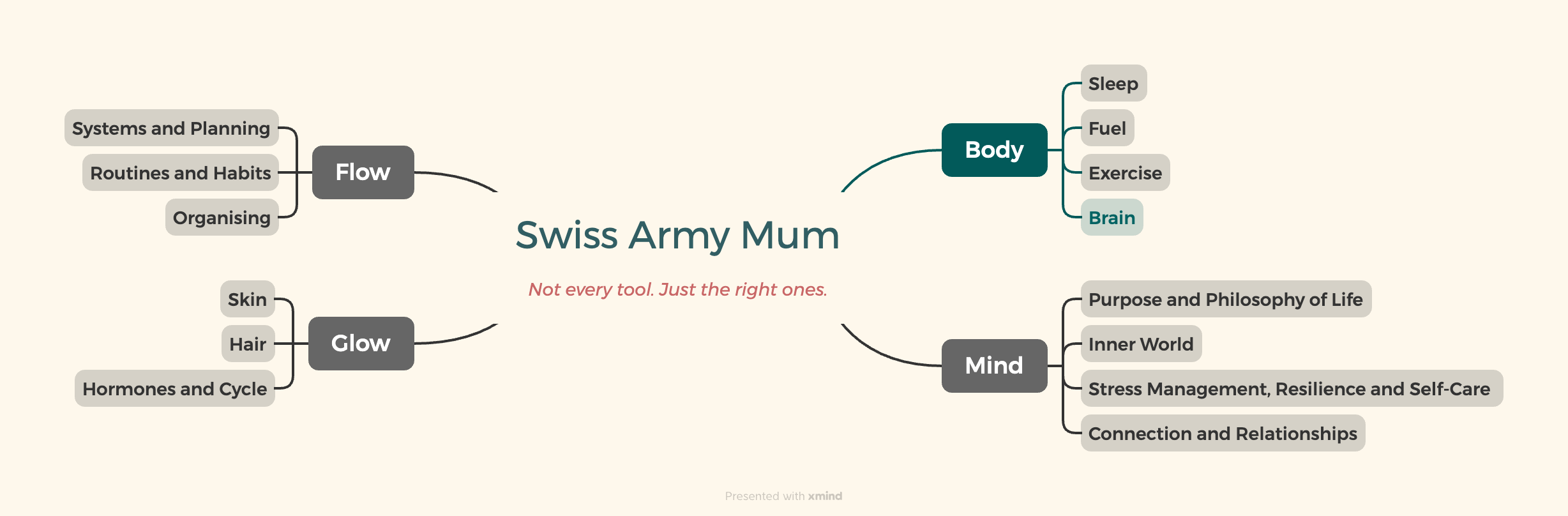
This post sits in the Brain area of the Body Pillar. Brain is the fourth area of the Body pillar, and the one where the other three meet: Sleep sets the conditions, Fuel sends the signals, Exercise builds the structure, and your brain is the organ running on all three at once. It is also the bridge to the Mind Pillar. Mind is about how you use your thinking. Brain is about keeping the hardware that does the thinking in good repair. This blueprint maps the whole area. The two zoom posts that follow go deeper on perimenopause and on the evidence behind each lever for good brain health.
The Word That Wouldn’t Come
You’re mid-sentence at dinner, reaching for a word you’ve used a thousand times, and it isn’t there. Not gone. Just not answering. You laugh it off, someone fills in the blank, the conversation moves on. But you clock it.
Most of us only start thinking about our brain at moments like that. Which is backwards. Your brain has been changing your whole life, and some of the risk factors that matter most for it at 80 are already being measured in your forties and fifties. That sounds alarming. It’s actually the good news. It means the window to act is open right now, and most of what keeps it open is stuff you already know how to do.
The Lancet Commission on dementia prevention puts it simply:
It’s never too early or too late to take action.
This post is the map: what’s changing, why perimenopause matters, how your brain keeps itself running, and the short list of levers that carry most of the weight.
New here? Start here:

Swiss Army Mum is a practical guide to long-term health for busy women, built on four pillars: Body, Mind, Glow, and Flow.
Not every tool. Just the right ones.
The SAM Brief
Why Midlife Brain Health Matters
A big share of the risk is in your hands
Dementia feels like a lottery. It isn’t, not entirely. When researchers pool the data on modifiable risk factors, the things you can actually change, they consistently land on a large number. Worldwide, around 12 modifiable factors account for roughly 40 to 45% of dementia cases. In a large Canadian study, those same factors accounted for nearly 50% of dementia cases among women specifically, with physical inactivity, obesity, hearing loss and high blood pressure among the biggest contributors1.
Read that again.
Around half. Not guaranteed, not a promise for any one person, but a population-level signal strong enough to take seriously.
Your genes deal the cards. A lot of the game is still yours to play.
Midlife is when the bill gets written
Several of the strongest risk factors for dementia are measured in midlife, and they still count decades later. In long-running studies, high blood pressure and diabetes in midlife contributed substantially to dementia risk decades later. Diabetes in midlife raises dementia risk by roughly 60 to 70%. In pooled US cohorts, midlife risk factors alone accounted for around a fifth of all dementia cases.
Think of it like compound interest running in reverse. Small, quiet problems in your forties and fifties keep accruing in the background. The good news is that the same logic works the other way. Fix them now, and you stop the meter running.
Perimenopause is a brain event, not just a hormonal one
For years, menopause was filed under reproduction and left there. Brain imaging has changed that. The menopause transition reshapes brain structure, connectivity and energy use in women, and comparisons with men of the same age show these changes are specific to menopause, not just to getting older2. Estradiol, the main form of estrogen, can fall by up to 90% across the transition. Your brain notices.
This is why a brain health blueprint for women over 35 can’t just copy the generic version. The midlife risk factors above and perimenopause land in the same decade of your life.
Your independence lives here
There are two very different things that get lumped together as “losing it”. Normal aging is gradual and doesn’t touch your independence. You misplace your keys; you don’t forget what keys are for.
Pathological decline, dementia, is different: progressive, global, and it eventually takes away the ability to live on your own. They are not points on the same line. They are different processes. Everything in the 80/20 below is about protecting the second outcome while making peace with the first.
Does perimenopause cause dementia?
No. Perimenopause is associated with mild, usually temporary cognitive changes such as brain fog, word-finding trouble and memory lapses. Research reviews conclude that these symptoms do not typically indicate dementia, and for most women they ease after the transition. Dementia is progressive and eventually disabling; perimenopausal brain fog is neither. If what you notice is steadily getting worse rather than coming and going, or it’s affecting your ability to manage daily life, that’s worth a conversation with your doctor.
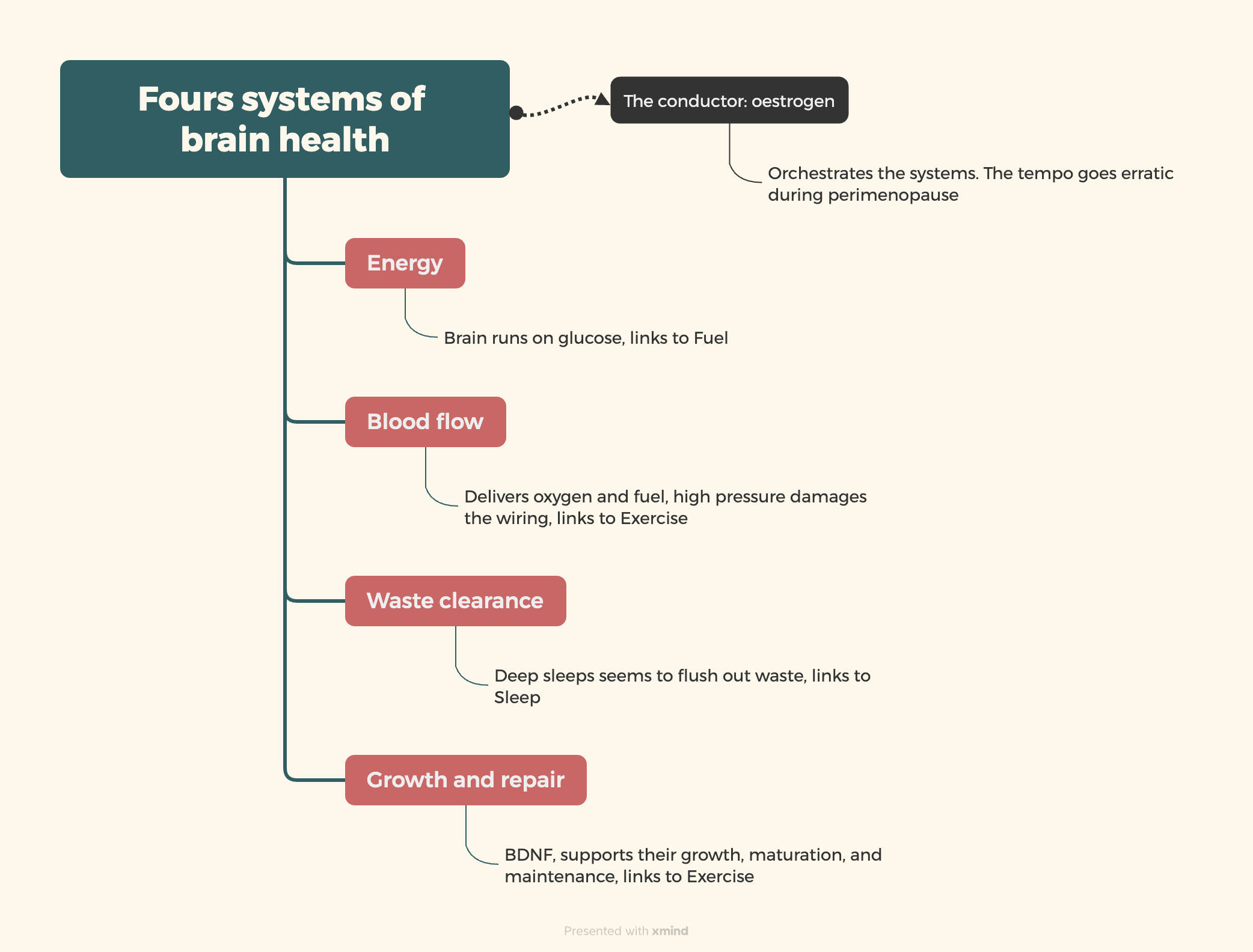
How Your Brain Stays Healthy: Four Systems
Picture your brain as a city that never closes.
To keep running, it needs four things: a power grid, a road network, a night-time cleaning crew, and construction crews that repair and build.
Each one maps onto an area of the Body pillar you already know.
And running across all four, there’s a manager most of us never knew we had.
The power grid: energy supply
Your brain runs on glucose. Estrogen helps run the grid: it governs how glucose gets into brain cells and how efficiently mitochondria, the cell’s power plants, turn it into usable energy. During perimenopause, brain glucose metabolism dips, and after menopause it settles at a lower level rather than bouncing all the way back3.
This is where Fuel comes in. The insulin and blood sugar story from the Fuel Blueprint doesn’t stop at your waistline. Managing blood sugar and metabolic health sits in the strongest tier of evidence for protecting the brain, alongside exercise and diet. Same lever, bigger payoff than you thought.
The road network: blood flow
Every neuron depends on blood delivering oxygen and fuel. Two things wear those roads down. Estrogen loss reduces blood flow to the brain. And high blood pressure in midlife is linked to white matter hyperintensities: small bright patches on brain scans that mark damage to the brain’s wiring, and to dementia later on.
Exercise is the road crew. Regular aerobic exercise increases blood flow to the brain. This is the Exercise Blueprint’s cardio, doing a job you probably didn’t know it had.
The night shift: waste clearance
Your brain has its own cleaning crew, and it seems like it only gets full access to the building after hours. It’s called the glymphatic system. During deep sleep, the space between brain cells widens so fluid can flush out the waste that builds up during the day, including proteins linked to Alzheimer’s4.
The crew works better when the rest of the city cooperates. In a study of more than 40,000 adults, people who combined too much or too little sleep with low physical activity had the most damage to their brain’s wiring on scans, and staying active softened the damage linked to poor sleep. One honest caveat: the cleaning crew is well established as a general feature of sleep. Whether it specifically explains perimenopausal brain fog hasn’t been shown yet.
The construction crews: growth and repair
Your brain is never finished. It keeps building connections and repairing itself, and one of its key materials is BDNF, brain-derived neurotrophic factor. Think of it as fertiliser for brain cells: it helps them grow, connect and survive. Exercise raises BDNF, which is part of why movement sits in the strongest evidence tier.
Estrogen matters here too. A 2026 study found that falling estradiol during perimenopause tracked with lower BDNF and higher inflammation, and those two changes together explained about 38% of the link between estrogen decline and memory problems5. Fewer construction workers, more fires to put out.
Over a lifetime, all this building adds up to what researchers call cognitive reserve: the capacity to withstand damage without it showing up as problems in daily life. Social engagement and combined lifestyle habits both help build it.
The manager running all four: estrogen
You’ll have noticed a pattern. Estrogen shows up in every system: the power grid, the roads, the construction crews. Its receptors sit in the regions you rely on most, including the hippocampus (your memory hub), the prefrontal cortex (planning and focus) and the amygdala (emotion).
For years, estrogen got filed under “reproductive hormone”. That’s a bit like describing a plant manager as the person who signs the payroll. Technically true, but incomplete. Perimenopause isn’t the manager quitting. It’s the manager’s schedule going erratic, present some days, absent others, before the city settles into a new routine.
What Actually Changes, and When
Here’s the part that surprises people: brain change didn’t start at menopause. It started years earlier.
Processing speed, how fast you pull an answer out of storage, starts a slow, steady decline in early adulthood. Working memory, the mental scratchpad you use to hold a phone number while you find a pen, starts easing off in your thirties and forties. Meanwhile, crystallised intelligence, your vocabulary, knowledge and judgment, holds steady or keeps growing into your sixties and seventies6.
You are not simply declining. You’re trading speed for depth.
Perimenopause then turns up the volume on that trade. Across the stages of menopause, imaging studies show a clear arc. Before: baseline. During perimenopause: grey matter volume and brain energy use decline, and white matter, the brain’s wiring, temporarily reorganises. After menopause: grey matter partly recovers, energy use stabilises at a lower level, and the wiring returns to its usual organised profile. The brain adapts.
What you feel during the dip is real. More than 60% of women report changes in their ability to think clearly, concentrate and remember during the transition, and most describe being 15 to 20% more forgetful than before. When researchers move beyond self-report to actual testing, a review pooling 26 studies confirmed that perimenopausal women perform measurably worse than premenopausal women, most consistently on verbal learning and memory7.
Two reassuring details sit alongside that. Most women stay cognitively normal throughout, with a minority showing clearer memory weaknesses, often alongside more disrupted sleep. And the same 26-study review found no significant difference between perimenopausal and postmenopausal women, which supports what long-term studies show: for most women, the dip is temporary.
One more note: researchers still don’t know how much the brain changes on scans directly cause the symptoms you feel. Sleep problems, hot flashes and low mood each make cognitive symptoms worse on their own.
Is brain fog during perimenopause the same as dementia?
No. Perimenopausal brain fog shows up as fluctuating difficulty with word-finding, memory and concentration, most consistently in verbal learning and memory. Most women stay cognitively normal throughout, and long-term studies suggest the dip largely resolves after menopause. Dementia involves progressive, global decline that eventually prevents independent living. Brain fog is common and usually temporary.
If sorting the real evidence from the noise is useful to you, subscribing keeps this series and everything after it landing straight in your inbox.
The 80/20: Five Levers That Carry the Weight
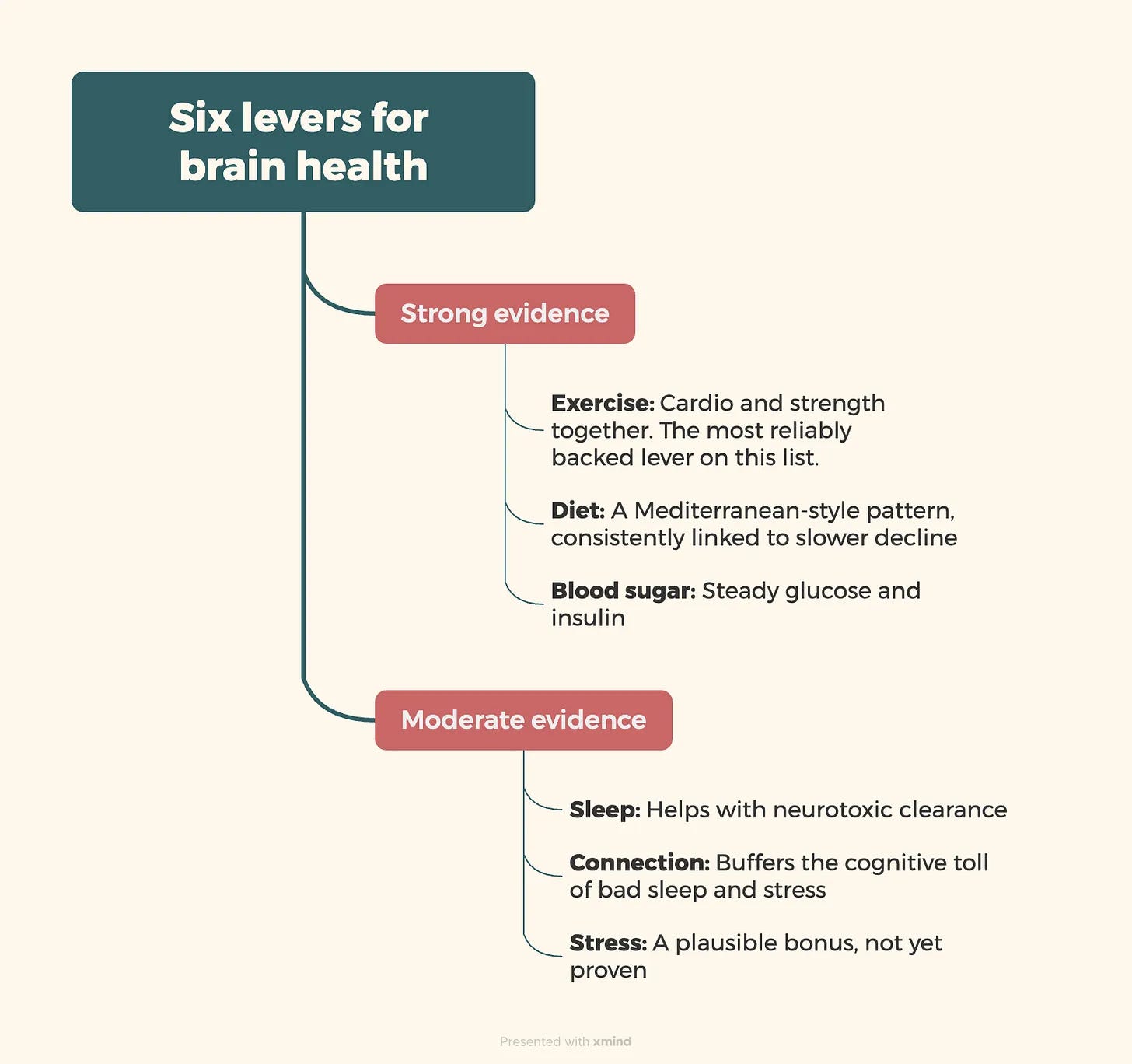
When it comes to midlife brain health, the research on lifestyle splits into two tiers. Exercise, blood sugar and cardiovascular control, and a Mediterranean-style diet have the strongest evidence. Sleep, stress reduction and social connection have moderate evidence: the associations are consistent, but the trials are smaller.
And there’s a bonus finding that matters more than any single lever: combining several habits consistently does better than going all in on one.
Here are the five that carry most of the weight.
Move, and lift things
What: About 150 minutes of moderate cardio a week, strength training twice/thrice a week, and 7,000 to 8,000 steps a day. The same doses from the Exercise Blueprint.
Why: Aerobic and resistance exercise consistently improve executive function, the brain’s planning and focus system, and raise BDNF. In a 6-month randomised trial in women, aerobic exercise improved executive function while lowering fasting insulin and cortisol. One habit, three systems: power grid, roads and construction crews.
How: If you’re starting from zero, start with steps. Then add two strength sessions. Cardio follows.
Know your numbers: blood pressure and blood sugar
What: Know your blood pressure and your blood sugar, and act on them if they’re creeping up.
Why: Midlife high blood pressure and diabetes are among the best-documented drivers of later dementia, and both are silent. You won’t feel them. You have to measure them.
How: Ask for both at your next check-up. If your blood sugar is drifting, the five principles in the Fuel Blueprint are your starting point.
Eat the pattern, not the superfood
What: A Mediterranean-style pattern: vegetables, legumes, olive oil, nuts, fish, whole foods. Fewer ultra-processed foods.
Why: A meta-analysis of 32 studies found that people who stick closely to a Mediterranean diet have lower rates of cognitive impairment and Alzheimer’s. Diets heavy in ultra-processed food are linked to faster cognitive decline. The trial evidence is less clear-cut than the observational data, which we’ll unpack in the lifestyle levers post. But the pattern is a good bet, and it’s the same one that flattens your glucose curve.
How: If you’ve already applied the Fuel Blueprint, you’re mostly there. No brain-specific shopping list required.
Protect your sleep and go easy on alcohol
What: The four sleep fundamentals from the Sleep Blueprint: a consistent schedule, morning light, a cool bedroom, a caffeine cut-off. And keep alcohol modest.
Why: Sleep is when the night shift runs. Sleeping too much or too little, combined with inactivity, showed up as the most wiring damage in a 40,000-person study. Excessive alcohol is one of the main modifiable risk factors for dementia, and it also wrecks the deep sleep your cleaning crew needs. While we’re here: chronic stress counts too. In a nine-year study of more than a thousand older adults, higher lifetime stress predicted worse thinking skills.
How: Pick one sleep fundamental and hold it for two weeks before adding the next.
Stay connected, and get your hearing checked
What: Regular time with people you actually enjoy. And a hearing test if you’ve been turning up the volume or asking people to repeat themselves.
Why: Social connection buffers cognitive decline. In one study of nearly 2,000 older adults, strong social engagement softened the cognitive toll of restless sleep and low mood. Hearing loss was among the biggest contributors to dementia risk in women in that Canadian data. Whether treating it lowers risk isn’t something the evidence in this post settles, but a hearing test is cheap, quick and painless.
How: Put one recurring social plan in the calendar. Book the hearing test.
Don’t try to do everything at once
Add one lever at a time:
Weeks 1 to 4: get your numbers checked, and lock in one sleep fundamental
Weeks 5 to 8: add steps and two strength sessions
Weeks 9 to 12: shift your plate toward the Mediterranean pattern and add the rest
Consistency beats intensity. These habits compound over decades, just like the risks do.
Common Mistakes
Hunting for a brain food. It’s tempting to look for the one ingredient that sharpens you. The evidence points somewhere less exciting and more useful: the overall pattern of what you eat, held for years.
Ignoring the boring numbers. Blood pressure, blood sugar and hearing don’t feel like brain health. They are some of the biggest contributors to dementia risk in midlife.
Expecting hormone therapy to sharpen your memory. Treating hot flashes, sleep disruption and low mood may ease cognitive symptoms, and hormone therapy is one way women treat hot flashes. But current guidelines do not support hormone therapy for treating cognitive problems or preventing dementia. The full story, including why timing matters, is in the next post.
Either panicking or dismissing it. Some women read every lost word as an early warning sign. Others brush it all off as stress. Neither is right. The dip is real and measurable, and for most women it is temporary.
Self-Assessment: Your Brain Health Audit
Answer yes or no:
Do you know your blood pressure from the last year?
Do you know your blood sugar from the last year?
Do you move for around 150 minutes a week?
Do you lift something heavy at least twice a week?
Do you mostly eat whole foods, with ultra-processed foods as the exception?
Do you sleep 7 to 9 hours on a consistent schedule?
Do you keep alcohol modest?
Have you had your hearing checked, or are you confident it’s fine?
Do you spend time most weeks with people you enjoy?
Every “no” is a lever with room to move. Don’t tackle them all. Pick the one that feels easiest and start there. Consistency beats perfection.
Fog or something else? Perimenopausal brain fog tends to come and go, shows up mostly as word-finding and verbal memory trouble, and gets worse with poor sleep, hot flashes and low mood. If instead what you notice keeps getting worse over months, or starts getting in the way of managing daily life, see your doctor.
The Next Level
Once the five levers are in place, here’s where to go deeper.
Stack your levers. Programmes that combine exercise, diet, sleep and social activity consistently outperform single-habit interventions. Once two levers are automatic, add a third. The combination is the point.
Have the hormone therapy conversation, for the right reasons. If hot flashes and night sweats are wrecking your sleep, treating them protects your night shift and may ease cognitive symptoms. Go in for symptom relief, not a cognitive upgrade. The perimenopause post walks through what the trials actually show about timing.
Resources Coming in This Series
Perimenopause Brain Fog: What’s Actually Happening: whether the changes last, hormone therapy and cognition
Lifestyle Levers for Brain Health: the evidence behind each lever, ranked, and where the wellness industry oversells
Your Brain’s Messengers: the main neurotransmitters, what they actually do, and whether “boosting” them is a good idea
My own experiment with food and cognition: I participated in a research project trying to elucidate the effect of food on cognition. I’m collaborating with The Brain Brief by Eleni to analyse my results
Medical note: This is educational, not personal medical advice. Your biology, history, and context matter. Work with a qualified healthcare professional.
Son, S. et al. “Potentially Modifiable Dementia Risk Factors in Canada: An Analysis of Canadian Longitudinal Study on Aging with a Multi-Country Comparison.” The Journal of Prevention of Alzheimer’s Disease, 2024. https://doi.org/10.14283/jpad.2024.105
Mosconi, L. et al. “Menopause impacts human brain structure, connectivity, energy metabolism, and amyloid-beta deposition.” Scientific Reports, 2021. https://doi.org/10.1038/s41598-021-90084-y
Mosconi, L. et al. “Menopause impacts human brain structure, connectivity, energy metabolism, and amyloid-beta deposition.” Scientific Reports, 2021. https://doi.org/10.1038/s41598-021-90084-y
Xie, L. et al. “Sleep drives metabolite clearance from the adult brain.” Science, 2013. https://doi.org/10.1126/science.1241224
Liu, S., Huang, Z., Zeng, Y. “Estradiol reduction during perimenopause is associated with lower BDNF, elevated inflammation, hippocampal loss, and cognitive decline.” Experimental Gerontology, 2026. https://doi.org/10.1016/j.exger.2026.113219
Menor, J. “Processing speed moderates the relationship between age and crystallized intelligence and influences the indirect effect of age on verbal working memory in middle-aged and older adults.” Frontiers in Aging Neuroscience, 2026. https://doi.org/10.3389/fnagi.2026.1736609
Bangle, A., Williams, D., Walters, J., Nguyen, L. “Cognitive functioning in perimenopause: An updated systematic review and meta-analysis.” Psychology and Aging, 2025. https://doi.org/10.1037/pag0000946