


This is Part 2 of a 4-part deep-dive series on the brain, and it’s the practical one: your brain health lifestyle, lever by lever.
We have covered the Brain Blueprint: the four systems that keep your brain running, and the 80/20 minimum. Last week, we zoomed in on perimenopause brain fog.
This mini-series breaks down the parts of brain health that deserve more than a paragraph:
Part 1: Perimenopause Brain Fog. Whether it’s real, whether it lasts, the Alzheimer’s question, and HRT
Part 2 (this post): Lifestyle Levers. The evidence behind each lever, ranked, and how to actually do it
Part 3: Your Brain’s Messengers. The main neurotransmitters, what they do, and some myth-busting
Part 4: Brain Training. A collaboration on what those brain games can and can’t tell you
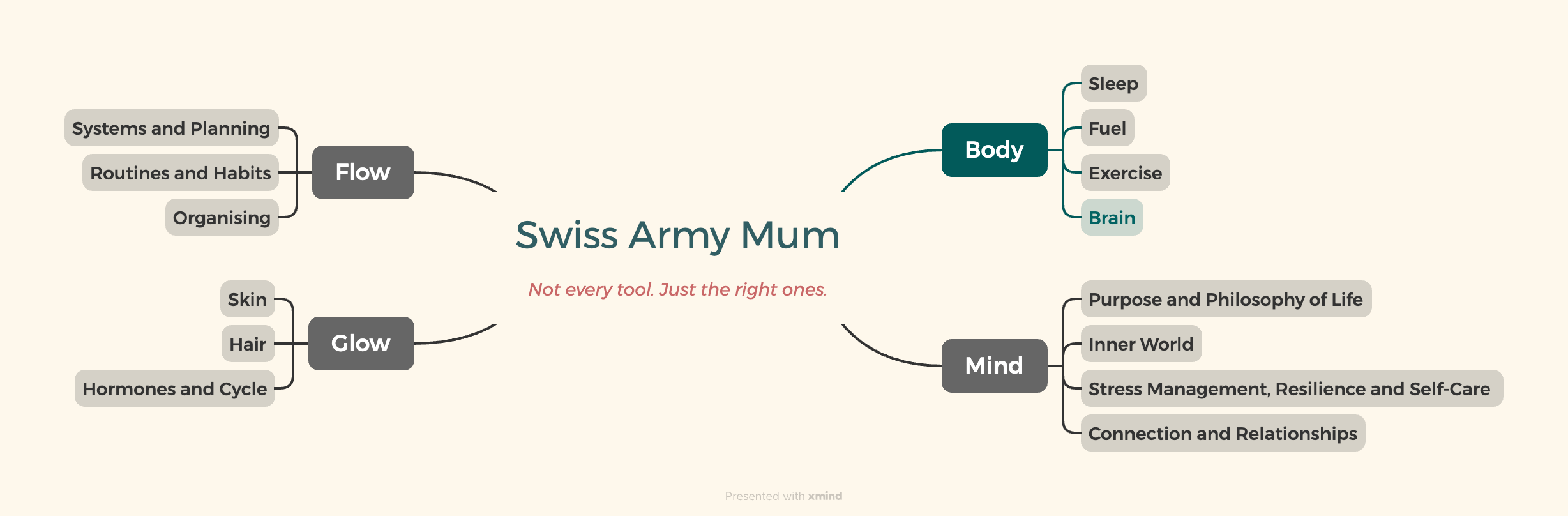
This post sits in the Brain area of the Body Pillar, as its practical engine room. The Blueprint gave you the 80/20 in one page. This zoom goes lever by lever: what the evidence says, how strong it is, and exactly how to do it. It’s also where the Brain area connects back to everything else in the Body Pillar. Almost every lever here is a habit you’ve already met in Sleep, Fuel or Exercise.
Pizza, Ice Cream, and a Movie
Saturday night in our house is pizza, ice cream and a movie with my family. Non-negotiable.
When I wore a glucose monitor for two weeks, Saturday night was a metabolic war zone. Several huge peaks. Glucose elevated for hours, and a rollercoaster overnight while I slept.
I didn’t give it up. It’s quality time, connection and joy. What I changed was around the edges: homemade “nice cream” (frozen berries blended with Greek yoghurt) instead of the store-bought tub, and a casual walk on the treadmill while we watch.
I’m telling you this because it’s a perfect picture of how brain health actually works. The movie night itself is one lever: connection. The walk is another: movement and blood sugar. Together, they do the job.
This post breaks down the six lifestyle levers for your brain health: what each one does, how strong the evidence really is, how much you need, and where the wellness industry oversells.
New here? Start here:

Swiss Army Mum is a practical guide to long-term health for busy women, built on four pillars: Body, Mind, Glow, and Flow.
Not every tool. Just the right ones.
Why It Matters
This is where the modifiable risk lives
Worldwide, around 12 modifiable risk factors account for roughly 40 to 45% of dementia cases. In a large Canadian study, those factors accounted for 52% of dementia cases among women, with physical inactivity, hearing loss and high blood pressure among the biggest contributors. Many of those factors are lifestyle levers1.
The evidence comes in two tiers
Not every lever is backed equally. Exercise, blood sugar and cardiovascular control, and a Mediterranean-style diet sit in the strongest evidence tier. Sleep, social connection and stress reduction have moderate evidence: consistent associations, but smaller and fewer trials. All six matter. The first three are where the proof is thickest.
They work better together
Programmes that combine several habits, exercise plus diet plus sleep plus social activity, consistently outperform single-habit interventions. That’s why this post is six levers, not one magic fix.
The levers
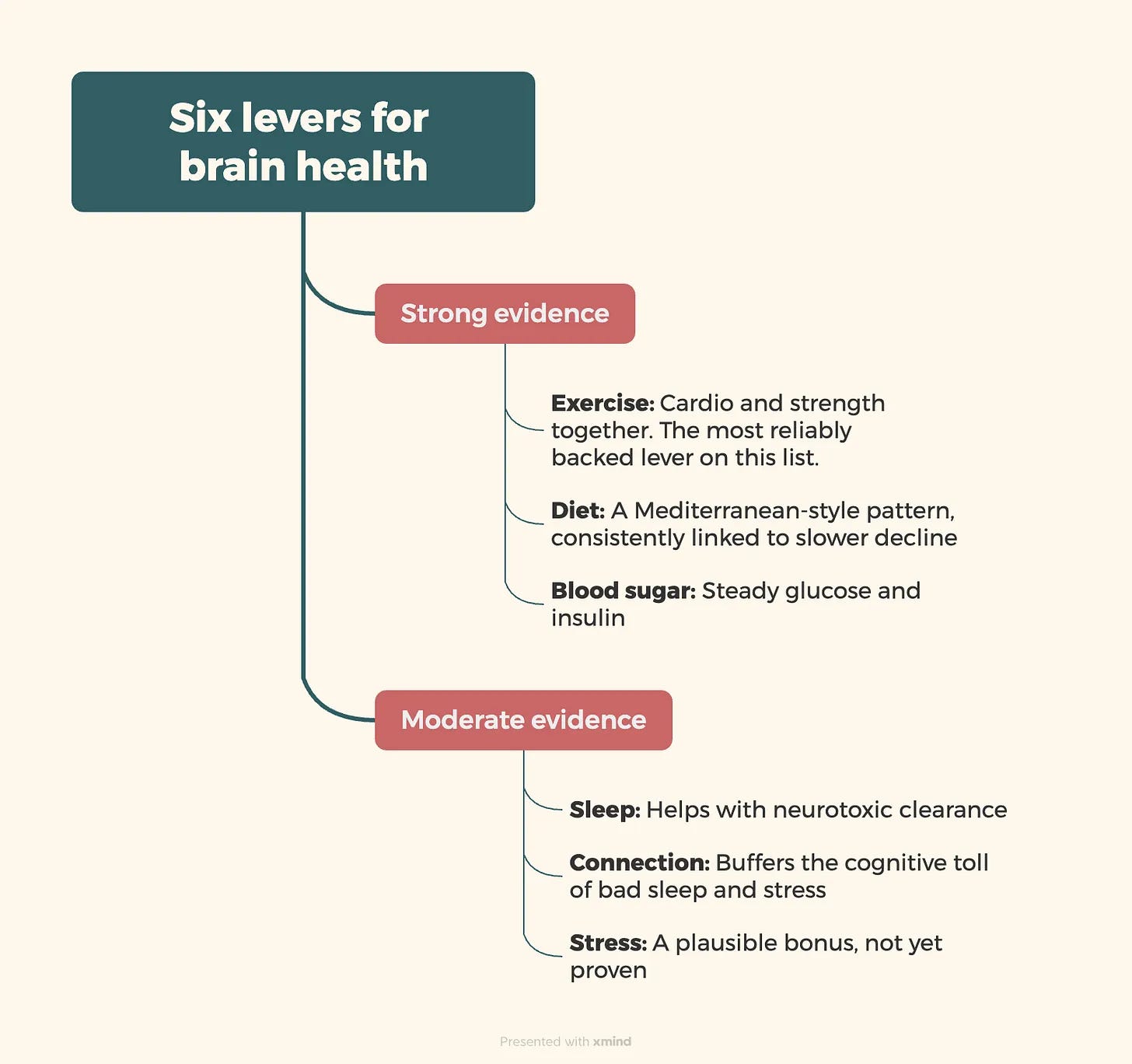
Strong evidence
Move, and Lift Things
Remember the Brain Blueprint’s city metaphor? Exercise works on two of its systems at once. Aerobic exercise increases blood flow to the brain, so the roads carry more fuel and oxygen. And both aerobic and resistance exercise raise BDNF, the fertiliser your brain’s construction crew relies on. Both kinds consistently improve executive function, your brain’s planning and focus system.
How big is the effect? Across dozens of trials in adults over 50, exercise at a real, moderate-to-vigorous intensity produced a modest but real improvement in cognitive performance2. Modest. This isn’t a brain transformation.
There’s a women-specific bonus too. In a 6-month randomised trial in women, aerobic exercise improved executive function while also lowering fasting insulin and cortisol. One habit, three wins.
How much: the same doses as the Exercise Blueprint. Around 150 minutes of moderate cardio a week, strength training two to three times a week, and 7,000 to 8,000 steps a day. The full protocols are in the Strength Training and Cardio posts.
Blood Sugar and Blood Pressure
These two don’t feel like brain health.
Managing blood sugar and metabolic health sits in the strongest evidence tier for protecting cognition. Diabetes in midlife raises dementia risk by roughly 60 to 70%. High blood pressure in midlife is linked to dementia and to white matter hyperintensities: small bright patches on brain scans that mark damage to the brain’s wiring. Both are silent. You won’t feel them. You have to measure them.
How: know your blood pressure and blood sugar, and act early if they creep up. For blood sugar, the five principles in the Fuel Blueprint are your starting point: whole foods, fewer added sugars and refined grains, protein and healthy fats with meals, plenty of fiber, and spaced meals with an overnight fast. And move after you eat: muscle acts as a glucose sink, pulling sugar out of your bloodstream.
Do you need a gadget? Probably not. I wore a continuous glucose monitor and loved the data, but for most people it isn’t necessary. The low-tech alternative works: notice how you feel two to three hours after a meal. Crashing, craving sugar or foggy? That meal spiked you.
Do you need a continuous glucose monitor if you’re not diabetic?
For most people, probably not. Blood sugar control matters for brain health, but the practical response is the same set of basics: whole foods, fiber, protein with meals, and moving after you eat. A monitor can be interesting if you’re curious and have access, but noticing how you feel two to three hours after meals gives you most of the same signal for free.
Eat the Pattern, Not the Superfood
A meta-analysis of 32 studies found that people who stick closely to a Mediterranean diet have lower rates of cognitive impairment and Alzheimer’s. The same pattern, vegetables, legumes, olive oil, nuts, fish and whole foods, is the one that flattens your glucose curve.
However, when researchers ran a rigorous trial comparing a brain-focused diet against a solid control diet, the difference in cognitive outcomes was small enough to be disappointing3. That’s one high-quality trial coming back null, not a body of evidence collapsing. The overall diet-and-brain evidence is still rated among the strongest on this list. It just isn’t the guaranteed brain-saver the headlines implied.
The other side of the coin is clearer. Diets heavy in ultra-processed food are linked, in large studies following people for years, to faster cognitive decline4. Cutting back on those may be more useful than adding any single “brain food”.
How: if you’ve applied the Fuel Blueprint, you’re mostly there. The evidence here is about overall eating patterns held for years, not about pills or single ingredients.
Moderate evidence
Sleep, the Night Shift
The Blueprint introduced the night shift: during deep sleep, it seems that your brain’s cleaning crew flushes out the waste that builds up during the day. Poor sleep is consistently linked to a higher risk of later cognitive impairment and Alzheimer’s in studies that follow people over years5.
Sleep and movement also work as a team. In a study of more than 40,000 adults, people who combined too much or too little sleep with low physical activity had the most damage to their brain’s wiring on scans, and staying active softened the damage linked to poor sleep. If your sleep is a work in progress, moving more still covers you a little.
Why only “moderate”? Because most of this evidence comes from observational studies. Trials testing sleep improvements for brain outcomes are still small and varied.
How: the four fundamentals from the Sleep Blueprint. A consistent schedule, morning light, a cool bedroom and a caffeine cut-off. And keep alcohol modest: excessive alcohol is one of the main modifiable risk factors for dementia, and it fragments the sleep your cleaning crew needs.
Does better sleep actually protect against dementia?
Poor sleep is consistently linked to a higher risk of cognitive impairment and Alzheimer’s in long-term studies. Most of that evidence is observational, though, and trials testing whether improving sleep protects the brain are still small. Sleep is worth fixing for its own sake, and it supports every other lever on this list.
Your People
Strong social engagement is linked, across a large body of research, to lower dementia risk6.
In a study of nearly 2,000 older adults, those with strong social engagement were protected against much of the usual cognitive toll of restless sleep and low mood. Your people don’t just add to your life. They cover for the rough patches in the rest of this list. Social engagement also helps build cognitive reserve: the capacity to withstand damage without it showing up in daily life.
One caveat: this evidence is observational, so cause and effect can’t be fully separated.
While we’re here: hearing loss was among the biggest contributors to dementia risk in women in that Canadian data. Whether treating it lowers the risk isn’t something the evidence in this series settles. But a hearing test is quick, cheap and painless, and staying in the conversation is half of what this lever is about.
How: one recurring social plan in the calendar, with people you actually enjoy. And book the hearing test if you’ve been turning up the volume or asking people to repeat themselves.
Stress
Chronic stress keeps your body’s stress system switched on, and prolonged activation is linked to faster cognitive aging. In one nine-year study of more than 1,000 older adults, people carrying more cumulative life stress had poorer thinking skills, independent of other factors.
Why moderate, not strong? Trials of stress-reduction programmes for brain outcomes are still small and varied. Manage stress for the dozen good reasons it deserves, sleep, mood, relationships, blood pressure. Count brain protection as a plausible bonus.
How: the Mind Pillar has the toolkit. Start with the posts on anxiety and worry, and on overwhelm and decision fatigue.
How Little You Actually Need
Here’s the reassuring part: a brain health lifestyle takes less time than you’d think. The movement doses above, the biggest time commitment on this list, add up to about 3% of your week, as the Exercise Blueprint showed. Sleep, food and blood sugar aren’t extra time. They’re how you already spend time, done slightly differently. Connection is a phone call or a standing coffee date.
What This Looks Like in My Week
This is how the levers fit into my actual week. Yours will look different. The point is that none of it is a separate brain health project.
Every morning: a 30-minute walk with my dog
Most evenings: 10 to 20 minutes on the walking pad after dinner
Wednesday, Friday, Sunday: strength training, about 30 minutes
Tuesday and Sunday: a short HIIT session, 10 to 15 minutes
Breakfast every day : a Greek yoghurt or skyr parfait with fruit, nuts and seeds, or chia pudding. Protein, fat and fiber.
Saturday : pizza, nice cream (the homemade kind) and a movie with my family
Wednesdays : a long FaceTime call with my parents, who live abroad
Common Mistakes
Mistake 1: Buying the gadget before fixing the basics
A glucose monitor, a supplement stack, a brain-training app. None of them do what a daily walk, a decent plate and a consistent bedtime do. Start with the boring stuff.
Mistake 2: Doing cardio only
Both aerobic and resistance exercise improve thinking skills and raise BDNF. Cardio alone also won’t protect your muscle and bones. Lift.
Mistake 3: Hunting for a brain food
There’s no single ingredient that sharpens you. The evidence points to the overall pattern of what you eat, held for years, and to eating less ultra-processed food.
Mistake 4: Treating connection as optional
It’s in the same category as sleep and movement. Put it in the calendar like you would a workout.
Mistake 5: Picking one lever and going all in
Combined habits consistently beat single ones. You don’t need all six perfect. You need several of them good enough, together.
If sorting the real evidence from the noise is useful to you, subscribing keeps this series and everything after it landing straight in your inbox.
Medical note: This is educational, not personal medical advice. Your biology, history, and context matter. Work with a qualified healthcare professional.
References
Son, S. et al. “Potentially Modifiable Dementia Risk Factors in Canada: An Analysis of Canadian Longitudinal Study on Aging with a Multi-Country Comparison.” The Journal of Prevention of Alzheimer’s Disease, 2024. https://doi.org/10.14283/jpad.2024.105
Northey, J.M. et al. “Exercise interventions for cognitive function in adults older than 50: a systematic review with meta-analysis.” British Journal of Sports Medicine, 2018. https://doi.org/10.1136/bjsports-2016-096587
Barnes, L.L. et al. “Trial of the MIND Diet for Prevention of Cognitive Decline in Older Persons.” New England Journal of Medicine, 2023. https://doi.org/10.1056/NEJMoa2302368
Gomes Gonçalves, N. et al. “Association Between Consumption of Ultraprocessed Foods and Cognitive Decline.” JAMA Neurology, 2023. https://doi.org/10.1001/jamaneurol.2022.4397
Bubu, O.M. et al. “Sleep, Cognitive impairment, and Alzheimer’s disease: A Systematic Review and Meta-Analysis.” SLEEP, 2017. https://doi.org/10.1093/sleep/zsw032
Sommerlad, A. et al. “Social participation and dementia risk: a synthesis of the evidence.” Nature Aging, 2023. 10.1038/s43587-023-00387-0
Love this….so important to pay attention!