



This is Part 2 of a 3-part deep-dive series on exercise.
We have covered the Exercise Blueprint: the overview of all six movement types and the 80/20 minimum (steps + strength 2x/week).
Now we’re zooming in. This mini-series breaks down the three essential categories of exercise:
Part 1: Strength Training - How muscle is built, the 6-step bracing protocol, lifting heavy
Part 2 (this post): Cardio - Zone 2 mechanism, HIIT VO₂ max and hormonal advantages
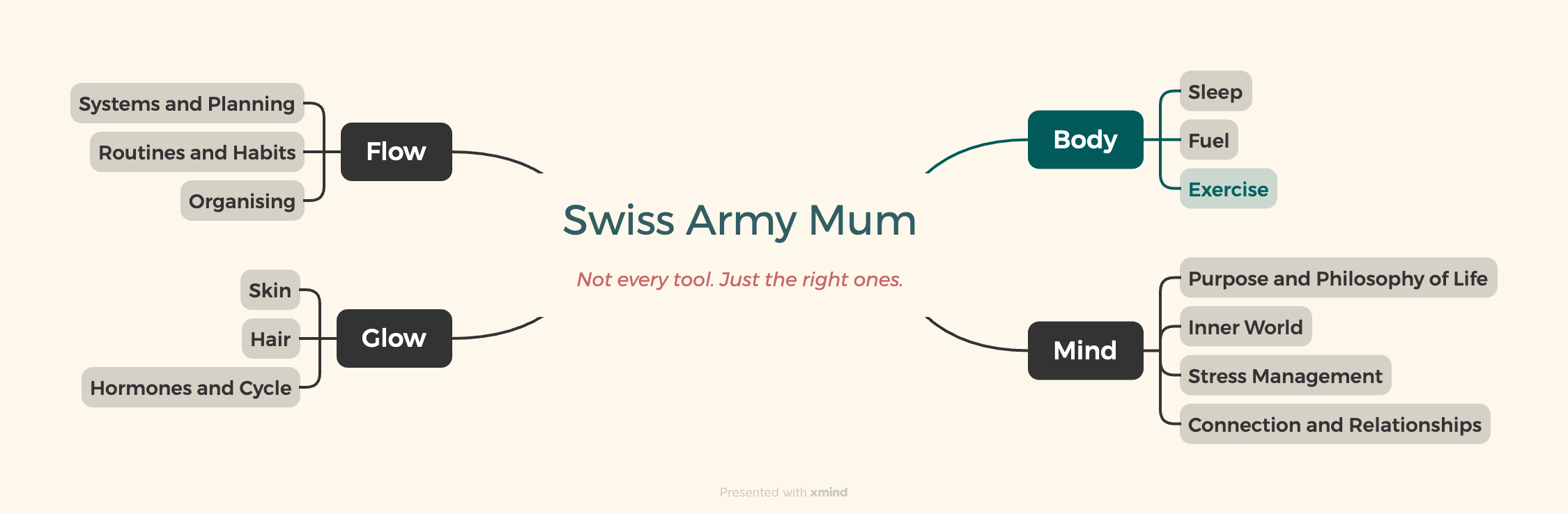
This post sits in the Exercise area of the Body Pillar, specifically in the Cardio component. Within Exercise, Cardio contains two distinct training modes: Zone 2, which charges your metabolic battery slowly so it holds more capacity, and HIIT, which drains it completely and forces adaptation. They do different jobs at the cellular level, and both belong in the programme. This post covers what separates them, why each matters specifically after 35, and how to use both without the time investment most people assume is required.
Most Women Get Cardio Wrong
Me included! I’ve never liked cardio. Running felt like punishment. Spin classes left me drained. I’d rather lift weights or do bodyweight work: anything but steady-state cardio.
So I skipped it. For years. I figured strength training was enough.
Like me, most women either skip cardio entirely or do too much of the wrong kind. They think cardio means running on a treadmill for an hour. Or they do spin classes 5x/week and wonder why they’re exhausted, constantly hungry, and not seeing results.
Then I learned about VO₂ max. Cardiovascular fitness is one of the strongest predictors of lifespan: stronger than BMI, stronger than cholesterol. People in the top 20% for VO₂ max live significantly longer than those in the bottom 20%. And you can’t build VO₂ max with strength training alone.
That got my attention.
But here’s what changed my mind completely: you don’t need hours of cardio. You need 150 minutes of Zone 2 per week (five 30-minute walks) and 20 minutes of HIIT (two 10-minute sessions). That’s 1.7% of your week.
I can do 1.7%.
There are two types of cardio that matter, and they serve two different purposes.
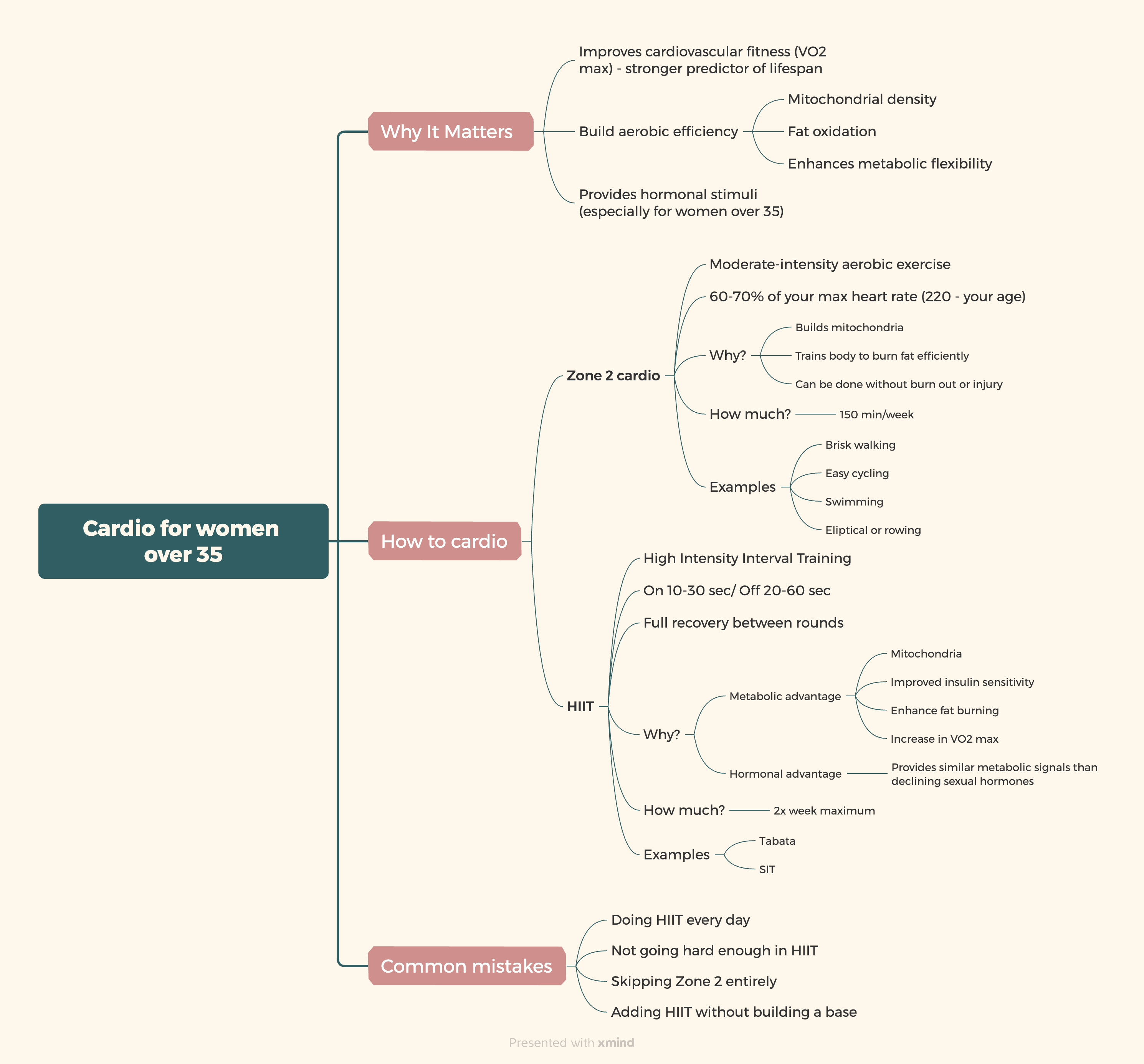
Zone 2 cardio (moderate intensity, conversational pace) builds your aerobic base: mitochondrial health, fat oxidation, cardiovascular efficiency.
HIIT (high-intensity interval training) boosts your VO₂ max and provides hormonal advantages that are especially valuable for women navigating perimenopause and menopause.
You need both. But you don’t need hours. And you definitely don’t need to do HIIT every day (more on that later, it’s a fast track to burnout).
This post breaks down what each type of cardio does, the mechanisms behind the adaptations, how much you actually need, and how to do it right.
New here? Start here:

Swiss Army Mum is a practical guide to long-term health for busy women, built on four pillars: Body, Mind, Glow, and Flow.
Not every tool. Just the right ones.
Why It Matters
Cardio Isn’t Just “Burning Calories”
Most women think cardio is about burning calories. Burn 300 calories in a 30-minute run, eat 300 fewer calories, lose weight.
But that’s not how it works. You can’t outrun a bad diet. One muffin and a latte = 500 calories. A 30-minute run burns ~300 calories. The math doesn’t work.
Here’s what cardio actually does:
Improves cardiovascular fitness (VO₂ max): Your VO₂ max (the maximum amount of oxygen your body can use during intense exercise) is one of the strongest predictors of lifespan. Not weight. Not BMI. Aerobic capacity.
Builds aerobic efficiency (Zone 2): Moderate-intensity cardio increases mitochondrial density, improves fat oxidation, and enhances metabolic flexibility. Your body gets better at using fat for fuel, which stabilizes energy and reduces glucose spikes.
Provides hormonal stimulus (HIIT): High-intensity intervals trigger hormonal responses that declining estrogen and progesterone no longer provide. For women in perimenopause and menopause, HIIT “picks up the slack” for hormonal changes.
The Dose-Response Data
A landmark study1 on sedentary postmenopausal women tested different doses of moderate cardio to see what actually works.
Here’s the key insight: ~150 min/week captured roughly 80% of the maximal fitness gain. Think of it like charging a battery: the first 80% charges fast, the last 20% takes forever.
You get most of the cardiovascular benefit at 150 minutes per week (2.5 hours, or five 30-minute walks). More helps, but returns diminish sharply.
Zone 2 Cardio
What it is
Zone 2 is moderate-intensity aerobic exercise. You’re working, but you can still hold a conversation. Your breathing is elevated, but you can speak in full sentences.
Heart rate: 60-70% of your max heart rate (220 - your age)
Examples:
Brisk walking
Easy cycling
Swimming at a steady pace
Light jogging (if you can still talk)
Elliptical or rowing at moderate pace
The “talk test”: If you can speak in full sentences but your breathing is noticeably elevated, you’re in Zone 2. If you’re gasping for air, you’re too high. If you can sing, you’re too low.
The Mechanism
You’ve probably heard that “Zone 2 is optimal for mitochondrial health” or “Zone 2 is the best for fat burning.” That’s not entirely accurate. Recent research challenges this.
A 2025 review by Storoschuk et al. titled “Much Ado About Zone 2” examined the claim that Zone 2 training is uniquely optimal for mitochondrial adaptations. The reality: in non-elite populations, higher-intensity training produces greater mitochondrial adaptations than Zone 22.
Zone 2 is still valuable. It builds more mitochondria (your cells' energy factories), grows new capillaries around muscle fibers (better oxygen delivery), and trains your body to burn fat efficiently. The big advantage: you can accumulate 150-300 minutes per week without burning out or getting injured—something you can't do with high-intensity work. Over time, your body gets better at switching between burning carbs and fat depending on what you're doing. Think of Zone 2 as building your aerobic engine's capacity without redlining it.
How Much You Need
The evidence shows 150 min/week captures ~80% of the maximal fitness gain. You can do more (up to 300 min/week for additional benefit), but returns diminish.
How to know if you’re in Zone 2
Method 1: Calculate your Zone 2 heart rate
If you track your heart rate, you can target zone 2 by knowing what that means to you.
Max HR = 220 - your age
Zone 2 = 60-70% of max
Example (40 years old):
Max HR = 220 - 40 = 180 bpm
Zone 2 = 180 × 0.6 to 180 × 0.7 = 108-126 bpm
Method 2: Talk test
Can you speak in full sentences? Breathing is elevated but you’re not gasping? You’re in Zone 2.
Method 3: Rate of Perceived Exertion (RPE)
On a scale of 1-10: Zone 2 = 5-6 out of 10 (moderate effort, sustainable for 30-60 minutes)
HIIT - High Intensity Interval Training
What It Is
HIIT (High-Intensity Interval Training) is simple: short bursts of maximum effort followed by rest. You go all-out for 10-30 seconds (as hard as you possibly can) then rest for 20-60 seconds while you recover. Repeat. The entire session, including warm-up and cool-down, takes 10-20 minutes.
Here’s the test: during the work intervals, you should be breathless, unable to speak. If you can hold a conversation during a work interval, you’re not going hard enough. It’s not HIIT—it’s just moderate cardio with breaks.
HIIT is uncomfortable. That’s the point. The intensity is what triggers the hormonal cascade and metabolic adaptations. Without that intensity, you’re missing the entire benefit.
A women-only systematic review and meta-analysis found that HIIT and moderate-to-vigorous continuous training produce similar VO₂max improvements in women3.
So HIIT’s main advantage isn’t superior cardio gains: it’s time-efficiency but also hormonal benefits.
The Mechanism + Hormonal Advantages
HIIT works because it creates massive metabolic stress: your body scrambles to adapt.
The Metabolic Mechanism
When you go all-out during a HIIT interval, you’re essentially draining your cellular battery. Your muscles burn through ATP (the energy currency cells use) faster than your body can replenish it. Breakdown products accumulate—like a low-battery warning light flashing on your dashboard.
That warning light triggers your cell’s energy sensor, which acts like a metabolic fire alarm: “We’re running out of fuel! Adapt!” The response is immediate: build more mitochondria (energy factories), improve glucose uptake (cells become more insulin-sensitive), and enhance fat-burning capacity.
Meanwhile, your cardiovascular system scrambles to keep up. Your heart, lungs, and blood vessels are pushed to their limit. They adapt by increasing capacity—improving your VO₂ max (peak aerobic capacity), which happens to be one of the strongest predictors of how long you’ll live.
The result: your muscles become dramatically more responsive to insulin, pulling glucose out of your bloodstream more efficiently than they would with steady-state cardio. HIIT rewires your metabolism in ways that moderate exercise simply doesn’t.
The Hormonal Mechanism
During perimenopause and menopause, estrogen and progesterone decline. These hormones previously supported muscle mass, bone density, metabolic function, cardiovascular health, and mood.
HIIT doesn’t replace hormones, but it provides similar metabolic signals: telling your body to maintain muscle, burn fat efficiently, and keep your metabolism running. Think of HIIT as a metabolic wake-up call for a body that’s losing its hormonal “volume control.”
Here’s what HIIT does:
Increases human growth hormone (HGH) and testosterone (supports muscle, libido, energy, bone density)
Decreases estrone (the less favorable estrogen from fat tissue)
Counteracts cortisol (when done 2x/week, overdoing it backfires)
Boosts BDNF (brain-derived neurotrophic factor, combats brain fog)
This is why HIIT is particularly valuable for women over 35. It “picks up the slack” for declining estrogen and progesterone.
How Much You Need
Frequency: 2x/week maximum
More is not better. HIIT is strong medicine. Overdoing it leads to cortisol overload, burnout, injury, diminishing returns.
Duration: 10-20 minutes per session (including warm-up/cool-down)
Critical Rules for HIIT
Go HARD during work intervals
RPE 9-10 (as hard as you can go). You should be breathless, unable to speak. If you can hold a conversation, it’s not HIIT.
Rest adequately between intervals
Use the full rest period. Walk around, breathe, recover. You need to be able to go hard again on the next interval. Make sure you can fully recover during rest so you can go all in again on the next round.
2x/week maximum
More = diminishing returns + burnout.
How Little Cardio You Actually Need
Here’s the breakdown:
Zone 2: 150 min/week = 1.5% of your week
HIIT: 20 min/week = 0.2% of your week
Total: 170 min/week = 1.7% of your week
That’s five 30-minute walks and two 10-minute HIIT sessions.
Compare that to:
Average TV/Netflix: 3 hours/day = 21 hours/week = 12.5% of your week
Average social media: 2.5 hours/day = 17.5 hours/week = 10.4% of your week
You have time. It’s about priorities, not availability.
Sample weekly schedule
This is how I organise my cardio throughout the week (as well as the strength training) Your schedule will look different, but this gives you a template.:
Monday: Morning walk with my dog (30 min) + Walking pad after dinner (10-20 min)
Tuesday: Morning walk with my dog (30 min) + Walking pad after dinner (10-20 min)
Wednesday: Morning walk with my dog (30 min) + HIIT (10-15 min) + Strength training (30 min) + Walking pad after dinner (10-20 min)
Thursday: Morning walk with my dog (30 min) + Walking pad after dinner (10-20 min)
Friday: Morning walk with my dog (30 min) + Strength training (30 min) + Walking pad after dinner (10-20 min)
Saturday: Morning walk with my dog (30 min) + Walking pad after dinner (10-20 min)
Sunday: Morning walk with my dog (30 min) + HIIT (10-15 min) + Strength training (30 min) + Walking pad after dinner (10-20 min)
You’ll notice that makes more than 150 min of moderate cardio. That’s because some days I walk less in the morning (the days I need to commute) and others I walk more (typically on the weekends). I also don’t always use the treadmill after dinner.
It’s not about perfection, it’s about making it work with you and showing up consistently.
Common Mistakes
Mistake 1: Doing HIIT Every Day
HIIT is not cardio for daily use. 2x/week max.
More = cortisol overload, burnout, injury, sleep disruption. If you’re exhausted all the time, you’re doing too much HIIT.
Mistake 2: Not Going Hard Enough in HIIT
If you’re not breathless and needing the rest interval, you’re not doing HIIT. You’re doing moderate cardio with intervals.
HIIT should feel hard. Uncomfortable. That’s the point.
Mistake 3: Skipping Zone 2 Entirely
HIIT alone won’t build your aerobic base. You need volume (Zone 2) + intensity (HIIT) for complete cardiovascular fitness.
Mistake 4: Doing “Moderate” Cardio in No Man’s Land
Too hard to be Zone 2 (not building aerobic base efficiently), too easy to be HIIT (not getting hormonal benefits).
Pick a lane: Zone 2 or HIIT. Don’t live in the middle.
Mistake 5: Adding HIIT Before Building a Base
If you’re completely new to exercise, build a Zone 2 base first (8-12 weeks), then add HIIT.
HIIT is advanced work. You need cardiovascular and neuromuscular readiness.
What’s Next
Next week: Balance, Mobility & Plyometrics
We’re diving into:
The neuromuscular control system (how balance actually works—visual, vestibular, proprioceptive systems)
Proprioception explained (mechanoreceptors in muscles, tendons, joints)
Why balance training reduces fall risk by 23%
Core stability (360° breathing, not just abs)
Fascia care (foam rolling, why it matters)
This is the “boring” work that prevents falls, keeps you functional, and allows you to lift heavy and do HIIT safely.
After that: Book Club: Next Level by Stacy Sims. The exercise and nutrition book written specifically for women navigating perimenopause and menopause. What she gets right, what to skip, and how it aligns with SAM.
Subscribe so you don’t miss it!
Your Turn
Are you doing Zone 2? Or have you been living in “moderate cardio no man’s land”?
Have you tried HIIT? What protocol worked for you?
What’s holding you back from adding cardio to your routine?
Drop a comment. I read every one.
Thank You
Thanks for reading Swiss Army Mum! If this resonated, forward it to someone who might benefit or hit the ♥️ button. It helps more people discover this work.
Church, Timothy S et al. “Effects of Different Doses of Physical Activity on Cardiorespiratory Fitness Among Sedentary, Overweight or Obese Postmenopausal Women With Elevated Blood Pressure: A Randomized Controlled Trial.” JAMA vol. 297,19 (2007): 2081-91. https://jamanetwork.com/journals/jama/fullarticle/1108370
Storoschuk, Kristi L et al. “Much Ado About Zone 2: A Narrative Review Assessing the Efficacy of Zone 2 Training for Improving Mitochondrial Capacity and Cardiorespiratory Fitness in the General Population.” Sports medicine (Auckland, N.Z.) vol. 55,7 (2025): 1611-1624. https://doi.org/10.1007/s40279-025-02261-y
Lindner, Robert et al. “Moderate to Vigorous-intensity Continuous Training versus Highintensity Interval Training for Improving VO2max in Women: A Systematic Review and Meta-analysis.” International journal of sports medicine vol. 44,7 (2023): 484-495. https://doi.org/10.1055/a-2044-8952
I'm menopausal and trying to get "into" exercise. I've started a sunrise walk and try to keep it moderate (zone 2?). Brisk walking was awful over even the short "beginner" distance I was doing.
A friend, and now you, have mentioned HIIIT this week, so I'm listening.
My hesitancy is 2 artificial hips, and an historic tendency to high cortisol from intense exercise.
The cortisol isn't such an issue now, fortunately, but I must watch it.
Suggestions? I don't expect my docs will know much about this, as I had to figure it out myself the first time