


This is Part 1 of a 3-part deep-dive series on exercise.
We have covered the Exercise Blueprint: the overview of all six movement types and the 80/20 minimum (steps + strength 2x/week).
Now we're zooming in. This mini-series breaks down the three essential categories of exercise:
Part 1 (this post): Strength Training - How muscle is built, the 6-step bracing protocol, lifting heavy
Part 3: Balance, Mobility & Plyometrics - Neuromuscular control, falls prevention, improving bone densitya
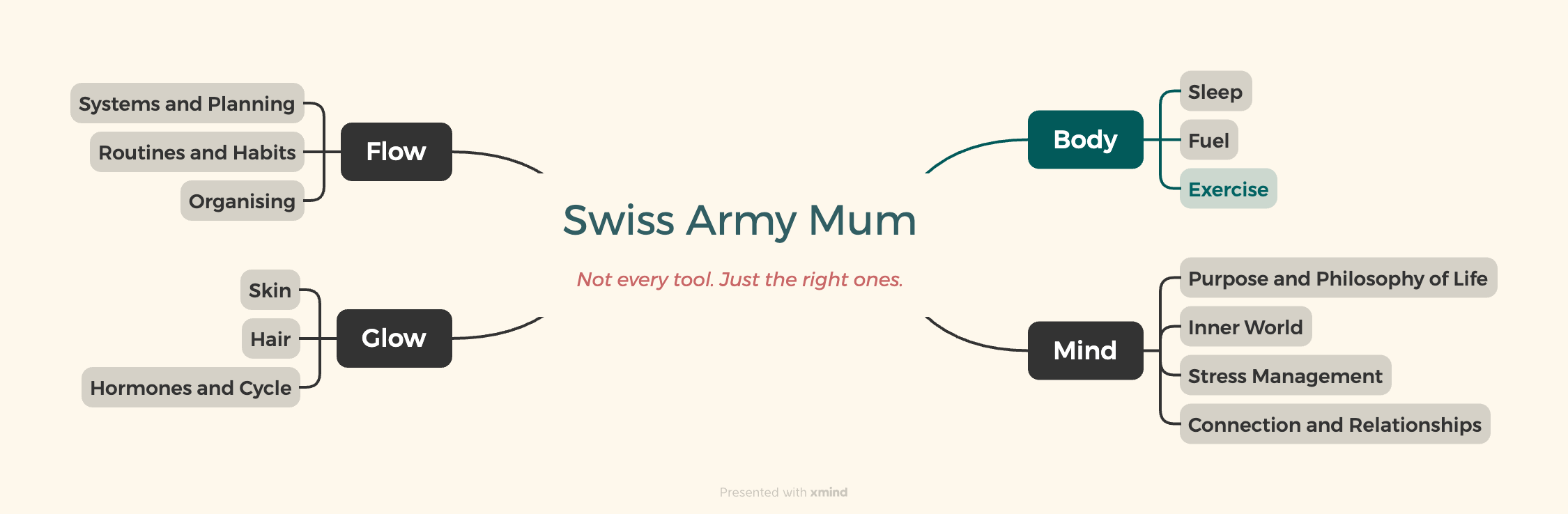
This post sits in the Exercise area of the Body Pillar, specifically in the Strength component. The Exercise area has three components: Strength, Cardio, and Balance/Mobility/Plyometrics. Strength is the non-negotiable one: it has the most direct impact on metabolic health, bone density, and functional independence across the decades, and it is the component most women over 35 are still under-investing in. If you only do one thing in the Exercise area, this is it.
I Was Lifting, But Not Heavy Enough
I’ve always hated cardio. Running on a treadmill felt like torture. I’d rather lift weights, do bodyweight exercises, anything but steady-state cardio.
So I lifted. I did squats and lunges. I used dumbbells. I felt strong. But I wasn’t lifting heavy enough.
I was doing 15-20 reps with light weights. I thought that’s what women were supposed to do: ”tone” without “bulking.” I avoided the heavy barbell. I never pushed myself to lift 6 reps or less with maximum weight. I stayed comfortable.
Then I learned about sarcopenia.
Sarcopenia is the age-related loss of muscle mass and strength. After 30, you lose 3-8% of muscle mass per decade. This isn’t just “aging.” This is neglect.
And here’s the thing: light weights for high reps won’t save you from sarcopenia. If you can do 15-20 reps, you’re building muscular endurance, not strength. You’re not signaling your body to keep (or build) muscle mass. Only heavy resistance training does that.
Muscle isn’t vanity. It’s your metabolic engine. It regulates glucose, protects your bones, supports your joints, and keeps you functional at 75, 80, 85. Lifting heavy isn’t about looking huge. It’s about staying strong.
This post breaks down why strength training is non-negotiable for women over 35, how muscle is actually built, and how to lift safely.
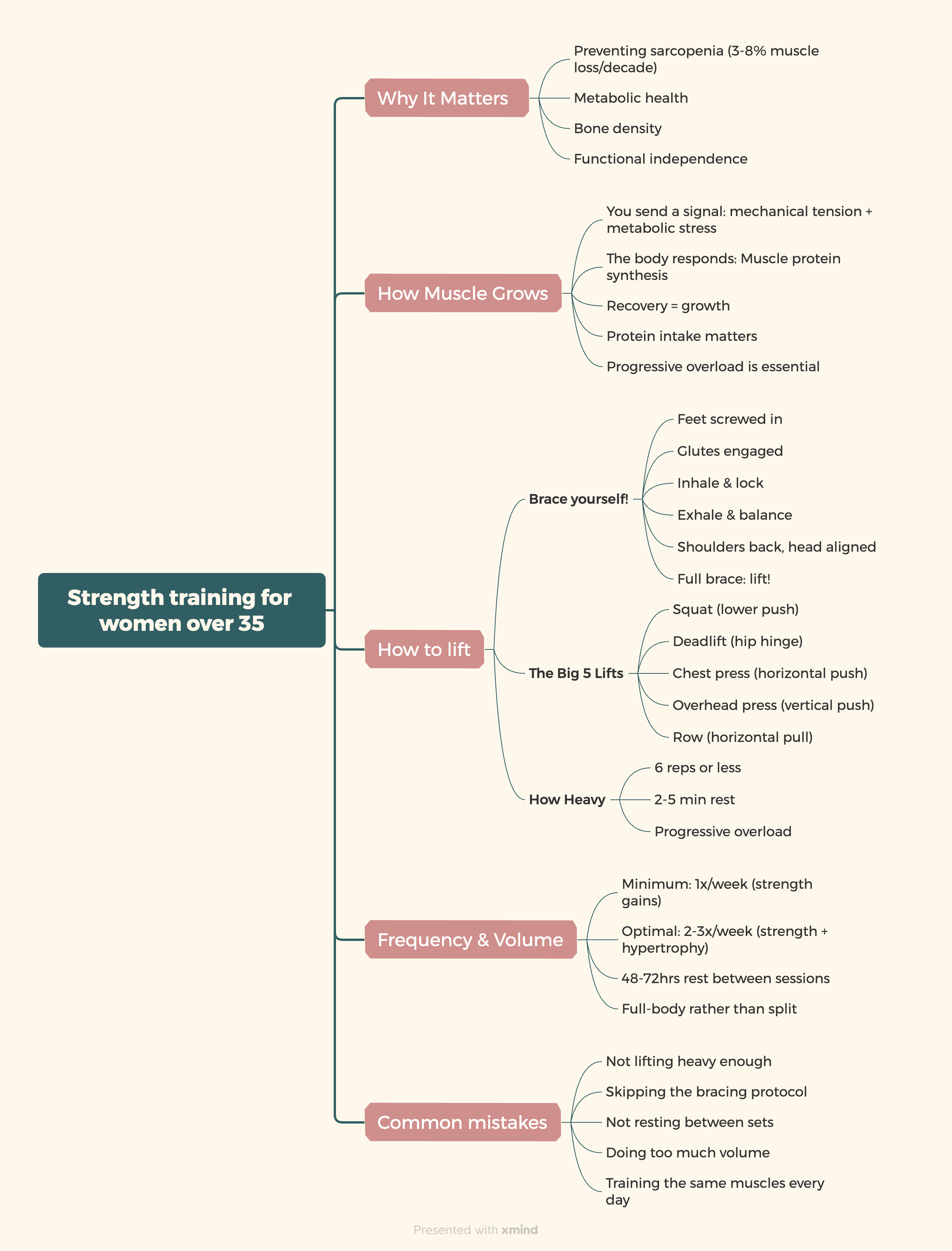
Why It Matters
Sarcopenia is Not Optional
The European consensus on sarcopenia defines it as progressive loss of skeletal muscle mass, strength, and function. It’s associated with increased risk of falls, fractures, disability, loss of independence, and mortality.
After 30, you lose 3-8% of muscle mass per decade.
This isn’t “normal aging.” It’s preventable. Progressive resistance training reverses sarcopenia at any age. This graph gave me a new perspective:
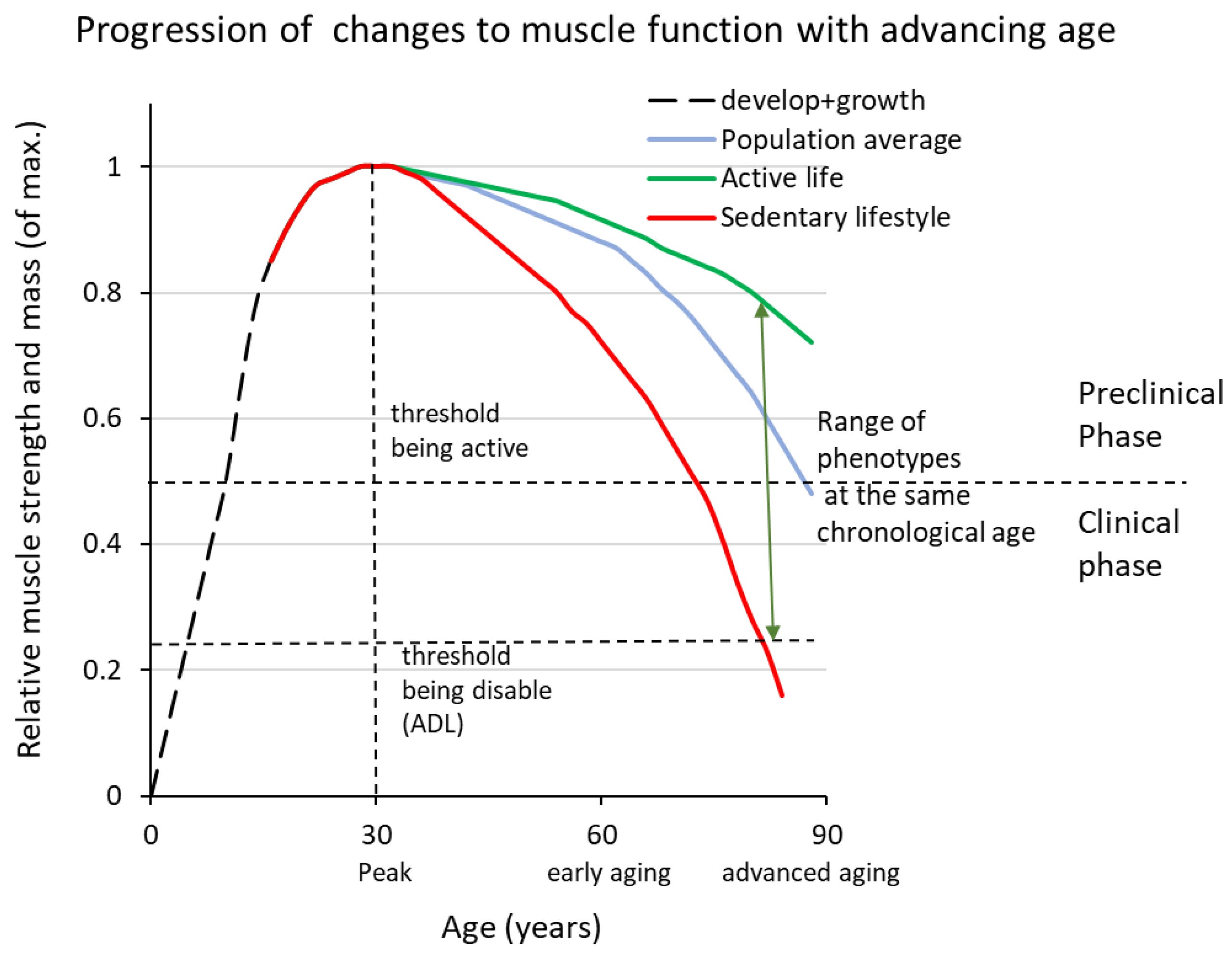
After 30, muscle decline is physiological. However, depending on how active you are and, especially how much you lift, the trajectory is vastly different. We’re talking about avoiding the “disability threshold” altogether.
That right there is why you lift.
Muscle is a Metabolic Organ
Most people think of muscle as structural: it helps you move. But muscle is also metabolic. It regulates glucose, influences insulin sensitivity, and has a favorable effect on metabolic syndrome.
Here’s what muscle does:
Regulates glucose: Muscle acts as a glucose sink. When you move, your muscles pull glucose out of your bloodstream without needing insulin. The more muscle mass you have, the better your glucose regulation.
Protects bones: Strength training doesn’t just build muscle: it builds bone. The LIFTMOR trial1 in postmenopausal women with osteopenia/osteoporosis showed that twice-weekly heavy resistance training plus impact loading improved lumbar spine bone mineral density by +2.9% compared to −1.2% in controls over 8 months. Functional measures also improved significantly.
Supports joints: Strong muscles take load off vulnerable joints. Weak quads = more stress on knees. Weak glutes = more stress on hips and lower back. Strength training protects your joints by distributing load properly.
Maintains metabolic rate: More muscle tissue means your body burns more energy at rest. This isn’t about “burning calories”: it’s about metabolic health. Muscle is metabolically active tissue.
“But I Don’t Want to Get Bulky”
Let’s address this directly: women do not have enough testosterone to “bulk up” without significant, intentional effort.
The women you see with large, defined muscles are either:
Genetic outliers
Training specifically for hypertrophy (bodybuilding) with high volume, high frequency, and precise nutrition
Using performance-enhancing drugs
What you’ll get from lifting heavy 2-3x/week:
Better posture
Functional strength (carrying groceries, lifting kids, climbing stairs)
Bone density
Metabolic health (insulin sensitivity, glucose regulation)
Injury prevention (strong muscles protect joints)
You’ll look strong, not huge. You’ll be able to get off the floor without using your hands. That’s the goal.
How Muscle is Built: The Mechanism
Understanding how muscle actually grows helps you understand why certain training approaches work and others don’t.
Think of muscle building like construction: lifting weights sends the signal, your body does the building, and protein provides the materials.
The Process
1. You send the signal: Mechanical tension + metabolic stress
When you lift heavy weights2, you’re essentially telling your body: “We need to be stronger for this.”
You create two types of stress:
Mechanical tension = The physical force of contracting against resistance. Imagine stretching a rubber band to its limit. That tension signals your muscles that they need to get stronger to handle the load.
Metabolic stress = Depleting your energy stores (like draining a battery) and accumulating byproducts (like lactic acid: the burn you feel). Think of this as your muscle cells saying “We ran out of fuel doing that work. We need more capacity.”
Both types of stress trigger molecular signals that tell your body: “Build more muscle to handle this better next time.”. An excellent example of a biological system getting stronger from stress.
2. Your body responds: Muscle protein synthesis (MPS) kicks in
After you lift, your body initiates a repair-and-upgrade process called muscle protein synthesis: building new muscle proteins to make your muscles bigger and stronger.
Here’s the timeline3:
4 hours after lifting: Protein synthesis up ~50%
24 hours after lifting: Protein synthesis up ~109% (more than double baseline)
36 hours after lifting: Back to normal
The key insight: You don’t build muscle during the workout. You build it during the 24-48 hours of recovery.
This is why rest days matter. This is why sleep matters. This is why you can’t train the same muscles every day: you’d interrupt the construction process.
Key Takeaway From The Mechanism
Recovery is where growth happens: Each workout triggers a 24-48 hour window of elevated MPS. If you train the same muscles again before this window closes, you interrupt the growth process. This is why 48-72 hours rest between sessions targeting the same muscle groups is critical.
Protein intake matters: Consuming protein post-workout maximizes MPS. Your muscles are primed to use amino acids for repair and growth during this window.
Progressive overload is essential: Your body adapts to the stimulus you give it. If you lift the same weight for the same reps every session, MPS won’t be triggered as strongly. You need to progressively increase weight, reps, or sets over time to keep signaling growth.
The 6-Step Bracing Protocol
Most lifting injuries happen because of poor form, not because the weight is too heavy. This bracing protocol teaches you how to create 360° core stability before you lift and protect your spine.
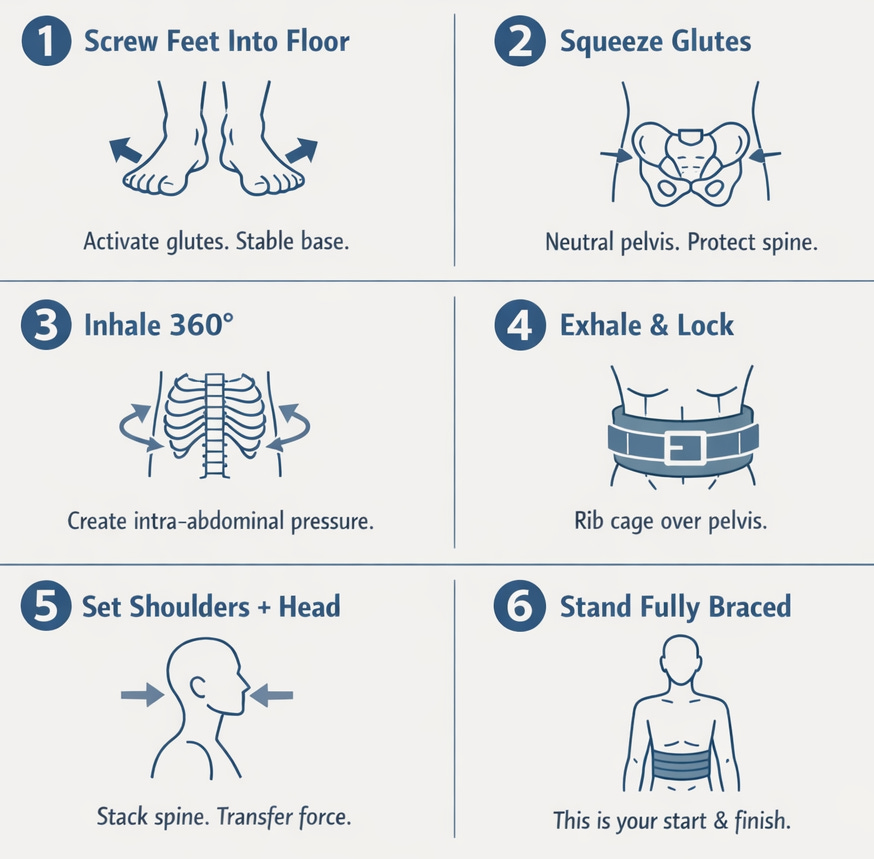
Master this unloaded first. Practice it standing with no weight. Then with an empty barbell. Then add load.
Step 1: Screw Your Feet Into the Ground
Stand with feet shoulder-width (or slightly wider for squats/deadlifts). Exert outward force from your hips as if you’re trying to twist the ground apart with your feet. You’re not actually moving your feet: you’re creating external rotation force from the hip joint.
Why this matters: Activates your glutes and stabilizes your pelvis. Creates a stable base for everything above.
Step 2: Squeeze Your Glutes
With feet screwed into the ground, squeeze your glutes hard. This sets your pelvis in a neutral position and prevents hyperextension of your lower back.
Why this matters: A neutral pelvis is critical for spinal safety. If your pelvis tilts forward (anterior pelvic tilt), your lower back hyperextends and becomes vulnerable to injury.
Step 3: Inhale and Lock It In
Take a big breath into your diaphragm (not your chest) while keeping your glutes engaged. Your belly, sides, and lower back should expand. This locks your pelvis and rib cage together, creating a stable cylinder.
Why this matters: Creates intra-abdominal pressure: the internal “brace” that protects your spine. Intra-abdominal pressure acts like a pressurized balloon inside your torso, stiffening your core.
Step 4: Exhale and Balance Your Rib Cage
Exhale slowly while tightening your belly. You’re not sucking in: you’re stiffening your abdominal wall to maintain IAP. Your rib cage should sit directly over your pelvis (not flared up or jutting forward).
Why this matters: Balances the rib cage over the pelvis, maintaining IAP while allowing you to breathe during the lift. This is the “locked” position you’ll maintain throughout the movement.
Step 5: Neutralize Head and Shoulders
Rotate your shoulders back (external rotation). Imagine widening your collarbones. Turn your palms up slightly. Your head should be in a neutral position: ears over shoulders, eyes looking slightly forward (not up or down).
Why this matters: Optimal spinal alignment from head to pelvis. This position allows force to transfer efficiently through your kinetic chain without compensations.
Step 6: Stand Fully Braced
This is your braced position. Every rep of every lift starts and ends here.
Compound Lifts: The Big 5
Compound lifts work multiple large muscle groups at once. They’re functional (mimic real-life movement patterns), efficient (you can train your whole body in 30-45 minutes), and effective (you can lift heavy with compound movements).
These five movements cover all the major patterns you need.
1. Squat (Lower Body Push)
What it works: Quads, glutes, hamstrings, core
Why it matters: Sitting and standing is a fundamental life skill. Squatting keeps you functional.
How to do it:
Feet shoulder-width or slightly wider
Toes slightly turned out
Brace (6-step protocol)
Push hips back, bend knees, lower until hips are below knees (full depth)
Knees track over toes (don’t cave inward)
Drive through heels to stand
Common mistakes: Not squatting to depth, knees caving in, losing bracing, heels lifting off ground
Variations: Back squat (barbell on back), front squat (barbell on front), goblet squat (dumbbell or kettlebell)
2. Deadlift (Hip Hinge)
What it works: Posterior chain (glutes, hamstrings, lower back, upper back)
Why it matters: Picking things up off the ground is the most functional movement there is. Deadlifts teach you to hinge at the hips without rounding your back.
How to do it:
Feet hip-width, barbell over mid-foot
Brace (6-step protocol)
Hinge at hips, grab bar (hands just outside legs)
Flat back (neutral spine), chest up
Drive through heels, extend hips and knees simultaneously
Bar stays close to body the entire time
Lock out at top (glutes squeezed, hips fully extended)
Common mistakes: Rounding lower back, starting with hips too low (turning it into a squat), bar drifting away from body
Variations: Conventional deadlift, sumo deadlift, Romanian/russian deadlift (RDL)
3. Chest Press (Horizontal Push)
What it works: Chest (pectorals), shoulders (anterior deltoids), triceps
Why it matters: Pushing movement: pushing open doors, pushing a stroller, getting up from the floor.
How to do it:
Lie on bench (or floor)
Feet flat on ground
Brace (6-step protocol)
Grip barbell slightly wider than shoulder-width
Lower bar to chest (elbows at ~45° angle, not flared out to 90°)
Press bar up until arms fully extended
Common mistakes: Elbows flared out to 90° (puts shoulder at risk), arching back excessively, not using leg drive
Variations: Barbell bench press, dumbbell bench press, floor press, push-ups
4. Overhead Press (Vertical Push)
What it works: Shoulders (deltoids), triceps, core
Why it matters: Lifting things overhead: putting luggage in overhead bin, lifting boxes onto shelves.
How to do it:
Standing, feet shoulder-width
Brace (6-step protocol)
Barbell or dumbbells at shoulder height
Press straight up (bar path should be vertical, close to face)
Lock out arms overhead (biceps by ears)
Lower under control
Common mistakes: Leaning back excessively (compensating for weak core or tight shoulders), not locking out fully, pressing forward instead of straight up
Variations: Barbell overhead press, dumbbell overhead press, push press (uses legs)
5. Row (Horizontal Pull)
What it works: Back (lats, rhomboids, traps), biceps, rear deltoids
Why it matters: Pulling movements, posture (counteracts hunched-over desk posture).
How to do it:
Bent-over: Hinge at hips, flat back, knees slightly bent
Brace (6-step protocol)
Barbell or dumbbells hanging straight down
Pull weight to lower rib cage (not to chest)
Squeeze shoulder blades together at top
Lower under control
Common mistakes: Rounding back, using momentum (swinging), pulling too high (to chest instead of ribs)
Variations: Bent-over barbell row, dumbbell row (single-arm), seated cable row, inverted row (bodyweight), pull-ups
How Heavy is “Heavy”?
Heavy means 6 reps or less with as much weight as you can safely handle.
If you can do 10+ reps, the weight is too light for building strength. You’re training muscular endurance, not strength.
The last 1-2 reps of each set should be hard. You should feel like you could maybe do one more rep with good form, but not three more.
If your form breaks down, the weight is too heavy. Drop the weight, fix your form, then progress.
Progression for Beginners
Don’t jump straight into heavy lifting. Build a foundation first.
Weeks 1-6: Learn the movements
Load: Moderate (you could do 8-15 reps)
Volume: 2-3 sets of 8-15 reps
Focus: Perfect form, bracing protocol, full range of motion
Weeks 7-12: Increase intensity
Load: Heavy (5-6 reps per set)
Volume: 5 sets of 5 reps
Focus: Progressive overload (add 2.5-5 lbs per week)
Weeks 13+: Heavy lifting
Load: Heavy to very heavy (3-5 reps per set)
Volume: 4-6 sets of 3-5 reps
Focus: Consistent progression, maintain form
Frequency & Recovery: How Much Do You Actually Need?
This is where the research gets specific for women over 35. Recent studies distinguish between strength gains (how much you can lift) and hypertrophy (muscle growth). The dose you need depends on your goal.
Strength Gains: Less Than You Think
Here’s surprising news: research on women over 35 shows that even 1x/week produces measurable strength gains. You won’t optimize muscle growth at that frequency, but you’ll get stronger.
Think of it like learning a language: one lesson per week keeps you progressing, but three lessons per week gets you fluent faster4.
Key takeaway: If your primary goal is strength (getting stronger, building functional capacity), 2x/week is optimal for women over 35, but even 1x/week produces substantial gains if you train hard (close to failure).
Hypertrophy: You Need More Volume
For muscle growth, frequency matters more. A 12-week study in postmenopausal women (average age 60) compared high-volume vs low-volume training. Both groups got stronger, but only the high-volume group built significant muscle mass5.
Key takeaway: For hypertrophy (muscle growth), you need 2-3x/week with higher volume (3-6 sets per exercise).
Recovery Between Sessions
48-72 hours rest between sessions targeting the same muscle groups because muscle protein synthesis stays elevated for 24-48 hours post-workout. Training the same muscles again before this window closes interrupts the growth process.
Progressive Overload is Non-Negotiable
Your body adapts to stress. If you lift the same weight every session, muscle protein synthesis won’t be triggered strongly enough.
Ways to progress:
Add weight: 2.5-5 lbs (1-2.5 kg) on lower body, 2.5 lbs (1 kg) on upper body
Add reps: If you hit 12 reps, increase weight and drop back to 6-8 reps
Add sets: Go from 2 sets to 3 sets over 4-6 weeks
Your body adapts to the stimulus you give it. If you lift the same weight for the same reps every session, MPS won’t be triggered as strongly.
Full body or body-part specific?
Most strength training programs fall into two categories: full-body (training all major muscle groups each session) or split training (upper/lower, push/pull/legs, or body-part splits).
I do full-body workouts, and here’s why:
Shorter sessions: You rotate between muscle groups, so rest time is minimized. Legs recover while you do chest press. Chest recovers while you row. You can finish a session in 30-45 minutes instead of 60+ minutes for a body-part split.
If you miss a session, you haven’t neglected an entire body part: Life happens. With full-body, every session hits everything. You’re never more than 3-4 days from training any muscle group. With splits, missing “leg day” means 7-10 days without training legs.
Frequency is built in: Training each muscle group 2-3x/week maximizes hypertrophy. With full-body 2-3x/week, you automatically hit optimal frequency. With splits, you need 4-6 days/week to match that.
If you’re training 4-6 days/week and have time for longer sessions, splits can work. But for most women juggling work, kids, and life? Full-body 2-3x/week is the 80/20 answer.
The 80/20 for Women Over 35
Based on evidence in women over 35:
Optimal dose (Strength + Hypertrophy) - The balanced approach:
2-3x/week, 3-6 sets per exercise
Moderate-to-heavy loads (70-85% 1RM, 6-12 reps)
Compound lifts with progressive overload
This maximizes both strength and muscle growth
Even 1x/week produces strength gains, but 2x/week is the evidence-based minimum for muscle maintenance and growth in women over 35.
Good news, there are free programs on YouTube that do precisely this, so you don’t need to plan for all of this for your workouts (see resources below).
Common Mistakes
Mistake 1: Not Lifting Heavy Enough
If you’re doing 15-20 reps, you’re not building strength. You’re building muscular endurance.
For strength and muscle mass, you need to lift heavy (6 reps or less). The weight should be challenging (but you should always maintain good form).
Mistake 2: Skipping the Bracing Protocol
Most lifting injuries happen because of poor form, not because the weight is too heavy.
Practice the 6-step bracing protocol unloaded first. Make it automatic. Then add weight.
Mistake 3: Not Resting Between Sets
Strength training is not cardio. Rest is part of the protocol.
If you’re breathless and can’t complete the next set with good form, you didn’t rest long enough.
Mistake 4: Doing Too Much Volume
More is not better. 3-5 sets per exercise is sufficient for most people.
If you’re doing 10 sets of squats, you’re either:
Not lifting heavy enough
Overtraining (diminishing returns + injury risk)
Lift heavy, rest adequately, go home.
Mistake 5: Training the Same Muscles Every Day
You build muscle during recovery, not during the workout. If you train the same muscles every day, you interrupt the muscle protein synthesis window.
Train each muscle group 2-3x/week with 48-72 hours rest between sessions.
Resources
All this information may seem too much to handle. But it’s not!
I strength train at home with second-hand gear (I’m thrifty!). It works. For form checks and programming, I use free YouTube channels. I’ll share which ones later in this series. Once a year, I sit down and program my strength sessions using those videos, and then every workout is ready with a few clicks. No thinking, no decision fatigue, just lift.
What’s Next
Next week: Cardio - Zone 2 + HIIT
We’re breaking down two types of cardio for two different purposes:
Zone 2: Builds aerobic base, mitochondrial health, fat oxidation
HIIT: Boosts VO₂ max and provides hormonal advantages for menopausal women
How much you need (less than you think), how to calculate your zones, and why HIIT is especially valuable for women over 35.
After that: Balance, Mobility & Plyometrics. The neuromuscular control system explained, proprioception, and why this “boring” work prevents falls and keeps you functional.
Subscribe, so you don’t miss it!
Your Turn
Have you been avoiding strength training? What’s holding you back?
Are you lifting, but not lifting heavy enough (15-20 rep range)?
Which of the Big 5 lifts are you most intimidated by?
Drop a comment. I read every one.
Thank you!
Thanks for reading Swiss Army Mum! If this resonated, forward it to someone who might benefit or hit the ♥️ button. It helps more people discover this work.
Watson, Steven L et al. “High-Intensity Resistance and Impact Training Improves Bone Mineral Density and Physical Function in Postmenopausal Women With Osteopenia and Osteoporosis: The LIFTMOR Randomized Controlled Trial.” Journal of bone and mineral research : the official journal of the American Society for Bone and Mineral Researchvol. 33,2 (2018): 211-220. https://doi.org/10.1002/jbmr.3284.
McGlory C, Devries MC, Phillips SM. Skeletal muscle and resistance exercise training; the role of protein synthesis in recovery and remodeling. J Appl Physiol (1985). 2017 Mar 1;122(3):541-548. https://doi.org/10.1152/japplphysiol.00613.2016.
MacDougall, J D et al. “The time course for elevated muscle protein synthesis following heavy resistance exercise.” Canadian journal of applied physiology = Revue canadienne de physiologie appliquee vol. 20,4 (1995): 480-6. https://doi.org/10.1139/h95-038.
DiFrancisco-Donoghue J, Werner W, Douris PC. Comparison of once-weekly and twice-weekly strength training in older adults. Br J Sports Med. 2007 Jan;41(1):19-22. https://doi.org/10.1136/bjsm.2006.029330.
Nascimento de Oliveira-Júnior, Gersiel et al. “Resistance Training Volume Enhances Muscle Hypertrophy, but Not Strength in Postmenopausal Women: A Randomized Controlled Trial.” Journal of strength and conditioning research vol. 36,5 (2022): 1216-1221. https://doi.org/10.1519/JSC.0000000000003601.