


This is Part 3 of a 3-part deep-dive series on exercise.
We have covered the Exercise Blueprint: the overview of all six movement types and the 80/20 minimum (steps + strength 2x/week).
Now we’re zooming in. This mini-series breaks down the three essential categories of exercise:
Part 1: Strength Training - How muscle is built, the 6-step bracing protocol, lifting heavy
Part 3 (this post): Balance, Mobility & Plyometrics - Neuromuscular control, falls prevention, improving bone density
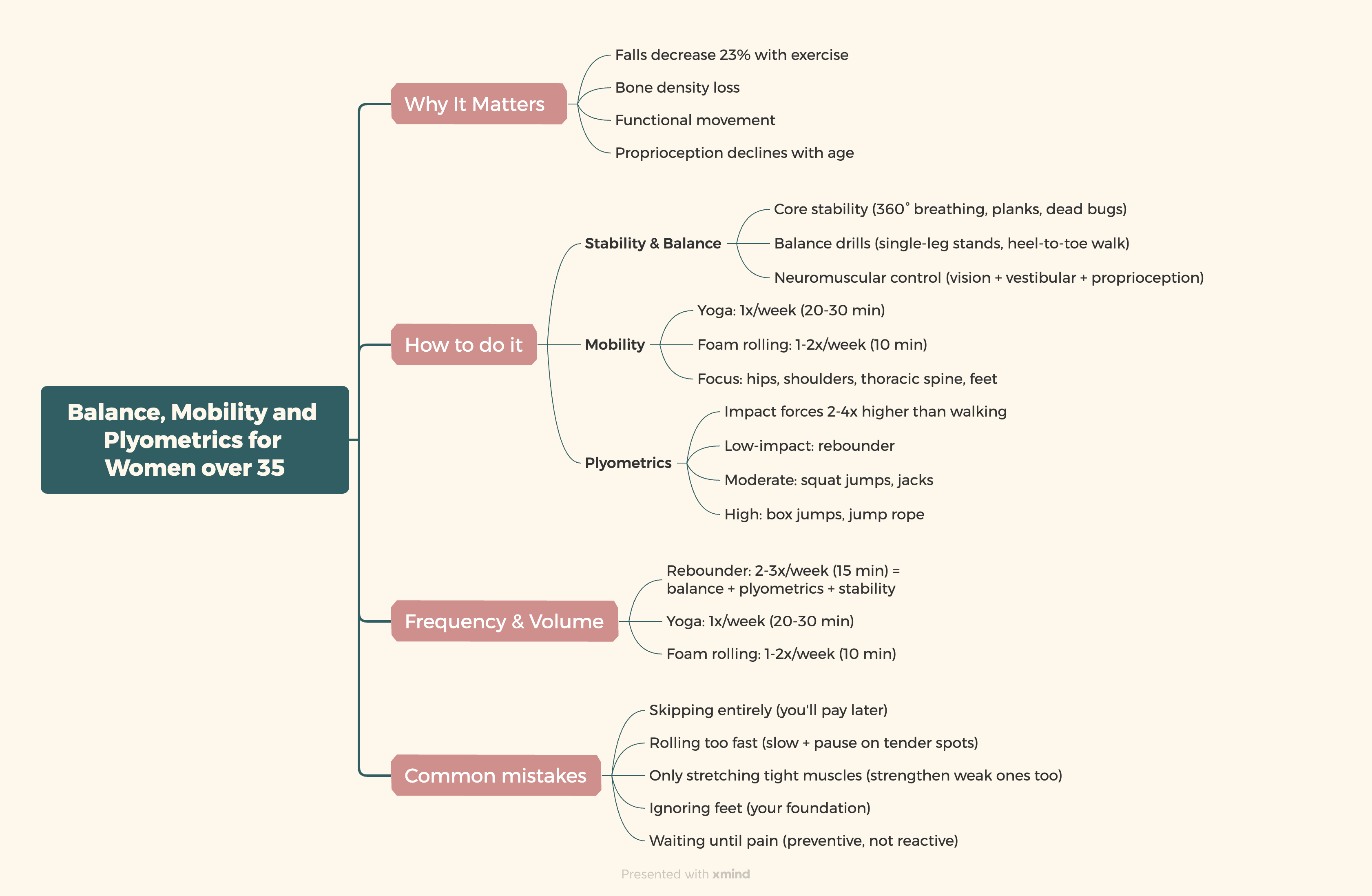
This post sits in the Exercise area of the Body Pillar, specifically in the Balance, Mobility and Plyometrics component. This is the part of Exercise that gets cut first when time is short, which is exactly why it earns its own post. Strength and Cardio tend to absorb the available training time; Balance and Mobility do their most important work quietly in the background, reducing injury risk, maintaining functional range, and keeping the other two components sustainable for decades. Skip it long enough, and the other two suffer for it.
This post is your complete guide to balance and mobility training for women over 35: preventing falls, building bone density, and staying functional for decades.
I Ignored Mobility Until I Couldn’t Squat
I thought mobility work was optional. Extra. Something you do if you have time after the “real” workout.
I was wrong.
A few years ago, I couldn’t squat to depth without my heels lifting off the ground. My ankles were so stiff from years of sitting that I couldn’t get into a proper squat position. I compensated by rounding my lower back, which is exactly how you get injured.
My physical therapist gave me one exercise: sit in a deep squat for 2 minutes every day. That’s it.
Within 3 weeks, my ankle mobility improved enough to squat properly. Within 6 weeks, I could deadlift without my back rounding.
Then she added balance work and plyometrics. Single-leg stands on unstable surfaces. Jumping on a rebounder (mini trampoline). At first, I felt ridiculous. But after a few weeks, I noticed something: my proprioception (my body’s awareness of where I was in space) improved dramatically. I could catch myself when I stumbled. My lifting form got better because my body knew how to stabilize automatically.
And the bone density benefits? Research shows that impact loading significantly improves hip bone density. Combined with heavy lifting, it’s one of the best protections against osteoporosis after menopause.
That’s when I learned: mobility, balance, and plyometrics aren’t extra. Here’s what they do:
Prevents falls. Falls are the leading cause of injury and death in older adults. Not the fall itself—the complications. Hip fracture → hospital → infection → decline. One fall can cascade into loss of independence.
Keeps you functional. Bending down to pick something up. Reaching overhead. Twisting to look behind you. Getting up from the floor without using your hands. These movements require mobility and stability.
Protects your joints. Tight hips, stiff shoulders, weak ankles: these compensations lead to injury. Mobility and stability work keeps your joints healthy so you can keep lifting, running, and moving for decades.
Builds bone density. Jumping (plyometrics) creates impact forces that signal bones to remodel and strengthen: critical for preventing osteoporosis after menopause.
A Cochrane systematic review1 found that exercise reduces fall rate by ~23% overall in older adults, with the strongest evidence for balance/functional training and multicomponent programs.
This isn’t extra. You can’t lift heavy safely (Part 1: Strength Training) without it. You can’t do HIIT effectively (Part 2: Cardio) without it. You can’t stay functional without it.
This post breaks down three essential activities:
Stability & Balance Training - Neuromuscular control, proprioception, core strength
Plyometric Training - Impact loading for bone density
Mobility Training - Range of motion, fascia health, flexibility
New here? Start here:

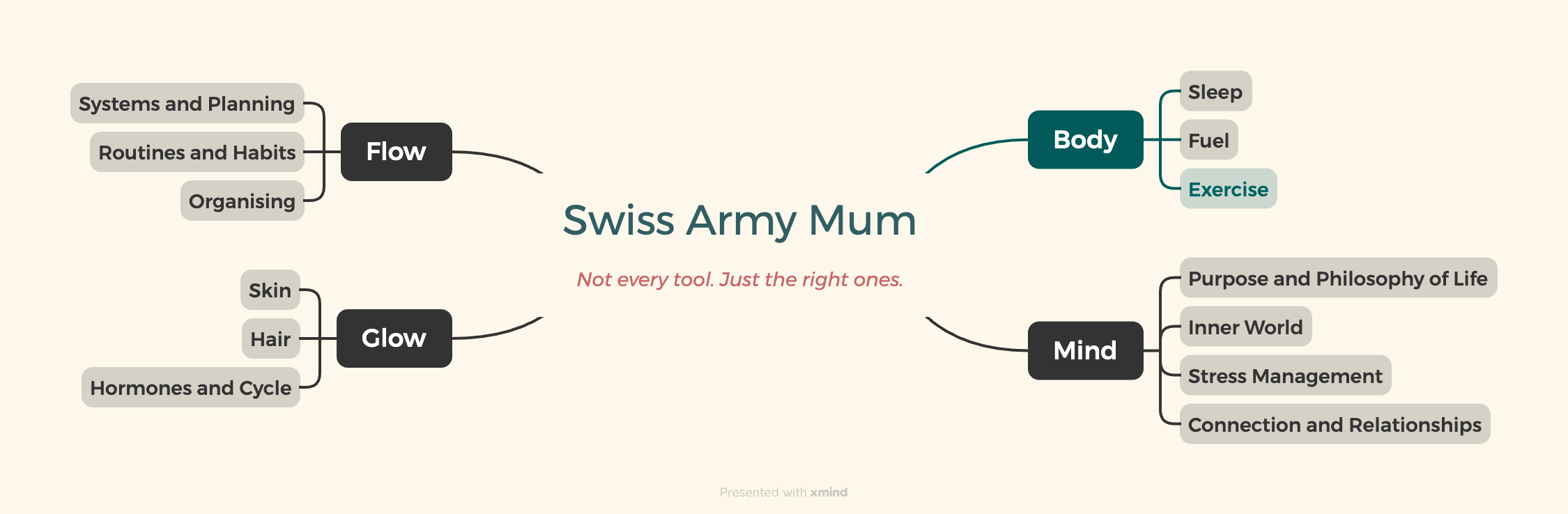
Swiss Army Mum is a practical guide to long-term health for busy women, built on four pillars: Body, Mind, Glow, and Flow.
Not every tool. Just the right ones.
Why It Matters
Falls Are Not Inevitable
Most people think falls are just part of aging. They’re not.
Falls happen when your neuromuscular control system (the integration of your brain, sensory systems, and muscles) fails to make the precise adjustments needed to maintain balance.
The evidence is clear: exercise reduces fall rate significantly. This matters most from age 60 onward, but prevention starts earlier. If you’re 35-55, this work is “prehabilitation”: building capacity before you need it.
Here’s what I think about: my grandmother fell at 78. Hip fracture. Surgery. Hospital for 3 weeks. She never fully recovered. Within 6 months, she lost her independence: needed help dressing, couldn’t drive, moved into assisted living.
One fall. That’s all it took.
Mobility Declines Without Use
“Use it or lose it” applies to joints, fascia, and range of motion.
Sitting 8+ hours per day creates tight hip flexors, stiff shoulders, and limited ankle mobility. Over time, restricted mobility leads to compensatory movement patterns (lifting with a rounded back because you can’t hinge properly), joint pain (knee pain from tight hips), and injury (shoulder impingement from limited thoracic mobility).
Hormonal changes matter: During perimenopause and menopause, declining estrogen affects connective tissue integrity. Tendons, ligaments, and fascia become less pliable. Without mobility work, stiffness accelerates.
Bone Density Requires Impact Loading
After menopause, women lose bone density rapidly. Estrogen decline accelerates bone loss: women can lose up to 20% of bone density in the 5-7 years following menopause.
Heavy strength training helps (remember the LIFTMOR trial from Part 1: +2.9% lumbar spine bone mineral density with twice-weekly heavy lifting plus impact loading). But the impact loading component is critical.
Jumping creates multidirectional stress on bones: your skeleton adapts by laying down new bone tissue2. Research shows that just 10 maximum vertical jumps, 3 times per week, significantly increases hip bone mineral density in 6 months3. That’s 30 jumps per week total. Less than 2 minutes of work.
Weight-bearing cardio (walking, jogging) helps, but high-impact plyometrics (jumping) produces superior bone-building stimulus. The key: ground reaction forces from jumping are 2-4 times higher than walking or jogging.
Without impact loading, your bones don’t get the signal to strengthen. Plyometrics isn’t optional after menopause: it’s essential.
Core Strength Is Not Just “Abs”
Most people think core strength means visible abs. It doesn’t.
Core = 360° torso stability. It’s everything except your limbs: abdominals (front), obliques (sides), spinal erectors (back), pelvic floor (bottom), diaphragm (top).
Remember the 6-step bracing protocol from Part 1 (Strength Training)? That’s 360° core stability in action: not just abs, but your entire torso working as a pressurized cylinder.
A strong core protects your spine during lifting, prevents urinary incontinence (common after menopause), allows safe force transfer when throwing or lifting overhead, and maintains posture. Think of it as the foundation that holds everything together.
A weak core leads to back pain, poor posture (rounded shoulders, anterior pelvic tilt), injury risk from compensations during lifting, and urinary incontinence.
Core strength is foundational for everything else.
How to train for it
Stability & Balance Training
What it is: Your ability to control your body position during movement (stability) and maintain equilibrium through proprioception and postural control (balance).
Why it matters: Your neuromuscular control system integrates three sensory inputs: (vision, vestibular (inner ear), and proprioception (body position sensors in muscles, tendons, joints)) to keep you upright. With aging, proprioceptive acuity declines (fewer mechanoreceptors, less sensitive, slower signals), increasing fall risk. Balance training recalibrates these sensors and strengthens brain-muscle communication.
Think of it like a car’s stability control system: sensors detect when you’re starting to skid (proprioception, vision, inner ear), the computer processes the data (your brain), and corrective actions happen automatically before you even realize you were losing traction (muscle adjustments).
Core Stability Exercises
If you’re doing the strength training protocol from Part 1, you’re already building core stability through:
360° Diaphragmatic Breathing - Creates intra-abdominal pressure (IAP), the internal brace that protects your spine. Lie on back, breathe into belly/sides/lower back (not chest), exhale while tightening abdominal wall.
Planks - Trains anti-extension (resisting lower back arch). Forearms on ground, body in straight line, squeeze glutes, breathe.
Dead Bugs - Trains anti-extension + coordination. Lie on back, arms up, knees bent 90°, press lower back flat, lower opposite arm and leg.
Bird Dogs - Trains anti-rotation. Hands and knees, extend opposite arm and leg, keep hips level.
Pelvic Floor Exercises - Kegels. Contract pelvic floor (imagine stopping urination mid-stream), hold 5-10 seconds.
Balance Exercises
Single-Leg Stands - Stand on one leg, hold 30 seconds each. Progress to eyes closed, unstable surface (pillow), or adding movement (reach arms overhead).
Heel-to-Toe Walk - Walk in straight line, placing heel directly in front of toes (like walking tightrope). 10 steps forward, 10 backward.
Balance Board / Wobble Cushion - Stand on unstable surface for 30-60 seconds. Progress to single leg.
Tai Chi - Slow, controlled movements with weight shifts. Strong evidence for falls prevention.
“Toe Yoga” - Lift big toe while keeping other toes down, then reverse. Improves foot strength and ankle stability. 10 reps each.
Rebounder Work - Jump on mini trampoline with single-leg bounces, heel-to-toe walks on rebounder surface, dynamic balance drills. The unstable surface activates proprioceptors intensely while being joint-friendly. This is my personal favorite and I’ll come back to it later on.
Plyometric Training
What it is: Jumping exercises. Squat jumps, box jumps, jumping jacks, skipping, rebounder jumps.
Why it matters: Jumping creates impact forces that signal bones to remodel and strengthen, especially important for preventing osteoporosis after menopause. Ground reaction forces from jumping are 2-4 times higher than walking or jogging, creating superior bone-building stimulus.
Research shows that just 10 maximum vertical jumps, 3 times per week, significantly increases hip bone mineral density in 6 months. That’s 30 jumps per week total, less than 2 minutes of actual jumping.
Plyometric Exercises
Low-Impact (Start Here):
Rebounder jumps - Mini trampoline reduces joint impact while providing bone-building stimulus. My fav!
Marching in place - Lift knees high, land with impact
Step-ups with hop - Step up onto box, add small hop at top
Moderate-Impact:
Jumping jacks
Skipping
Side hops
Squat jumps
High-Impact (Advanced):
Box jumps (start low, 6-12 inches)
Jump rope
Tuck jumps
Broad jumps
Critical note: If you have joint issues, low bone density (osteoporosis), or haven’t exercised in years, get medical clearance first. The LIFTMOR researchers specifically caution against unsupervised high-impact programs in women with osteoporosis—supervision and proper progression matter.
Start low-impact: Use a rebounder (mini trampoline) for joint-friendly plyometrics. The unstable surface also trains balance and proprioception while you jump.
Mobility Training
What it is: Range of motion in joints + flexibility + fascia health.
Why it matters: Without mobility, daily movements become difficult: reaching overhead, bending down, twisting, getting up from the floor. During perimenopause and menopause, declining estrogen affects connective tissue integrity. Tendons, ligaments, and fascia become less pliable. Without mobility work, stiffness accelerates.
You need two things: Yoga or stretching (for flexibility, range of motion, and mental health) and Foam Rolling (for fascia care and muscle tension release).
Yoga: Mobility + Mental Health
Yoga is great for mobility. It stretches tight areas (hip flexors, hamstrings, chest, shoulders, thoracic spine), improves range of motion, and reduces stress.
How to approach yoga:
Frequency: 1-2x/week (20-30 min sessions)
Styles for mobility:
Yin yoga: Long holds (3-5 min), deep stretches
Vinyasa flow: Dynamic movement, full-body mobility
Restorative yoga: Gentle, supportive stretches
Focus areas for women:
Hip flexors - Couch stretch, lunge stretch
Hamstrings - Forward fold, strap stretch
Chest/shoulders - Doorway stretch, wall angels
Thoracic spine - Cat-cow, thread the needle
Mental health bonus: Yoga reduces cortisol, improves sleep quality, and helps with perimenopausal/menopausal symptoms like mood swings and anxiety. You’re getting mobility and mental health in one session.
Foam Rolling: Fascia Care
What is fascia? Fascia is connective tissue that wraps muscles, organs, and bones. With inactivity, repetitive movements, or stress, fascia gets “stuck”: adhesions form, restricting movement and causing pain.
Foam rolling breaks up adhesions, improves blood flow, and restores mobility.
How to foam roll:
Pressure: Uncomfortable but not painful (6-7 out of 10)
Duration: 30-60 seconds per area
Technique: Slow rolls, pause on tender spots (don’t roll back and forth quickly)
Frequency: 5-10 minutes, 1-2x/week
Target areas for women:
Hips (IT band, TFL, glutes) - Roll outer thigh, front of hip, glutes
Feet (plantar fascia) - Roll with lacrosse ball or frozen water bottle
Shoulders/upper back (traps, rhomboids) - Roll upper back on foam roller
Achilles/calves - Roll calves, stretch Achilles
How Much You Need: The 80/20 Approach
Here’s the best part: you can combine stability, balance, and plyometrics in a single tool: the rebounder (mini trampoline).
A 15-minute rebounder session covers:
Balance work - Single-leg bounces, dynamic balance drills on unstable surface
Plyometrics - Jumping for bone density (squat jumps, high knees, tuck jumps)
Core stability - Maintaining stability while jumping activates deep core muscles
You can even use the rebounder to sneak in your HIIT in the same amount of time! Add yoga for mobility and foam rolling for fascia care, and you’re done.
Minimum effective dose:
Rebounder: 3-4 sessions × 10-15 min = 30-60 min/week
Yoga: 1 session × 20-30 min = 20-30 min/week
Foam rolling: 1-2 sessions × 10 min = 10-20 min/week
Total time: 60-110 min/week (1-2 hours = 0.6-0.9% of your week)
Sample Weekly Routine
Here’s how I actually structure my week. This is the minimum effective dose for stability, balance, plyometrics, and mobility:
Monday: Day off
Tuesday: Rebounder session (10 min) - HIIT + Foam rolling (10 min)
Wednesday: Rebounder session (10 min) - Balance and stability work
Thursday: Day off
Friday: Rebounder session (10 min) - HIIT
Sunday: Rebounder session (10 min) - Plyometrics + Yoga (20 min)
Total time per week: 70 min/week
This sample focuses on balance/mobility/plyometrics only. In the BTS post, I'll show you how I integrate this with strength training and cardio in one cohesive weekly schedule. Google calendar and all!
Common Mistakes
Mistake 1: Skipping This Entirely
“I don’t have time” → You’ll have time for physical therapy after you get injured.
Falls, joint pain, and mobility restrictions cost more time (and money) than 10 minutes of preventive work twice a week.
Mistake 2: Rolling Too Fast
Foam rolling isn’t about speed. Slow, deliberate, pause on tender spots.
If you’re rolling back and forth quickly, you’re not breaking up adhesions: you’re just bruising tissue.
Mistake 3: Only Stretching Tight Muscles
You also need to strengthen weak/inhibited muscles. Sometimes, the reason a muscle is tight is because of an antagonist being tight too.
Example: Tight hip flexors often mean weak glutes. Stretching hip flexors helps, but strengthening glutes fixes the root cause.
Mistake 4: Ignoring Feet
Your feet are your foundation. Weak, stiff feet = problems upstream (knees, hips, back).
Do toe yoga. Roll your feet. Strengthen your ankles with single-leg balance work on the rebounder.
Mistake 5: Waiting Until You’re In Pain
This is preventive maintenance, not reactive treatment.
Don’t wait until you’re injured to start mobility work. By then, you’re in recovery mode (which takes longer).
Resources
You don’t need expensive equipment or a gym membership. You need the right tools and a simple system.
More on that soon.
What’s Next
Next week: Book Club: Next Level by Stacy Sims
Stacy Sims wrote Next Level specifically for women navigating perimenopause and menopause. It’s THE book on exercise and nutrition for hormonal changes.
We’re breaking down:
What Sims gets right (a lot)
What to skip (some recommendations don’t align with SAM)
How Next Level fits the Swiss Army Mum approach
Who should read it
After that: Behind the scenes - My Exercise Routine and setup. How I make sure I lift, do HIIT, plyometrics and balance/stability/mobility in less than 3% of my time. I’ll also share my setup (mostly thrifted!) and the free YouTube ressources I use every week.
Subscribe so you don’t miss it!
Your Turn
Do you do any mobility or balance work currently?
What’s the tightest area in your body right now (hips, shoulders, lower back)?
Have you experienced any falls or near-falls? What happened?
Drop a comment. I read every one.
Medical note: This is educational, not personal medical advice. Your biology, history, and context matter. Work with a qualified healthcare professional.
Thank you!
Thanks for reading Swiss Army Mum! If this resonated, forward it to someone who might benefit or hit the ♥️ button. It helps more people discover this work.
Sherrington C, Fairhall NJ, Wallbank GK, Tiedemann A, Michaleff ZA, Howard K, Clemson L, Hopewell S, Lamb SE. “Exercise for preventing falls in older people living in the community.” Cochrane Database of Systematic Reviews 2019, Issue 1. Art. No.: CD012424. https://doi.org/10.1002/14651858.CD012424.pub2
Vetrovsky, Tomas et al. “The Efficacy and Safety of Lower-Limb Plyometric Training in Older Adults: A Systematic Review.” Sports medicine (Auckland, N.Z.)vol. 49,1 (2019): 113-131. https://doi.org/10.1007/s40279-018-1018-x
Kato, Takeru et al. “Effect of low-repetition jump training on bone mineral density in young women.” Journal of applied physiology (Bethesda, Md. : 1985)vol. 100,3 (2006): 839-43. https://doir.org/10.1152/japplphysiol.00666.2005