


If you’re new here, hi!
Swiss Army Mum is a simple, science-based wellness system for busy women. Four pillars. No overwhelm.
Not every tool. Just the right ones.

Over the last few weeks, we covered the full exercise pillar: strength training, cardio done smart and balance, mobility and plyometrics.The science is solid. The protocols are clear. But I promised you a behind-the-scenes post. What does this home workout setup actually look like in a real week, with a real life?
This is that post.
No ideal setup. No gym contract. No perfect gear.
Just what I actually use, and the system that makes it effortless to start.
I Don’t Go to the Gym
I used to. In my 20s, a gym membership made sense. I had more time, fewer competing priorities, and no strong opinion about commuting for a workout.
I don’t anymore.
Adding a gym trip to my day now means commute, changing rooms, equipment queues, coming back. That is not a motivation problem. It is a friction problem. And friction is the enemy of consistency, which is the only thing that matters over decades.
So I removed it.
Now it looks like this: I finish work, I pull out the rebounder, I am moving within ten minutes. That is it.
If the gym works for you, keep it. But if you are struggling to show up consistently, do not ask “what is optimal?”
Ask: “what makes this easy to start?”
You Don’t Need Fancy Clothes Either
Before we get to the gear: I do not have cute gym outfits. I wear my trusty old leggings and oversized t-shirts, and yes, sometimes a second sports bra on top of my regular bra when I rebound, because gravity.
Reality over aesthetics. Always.
The Gear: My Complete Home Workout Setup
This is everything I use for a complete workout week. Five items. No machines. No complicated assembly. Each one earns its floor space.
The Rebounder
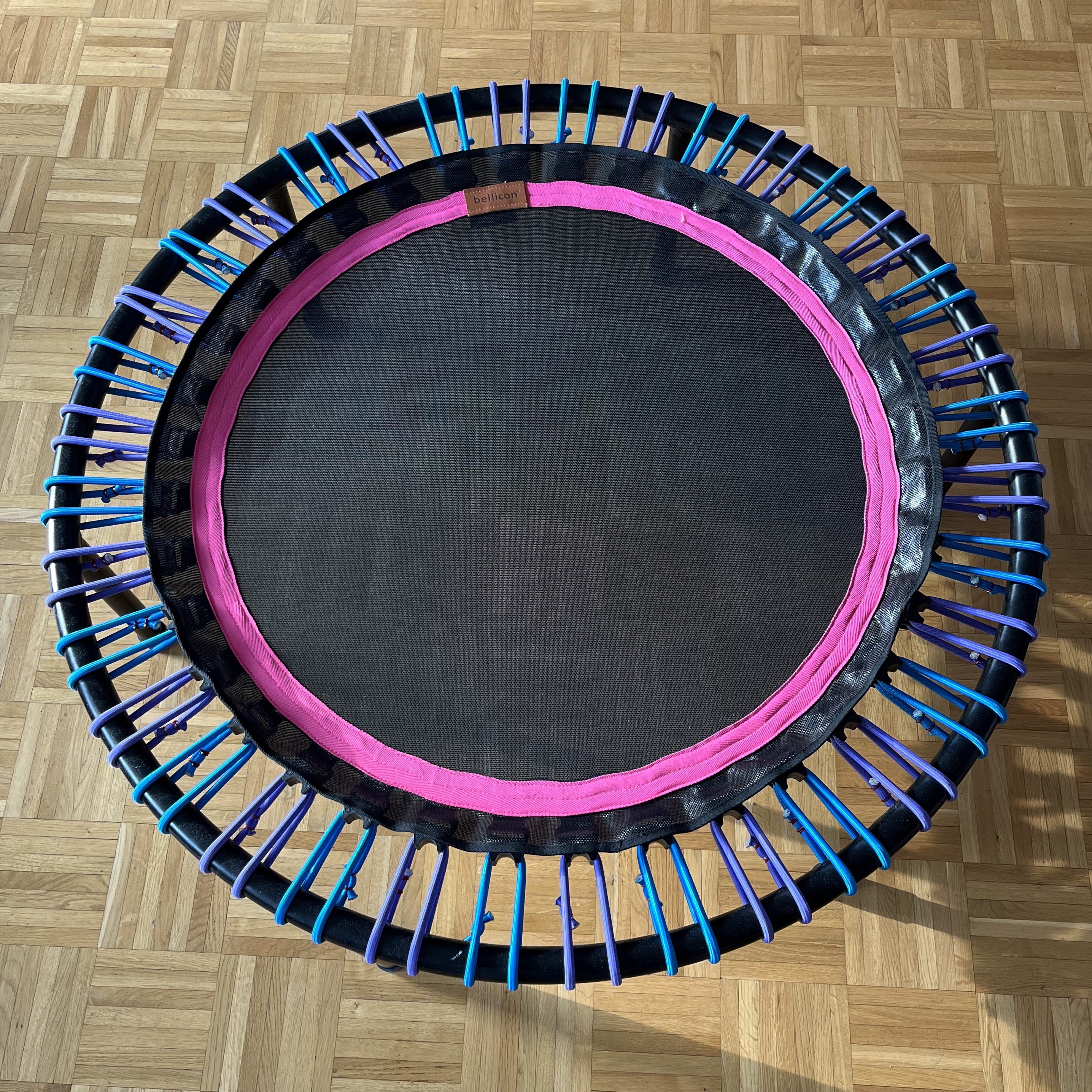
This is my most-used piece of equipment. Not by a small margin. By a lot.
My first mini trampoline was a cheaper model, also thrifted. I had no idea whether I would actually use it. But I found myself getting on it regularly, almost without thinking, which is the clearest possible signal that something is working. Once I knew rebounding was genuinely part of my routine, it felt worth investing in a better model. I found a Bellicon secondhand, and the difference is real: the bungee cord system is noticeably softer underfoot, which matters when you are using it almost every day.
The reason a rebounder earns so much floor space is that it covers three exercise categories with one tool. It is HIIT when you go hard. It is plyometrics when you focus on jump quality and impact. It is balance training because the elastic surface activates the proprioceptive system (your body’s position sensors in muscles, tendons, and joints) far more intensely than standing on flat ground. That is the same neuromuscular system we broke down in the balance and mobility post, the one that keeps you upright when you stumble, and it gets a serious workout every time you step on an unstable surface.
There is also something harder to quantify. It is genuinely fun. After years of forcing myself through workouts I resented, that matters more than I expected.
The Weights
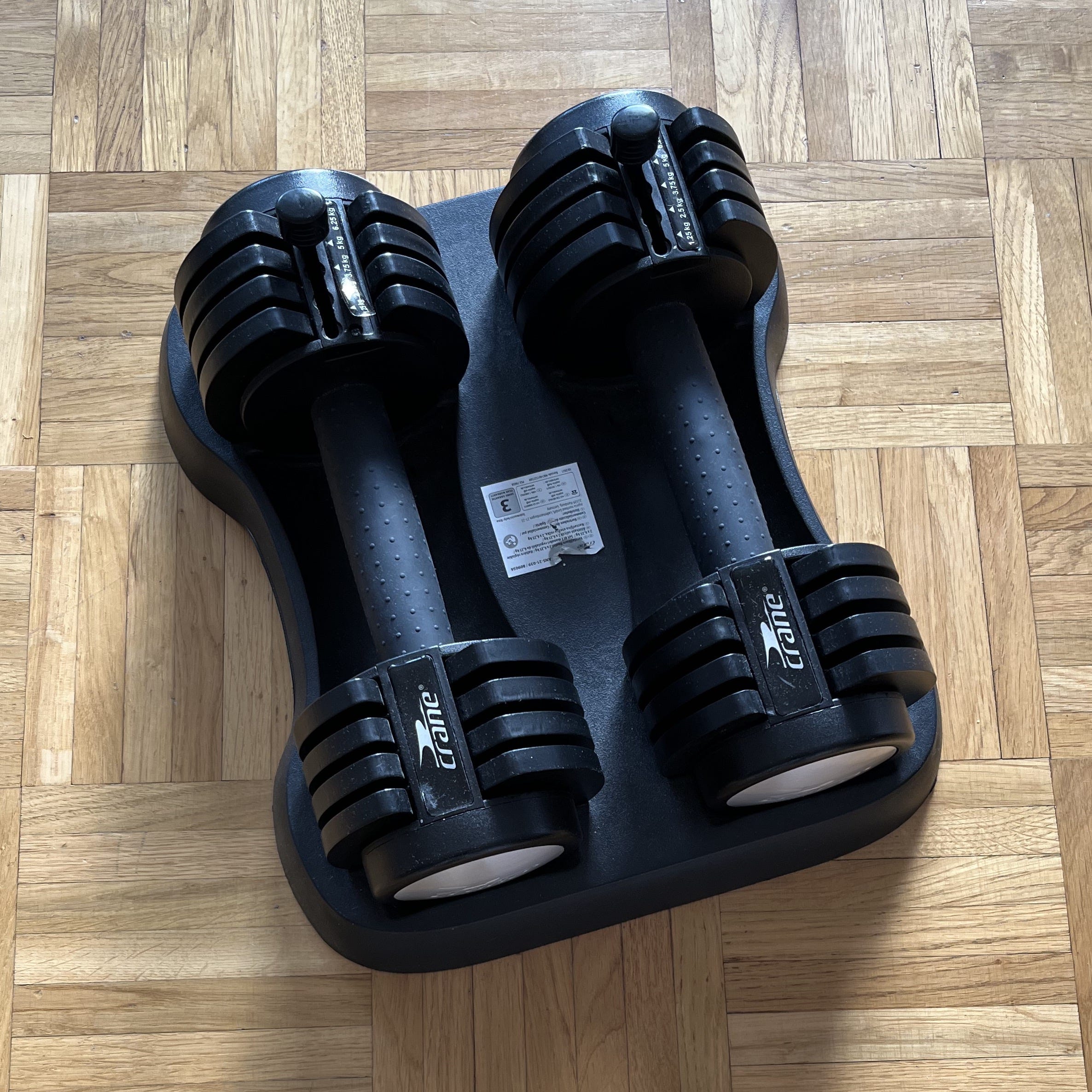
Two adjustable dumbbell sets. Both thrifted.
The first goes up to 6.25 kg (14 lb).
The second, which I added once the first felt comfortable, goes up to 11.3 kg (25 lb).
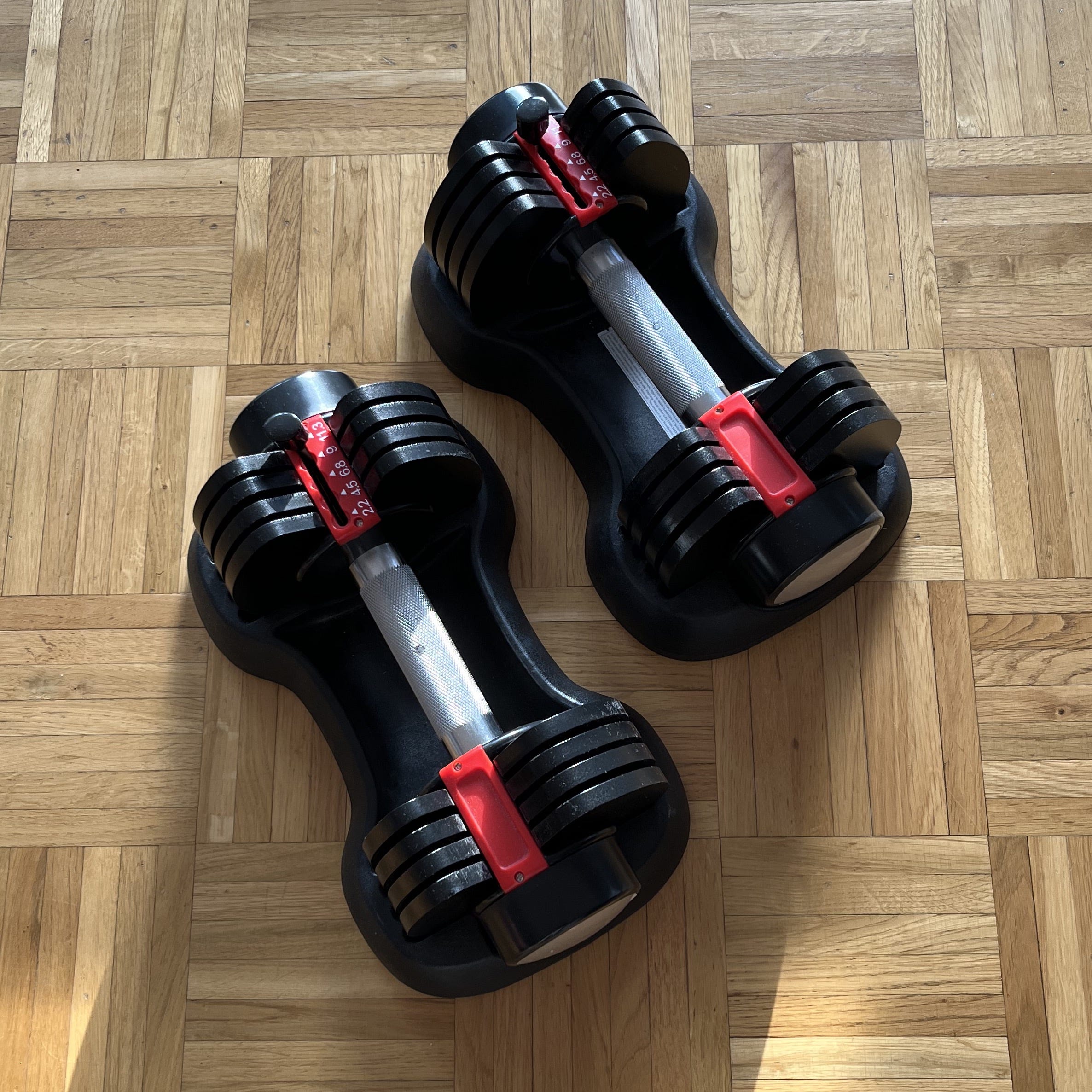
In practice, the heavier set handles lower body and back work: squats, deadlifts, rows. These are the large muscle groups, and they need more load to generate a real training signal. For upper body, I stay around 6 to 7 kg (13 to 15 lb) for now. That is the range where I still have to genuinely work through the last few reps, which is the whole point.
Adjustable dumbbells are worth knowing about because they give you an enormous range of loads in a very small footprint. Rather than a rack of fixed weights taking up half a room, you have two compact sets that cover everything from light accessory work to heavy compound movements. The trade-off is that changing the weight mid-workout takes a few extra seconds. I have never found this to be a real problem.
A word on progressive overload in practice: I did not buy both sets at once. And they were both thrifted. I started with the lighter pair, used it until the exercises started feeling manageable rather than challenging, and then added the heavier option. That is exactly how it is supposed to work. You do not need the full range on day one. You earn your way up.
One thing I notice on every new cycle through my program: I have gone heavier, I have slowed the movements down, and I focus more carefully on the muscle I am actually working rather than just completing the rep. That is what strength progress looks like in practice. Not dramatic. Measurable.
The Walking Pad
Also thrifted, also used constantly. This is probably the most invisible part of my routine, but not the least impactful.
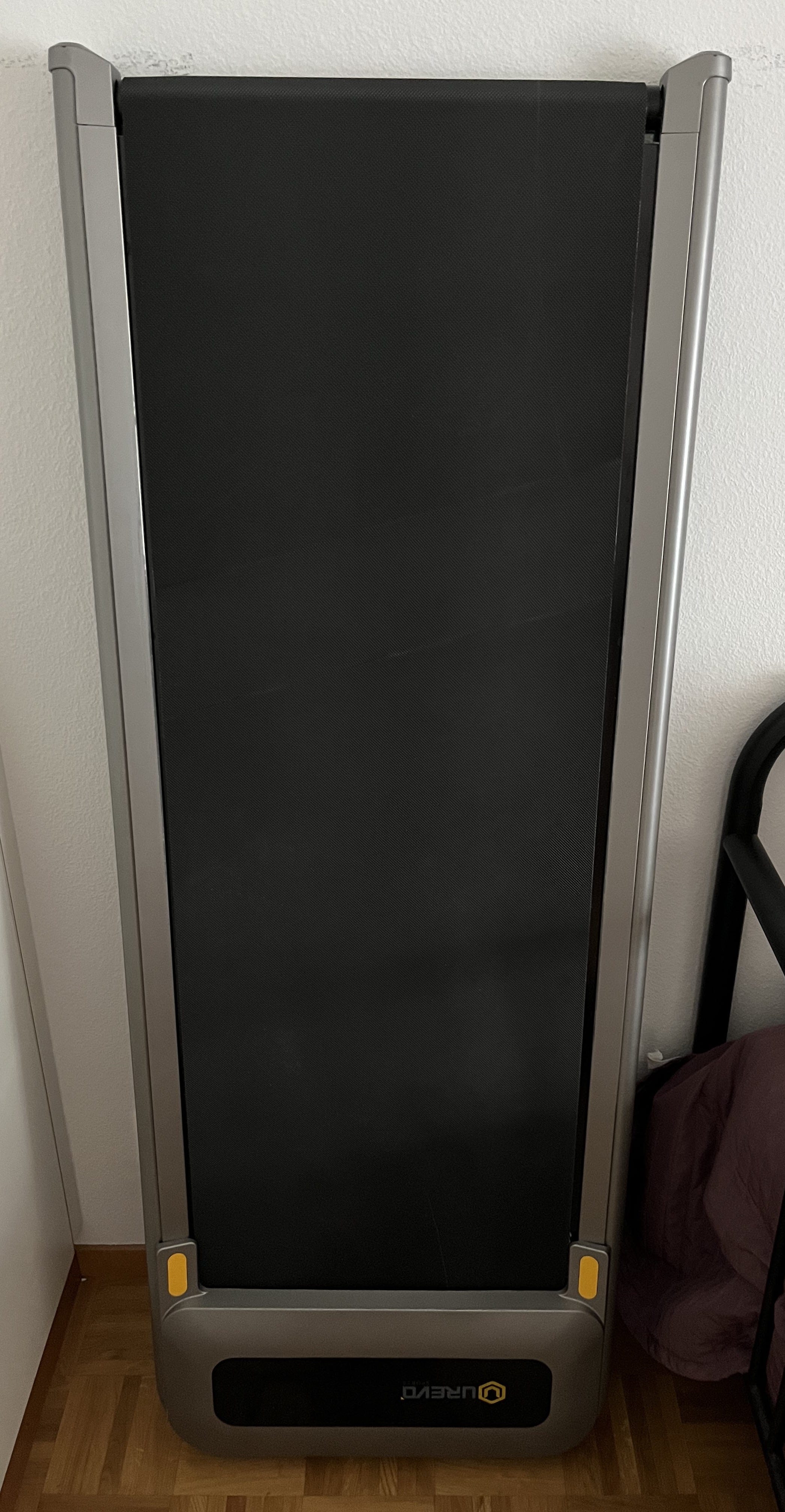
On days I work from home, I can easily walk an hour without noticing. Every evening after dinner, I step back on for 10 to 30 minutes, depending on where my step count sits. No planning, no outfit change, no transition. Just walking.
This is how I hit my daily movement baseline without it feeling like exercise. My morning dog walk covers part of it. The pad covers the rest, particularly on days when I need to commute and the morning walk is shorter.
The Yoga Mat and the Foam Roller
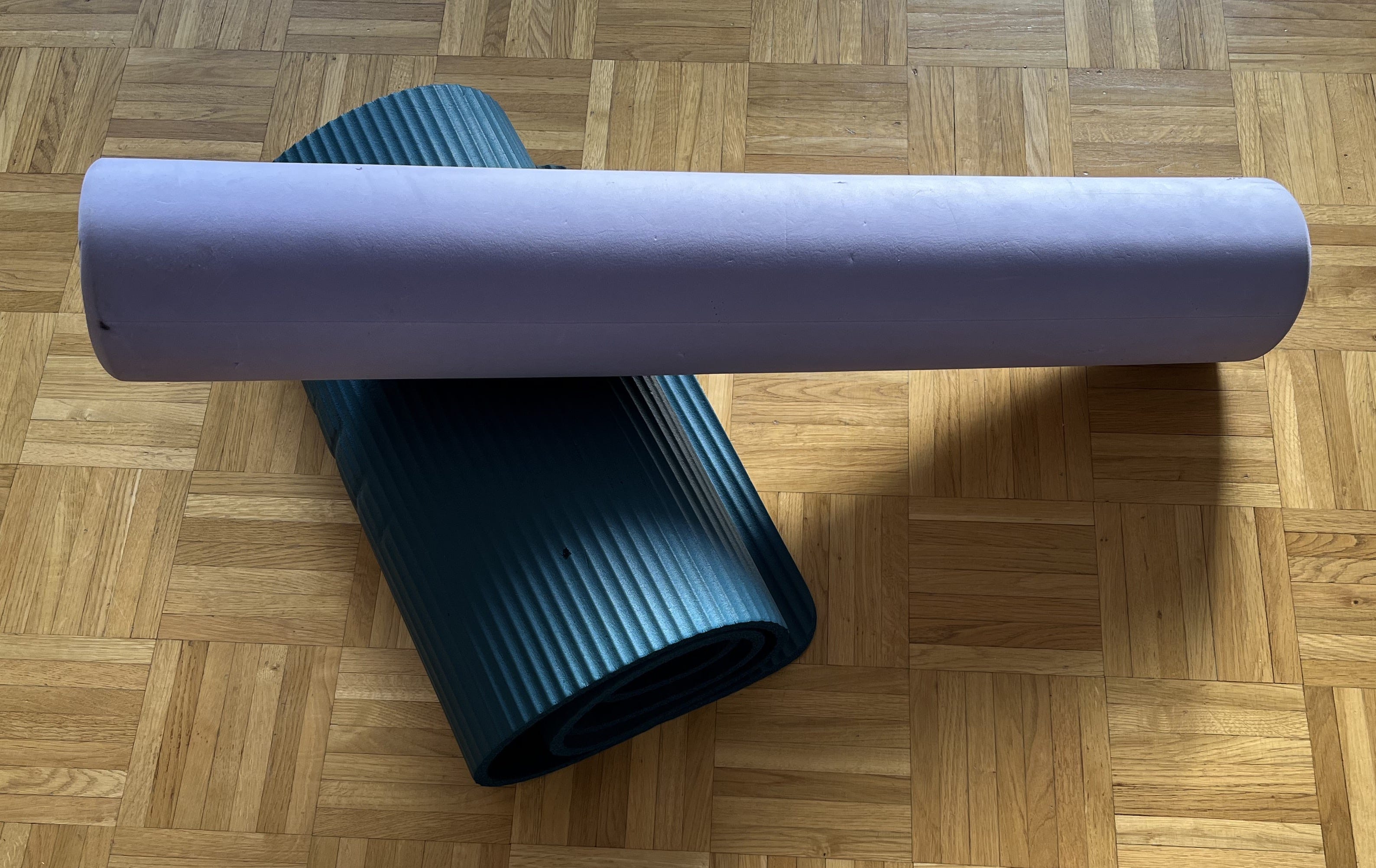
The one item I bought new is the yoga mat. I use it for everything: strength work, mobility, yoga, stretching, foam rolling. It has not left the floor.
My foam roller is old. Still perfectly functional. Foam rollers do not wear out the way people think. This is the kind of tool that does not feel exciting but keeps everything else working. 10 minutes twice a week is enough to make a real difference to how you move and recover.
The YouTube System That Runs Everything
I do not plan individual workouts. Or more accurately, I plan them once, at the start of the year, and then that decision does not exist anymore.
This is a Flow pillar principle applied directly to exercise: remove the decision entirely. When it is time to train, I do not search, scroll, or wonder what to do. I press play.
Here is how each category works.
Strength: Lift with Cee
This is the backbone of my lifting. There are tons of YouTube fitness channels. I’ve tried quite a few and I kept coming back to Cee. She does real lifting, does not talk incessantly (which is something I do not appreciate in fitness videos), and has a clear objective and structure to her videos. We’re here for strength and strength is what we get.
If you are new to lifting weights, watch her introduction video first. She explains her method clearly, and it saves you the confusion of trying to figure it out where to start.
I use two of her full-body combo set playlists, 21 videos each.
I alternate them week by week: week 1 from playlist A, week 1 from playlist B, week 2 from playlist A, and so on. Each workout repeats three times in a week before I move to the next. 42 videos total. With holidays factored in, this covers almost a full year before cycling back to the beginning.
Both playlists have identical total volume, 24 working sets per session, just structured differently. Playlist A uses a 40 seconds on, 20 seconds rest timing. Playlist B is rep-based. I ignore both systems. I choose a weight I can lift for 6 to 8 clean reps, and I use whatever time remains to recover and reset.
The content is what matters. The timer is just scaffolding.
These playlist have been real game changers to achieve consistency.
Rebounding: Earth & Owl
Earth and Owl is my primary rebounding resource. Nikki’s pace, her attention to tempo, and the overall feel of her sessions suit how I like to move. It is not high-adrenaline or performative. It is focused and deliberate, which is exactly what I want.
For HIIT, I rotate through her menopause playlist, particularly the 30/90 versions (30 seconds on, 90 seconds recovery). On lower-energy days, I choose one of her lighter flow or gentle sessions instead. The range she covers means I always have something that fits the day I am actually having, not the ideal day I planned for.
A few other channels worth knowing:
Jump and Jacked has a more upbeat, high-energy feel. Great if you respond well to that kind of motivation and want something with more momentum behind it.
SanFran Fitness is more grounded and athletic in tone. I keep their lymphatic drainage video on my quick-access list for days when I want to move but nothing intense sounds appealing.
Michelle Briehler is high-intensity and very focused. Her sessions are short but genuinely demanding. On days when I have the energy and want something punchy, 10 minutes with her is plenty.
Mobility & Yoga
Charlie Follows is my go-to for stretching and yoga. Her 10 to 15-minute videos sit in a useful middle ground: long enough to actually open things up, short enough to slot into a day without a second thought.
Depending on where I am in my cycle or how the body feels, I pick something gentler or something more dynamic. I will come back to how I adapt training across my cycle when we get to the Glow pillar.
For foam rolling, I rotate between two videos I have bookmarked: the 15-minute routine from Well and Good, and Tom Peto’s 10-minute version. Both work well. Which one I use depends entirely on available time.
On days when I have skipped a strength session, a longer mobility flow from Strength and Flow Fitness is what I reach for. 15 minutes of deliberate movement, and I never regret it.
The Calendar System (This Is What Actually Makes It Work)
The gear and the videos are tools. The calendar is the system that ties them together.
Here is exactly how I structure it.
42 weekly events, set up once a year. For strength training, I create a recurring weekly event for each workout in the Lift with Cee rotation. Each event has the title of that week’s session and the direct link to the video embedded in the notes. Set up 42 of these at the start of the year and you are done. No searching, no deliberating, no friction. When the event appears, I open it, click the link, and train.
A Sunday “YouTube Resources” block. Every Sunday, I have a recurring all-day event that holds all my other go-to links: rebounder sessions for different energy levels, yoga and mobility videos, foam rolling routines. It is not a task. It is a reference library. On any given day, I open one event and choose from what is already there.
Color-coded exercise blocks. All my exercise commitments, strength, cardio, mobility, use the same calendar color, distinct from my work and personal commitments. This is a small thing that makes a real difference. At a glance, I can see how my movement is distributed across the week without reading a single event title. If a week looks light on that color, I know before it happens.
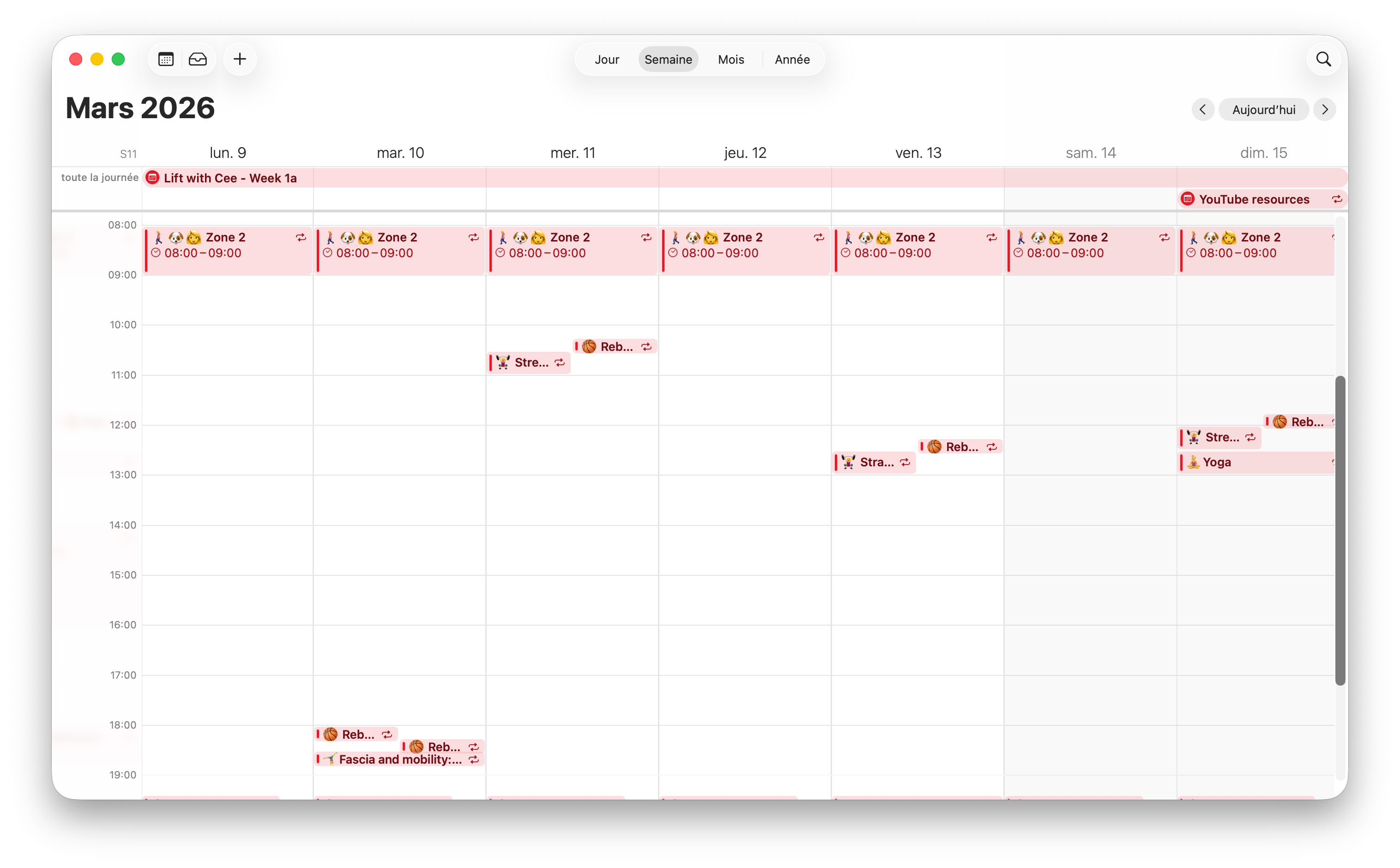
The result is a week that runs on autopilot. The decisions were made in once a year. Everything else is just following the plan.
Please take a minute to appreciate the fact that most of the calendar is free! You actually need less than 3% of your time to hit the recommended amount of exercise.
Links for your resource block (Copy This Into Your Calendar)
Build your Sunday block today. It takes about 20 minutes to set up and removes a decision you would otherwise make dozens of times a year. Remember my strength videos are in my calendar but as weekly events, since I change each week.
Everyone’s preferences will differ, so adjust for yours, but this is mine:
Rebounder
HIIT
High energy cardio
Lymphatic drainage
Plyometrics
Yoga
Foam rolling
Primal mobility flow
What This Looks Like in Practice
Some weeks are clean. I lift three times, rebound four times, do a yoga session on Sunday, and hit my step count without much effort.
Other weeks are not. There is a deadline, or someone is sick, or I just have no energy for anything demanding. Those weeks, I walk. I do 10 minutes on the rebounder. I stretch on the mat. I do something small.
Because everything is simple, at home, and pre-decided, I show up consistently even when motivation is low. That is the whole point. Systems do not require you to feel like it. They just require you to start.
The Home Workout Setup You Actually Need
You do not need a gym. You do not need expensive equipment. You do not need a different routine every week.
You need low friction, a few versatile tools, and a system you can repeat without thinking.
Rebounder. Weights. Walking pad. Mat. Calendar.
That is it. That is the whole thing.
Your Turn
What is your current workout setup? Home, gym, both?
Is friction the thing stopping you, or something else entirely?
And if you are already rebounding: which channels or videos are you using? I would love to expand the list.
Drop a comment below. I read every one.
Thank you
Thank you for reading, sharing, and supporting this work. Whether you’ve been here since the beginning or just found Swiss Army Mum, I’m glad you’re here.
Building sustainable health without overwhelm takes a village. If something resonated with you, I’d be grateful if you forwarded this to someone who might benefit or hit the ♥️ or ↻ Restack button. It helps more people discover this space.
Medical note: This is educational, not personal medical advice. Your biology, history, and context matter. Work with a qualified healthcare professional.