


We have spent the last two posts building the Stoic framework: why a philosophy of life matters, and what Stoics actually believed and the compass they left us. Today we test it. Because the real question about any philosophy is not whether it sounds good. It is whether it holds up when things get hard.
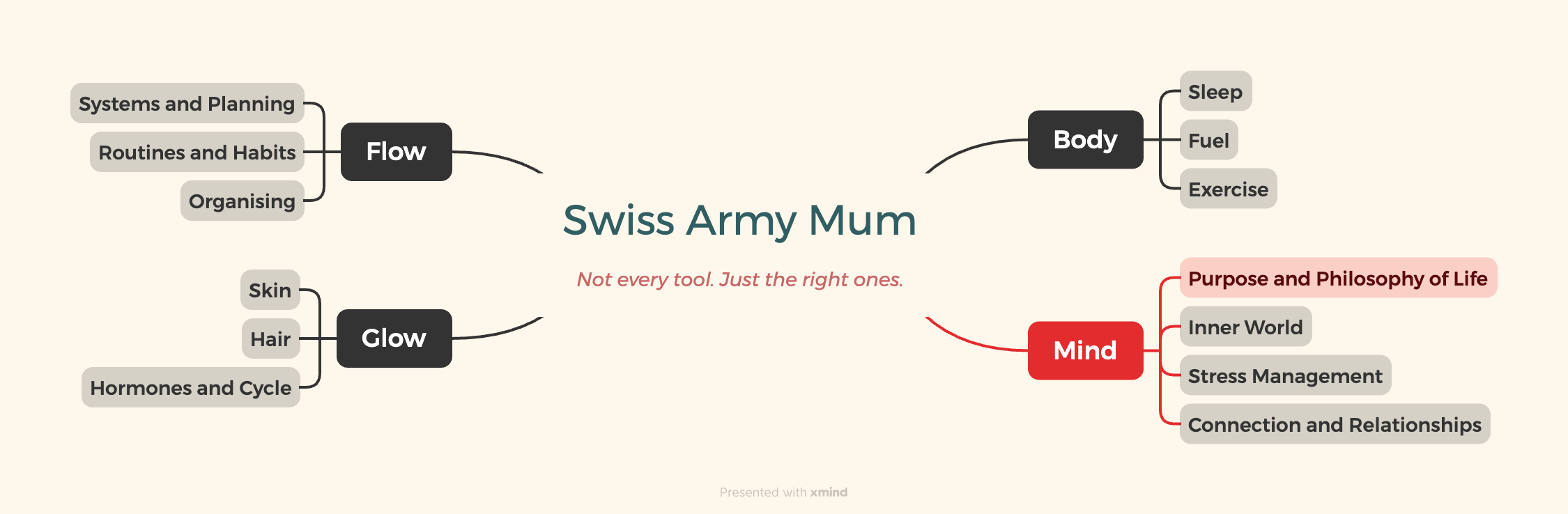
This post sits in the Purpose and Philosophy of Life area of the Mind Pillar, and it is the most practical post in the area so far: it takes the Stoic framework built across the previous two posts and tests it against the kind of difficulty that actually lands in real life. The Emotional Resilience and Stress Management area, coming later in the Mind series, builds on the same foundations, applied to longer patterns of stress and coping rather than specific hard moments.
The Thing Nobody Warns You About
I moved country with a six-month-old and a two-and-a-half-year-old to pursue research abroad. My husband travelled two weeks out of every four. Which means that for two weeks out of every four, I was the only adult in the house, managing two children under three, building a research career in a new country, with no family nearby, no established support network, and no clear idea of when it would feel less overwhelming.
From the outside it looked like an adventure. From the inside it looked like the laundry pile at 11pm, the baby refusing to sleep for the fourth night in a row, the toddler who needed more of me than I had left to give, and the quiet, persistent feeling that I was failing at everything simultaneously, the research, the parenting, the partnership, because I could not be fully present to any of them.
Nothing was catastrophically wrong. That was almost the problem. There was nothing to point to, no single crisis to resolve. There was just the weight of it, accumulating, day by day, in the gap between the life I had chosen and the reality of living it.
It was during that stretch that I first read Epictetus properly. Not as a philosophical exercise. As a field manual.
That is the kind of hard Stoicism was built for. Not only the dramatic losses, the grief, the diagnosis, the sudden rupture. The sustained, unglamorous, invisible kind that does not get acknowledged because from the outside everything looks fine.
And it is also the kind of hard that the women reading this know better than most. The particular weight of being the one who notices everything, remembers everything, organises everything, and whose noticing and remembering is so invisible that it doesn’t even register as work. The mental load that accumulates not in single dramatic moments but in the ten thousand small ones: the packed lunch that nobody else thought to make, the dentist appointment that only you remembered, the emotional temperature of the household that only you are monitoring. The years of being the default parent, the default worrier, the default keeper of the whole operation.
And for some readers, layered on top of all of that: the 3am wake-up that is not quite anxiety and not quite grief. The rage that arrives before you have a reason. The appointment where you described your symptoms and were told it was probably stress. The feeling, captured so precisely in research on women in midlife, that your body is renegotiating its terms without consulting you, while you are still expected to show up for everything else at full capacity.
This is not a philosophy developed in comfort by academics writing for a comfortable audience. It was developed in the middle of actual life, by people facing conditions most of us will only encounter at the edges of ours. Epictetus, enslaved. Marcus Aurelius, governing an empire while watching his children die. Seneca, writing his clearest thinking in the final years of his life, knowing that Nero might order his execution at any moment.
They were not performing resilience. They were trying to figure out, in real time, how to act with integrity when acting with integrity cost something.
What they left us is a toolkit. This post is about how to use it when you need it most.
New here? Start here:

Swiss Army Mum is a practical guide to long-term health for busy women, built on four pillars: Body, Mind, Glow, and Flow.
Not every tool. Just the right ones.
The Foundation: Sort First
When something hard arrives, the first instinct is to react. To fix. To resist. To collapse. All of these are understandable. Most of them are costly.
The Stoics begin differently. Before anything else, sort.
The trichotomy of control is the first tool you reach for in any difficult situation, not because it makes the difficulty smaller, but because it tells you where to direct your energy. Everything falls into one of three categories: fully within your power, partially within your power, or entirely outside it1.
Let me give you a few concrete examples, because this distinction matters most when it is hardest to see clearly.
Your child is struggling at school and you don’t know why. The outcome, whether it resolves, how long it takes, what it means for them, is not fully within your power. What you do today: the conversation you initiate, the attention you bring, the support you arrange, that is yours. Investing your energy in catastrophising about the outcome is wasteful twice over: it drains you and it does not change the outcome.
You are overwhelmed at work. The volume of demands is not within your power. Your manager’s priorities are not within your power. Whether you get through today by reacting to everything that arrives, or by choosing deliberately what to engage with and what to let sit, that is yours.
You are waking at 3am, which is disrupting everything, mood, concentration, patience with your children and your partner. The broken sleep is partly the hormonal transition for some readers, partly elevated cortisol for many more, partly the racing mind that arrives uninvited at all ages. The hormonal component is not fully within your power. But the conditions you are creating around sleep, the alcohol at dinner, the screen time before bed, the unfinished conversation you took to bed with you, those are partially or fully yours. The sleep post covers the levers in detail.
The point across all of these: sorting before you act prevents you from investing furious energy in what cannot be changed, while neglecting what can.
Epictetus knew this because he lived it under conditions most of us will not face. He had been owned by someone else. His body, his location, his daily existence: none of it his to control. And from that position of absolute external constraint, he wrote the most uncompromising account of internal freedom in Western philosophy.
”Seek not that the things which happen should happen as you wish; but wish the things which happen to be as they are, and you will have a tranquil flow of life.”
That is not resignation. It is a precise allocation of effort. Everything into what you can influence. Nothing wasted on grieving what you cannot.
The Second Move: Let It Be What It Is
There is a principle the Stoics lived by that is often misattributed and frequently misunderstood. Amor fati. Love of fate.
Not acceptance in the sense of going limp. Not pretending that what is hard is not hard. Something more specific and more demanding: the willingness to take what arrives, including what is genuinely painful, and to work with it rather than against it.
I want to name what this asks of women specifically, because I think it is under-discussed in wellness content that tends to be either relentlessly practical or relentlessly spiritual.
The letting go that amor fati invites is not passive. It is active and it is specific. It means letting go of the idea that you can control how your children turn out, while continuing to do your best. It means letting go of the version of your career that you imagined at 28, while continuing to invest in the one in front of you. It means letting go of the expectation that your body in your 40s should perform like your body in your 30s, while continuing to take care of it. In each case, the letting go is not resignation. It is the precise, deliberate redirection of energy from what cannot be changed to what can.
For women in perimenopause specifically, this has an added and personal dimension. The transition is asking you to let go of a version of yourself, the version whose body behaved predictably, whose energy followed certain rules. Some of that loss is real and worth grieving. The Stoics would not tell you otherwise.
But there is a difference between grieving what is genuinely over and resisting what is simply changed. The research is increasingly clear that the transition, however disruptive, is also a reorganisation, one that, for many women, eventually produces a clarity about what matters that the earlier decades did not.
What remains, on the other side of acceptance, is almost always more than we think.
The Third Move: Use the Obstacle
There is a passage in one of Marcus Aurelius’ Meditations adaptation I return to more than almost any other.
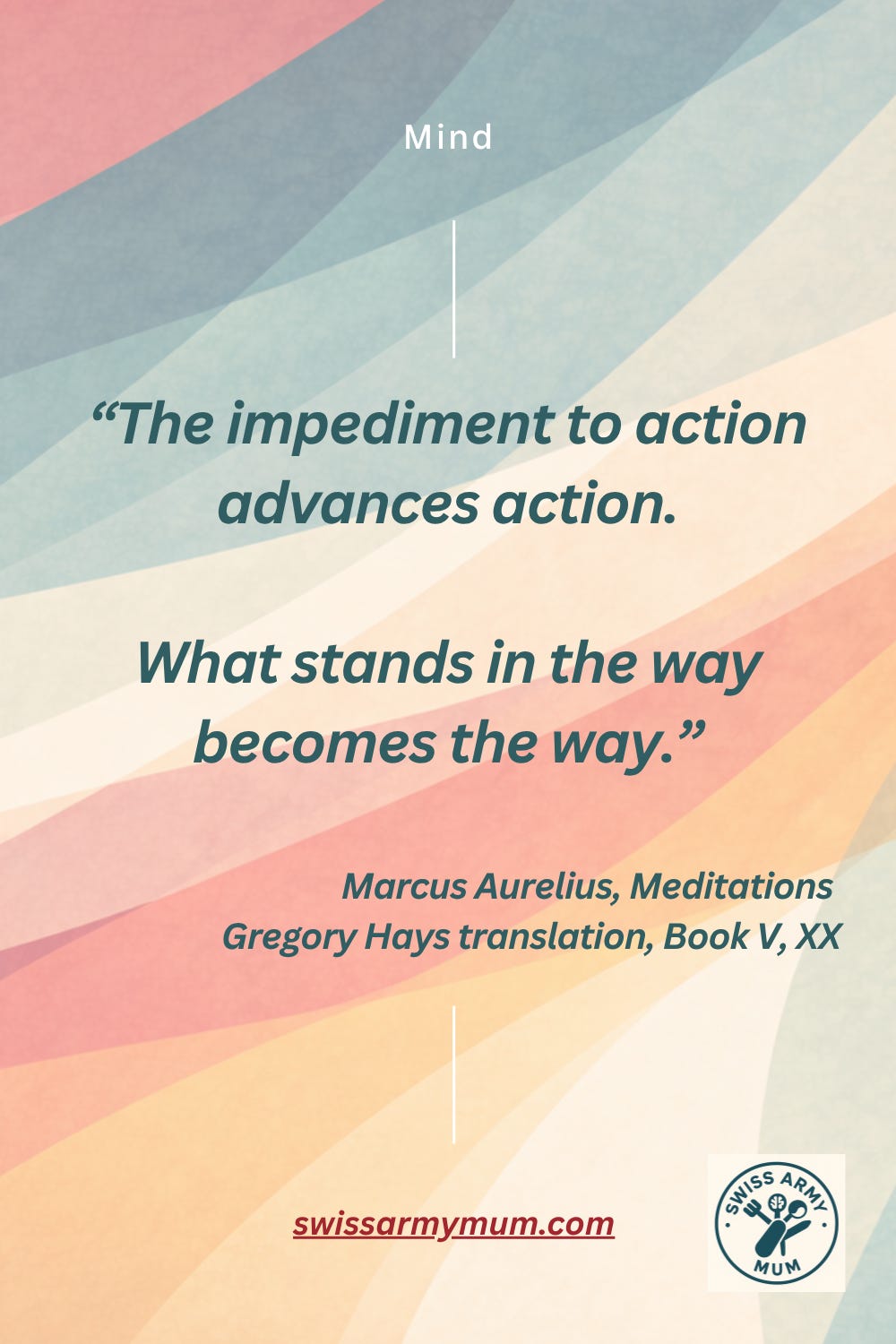
He wrote this as a man managing an empire in decline, fighting wars he had not chosen, watching the people he loved die before him. He was not being motivational. He was being precise.
The Stoics understood something about adversity that takes most people decades to learn: difficulty is not an interruption of the real work. It often is the real work. The impossible conversation reveals character. The diagnosis reorganises priorities. The years of sustained overwhelm, the new-country-with-young-children years, the perimenopause years, force a reckoning with what actually matters. That reckoning is not a detour. It is the education.
This is not the toxic positivity that insists everything happens for a reason. It is the more honest observation that you are always building something with what you have, including what you did not ask for. The Stoics would call it the discipline of action: act well regardless of outcome, invest fully in the effort, and release your grip on the result.
“The archer draws the bow as well as possible, aims with full attention, and then releases. Whether the wind shifts in the last moment is not within the archer’s power. The quality of the draw is.”
The Fourth Move: Remember It Ends
Memento mori. Remember you will die.
This sounds, to modern ears, like an invitation to despair. The Stoics meant something almost the opposite.
I am aware this is an unusual thing to say to an audience of women in their 30s, 40s, and 50s, many of whom are already quietly reckoning with mortality in a way their younger selves were not. The parents who are ageing. The friends who have had difficult diagnoses. The body that is visibly changing. The sense that time has a different texture now than it did at 25.
The awareness that time is finite is not a reason for anxiety. It is the most effective tool available for restoring proportion. The grudge you have been carrying for months. The opportunity you have been putting off until conditions are better. The conversation you keep meaning to have. Held against the fact of your own mortality, not morbidly, but honestly, these things change size.
And it works in the other direction too. The people you love. The ordinary Tuesday evening that, if you stopped to notice, contains more than enough for a good life. The fact that you are here, functioning, reading this, capable of thinking about how you want to live. Held against the same awareness, these things also change size.
William Irvine considers negative visualisation, the deliberate practice of imagining the loss of what you value, the single most important Stoic practice. Memento mori is its largest form. Not a reason to grieve prematurely, but a reason to show up more fully for what is already here.
What Stoicism Cannot Do
I want to be honest about the limits, because I think dishonesty here is what turns people away from philosophy when they need it most.
Stoicism cannot fix a hormonal transition. It cannot take away genuine grief. It cannot make loss not hurt. It cannot speed up the process of adjusting to something that has fundamentally changed your life. It is not a substitute for adequate sleep, for the metabolic foundations the Body Pillar covers, or, where appropriate, for medical support including HRT. A philosophy of life is not a replacement for the body’s basic needs, it is what you build on top of them.
What Stoicism offers in hardship is not comfort. It is structure. A way of remaining oriented when the external landmarks have gone. A set of questions that are answerable even when nothing else feels certain: what is within my power here? What is the right action available to me now, regardless of the outcome? What would a person of good character do in this situation?
Those questions do not make hard things easy. They make them navigable.
A Note on What’s Coming
I have been building something alongside this series.
The Pocket Stoic is a situation-by-situation reference guide to Stoic wisdom for the specific moments that are hardest to navigate. Not a philosophy textbook. A companion. You open to the chapter that matches your moment, on anger, on anxiety, on overwhelm, on grief, on the kind of fatigue that sleep doesn’t fix, you get the ancient wisdom in plain language, practical steps, and prompts you can use the same day. Then you close the book and handle your life.
The next posts in this series will give you three chapters as a preview: on anxiety and worry, on overwhelm and decision fatigue, on envy and comparison. Each one is built on the compass.
The book will be available later this year. If you want to be the first to know, you are already in the right place.
Thank You
Thank you for reading, sharing, and supporting this work. Whether you’ve been here since the beginning or just found Swiss Army Mum, I’m glad you’re here.
If this post reached something real for you, I’d be grateful if you forwarded it to someone who might need it, or hit the ♥️ or ↻ Restack button. It helps more people find this space.
Share Swiss Army Mum
Medical note: This is educational, not personal medical advice. Your biology, history, and context matter. Work with a qualified healthcare professional.
References
Irvine, William B, A Guide to the Good Life: The Ancient Art of Stoic Joy (New York, NY, 2008), https://doi.org/10.1093/oso/9780195374612.001.0001