



If you have been following the Mind Pillar series from the beginning, you have now covered why a philosophy of life matters, the Stoic framework and the compass, how to use it when things get genuinely hard, and the first sample chapter post on anxiety.
This is the second of three sample chapters from The Pocket Stoic. Each chapter is designed to stand alone. The structure is the same every time: here is the situation, here is what the Stoics said, here is what it means in plain language, here is which compass points apply, here is what to do, here are the questions worth sitting with. You do not need to read them in order. Open to the page that matches your moment.
These posts sit within the Mind Pillar, specifically the Purpose and Philosophy of Life area. Chronic overwhelm is not just an inconvenience. It is a physiological state: elevated cortisol, degraded decision quality, disrupted sleep, and a reduced capacity to show up well for anything that actually matters. The Body Pillar series covers what chronic stress does to the body in detail. The Mind Pillar is where we work on the upstream causes.
Overwhelm is almost always a values clarity problem masquerading as a time management problem, and the Stoics had a precise diagnosis for it two thousand years before productivity culture did. The Mind Pillar blueprint is the starting point if you want the full framework.
The Situation
It is not a crisis. Nothing has collapsed. You are not in danger. But it is Sunday evening and the week ahead is already pressing on you before it has begun, and when you try to think about where to start, the list is so long and so tangled that you cannot find the thread.
You have seventeen tabs open in your browser and the same number open in your mind. The inbox. The appointment you have been rescheduling. The work project. The school thing. The ageing parent. The friendship you have been meaning to tend to. The thing you want to be doing with your life that keeps getting deferred to next month.
You are not lazy. You are not disorganised. You are simply overwhelmed, and the particular shape of this overwhelm is that you cannot even decide what to address first, so you address nothing, or you address the easiest things, the ones that feel productive without being important, because at least they can be finished.
The Stoics would have recognised this condition immediately, though they named it differently.
New here? Start here:

Swiss Army Mum is a practical guide to long-term health for busy women, built on four pillars: Body, Mind, Glow, and Flow. Four pillars. No overwhelm.
Not every tool. Just the right ones.
What the Stoics Said
Seneca’s On the Shortness of Life is, in one reading, a two-thousand-year-old essay about overwhelm. He opens with an observation that still lands like a diagnosis: “It is not that we have a short time to live, but that we waste much of it.”1 The people who complain that life is too short have confused its length with what has been done with it. Life is, in fact, long enough, if used well. The problem is not time. The problem is what we do with it.
He is more pointed elsewhere: “You live as if you were destined to live forever, no thought of your frailty ever enters your head. You squander time as if you drew from a full and abundant supply, though all the while that day which you bestow on some person or thing is perhaps your last.”2 This is not a lecture about mortality. It is a practical observation about the relationship between how we prioritise and how we experience our days. The person who behaves as though they have unlimited time will fill it with whatever presses loudest, regardless of whether it matters.
Marcus, governing an empire with its infinite demands, arrived at his prescription through direct experience: “If thou wouldst know contentment, let thy deeds be few. Better still, limit them strictly to such as are essential.”3 This is not the advice of someone who had no demands. It is the advice of someone who learned, under the most demanding conditions imaginable, that the path through overwhelm is not to do everything faster. It is to do fewer things properly.
Seneca distils it to its core: “While we are postponing, life speeds by. Nothing, Lucilius, is ours, except time.”4
And Epictetus, with his characteristic attention to what we commit to: “In every affair consider what precedes and follows, and then undertake it. Otherwise you will begin with spirit indeed, careless of the consequences, and when these are developed, you will shamefully desist.”5 The undone things accumulating on your list are often things that should not have been taken on in the first place, or things that were accepted without examining what they actually require.
Modern Translation
Overwhelm is structurally different from anxiety, though they share a family resemblance. Anxiety is the mind living in a feared future. Overwhelm is the mind trying to hold too many presents simultaneously: too many obligations, too many decisions, too many things that need doing and no clear principle for deciding which to do first.
The Stoic diagnosis is precise: most overwhelm is not a time management problem. It is a values clarity problem. If you knew, with complete clarity, which three things genuinely mattered most to you this week, and which of your obligations actually served those things, the list would shorten dramatically. What remains long is the list assembled without that clarity, by a version of you who said yes whenever asked, deferred judgment on priorities, and assumed the sorting would happen later.
The trichotomy of control applies here differently than it does to anxiety. In anxiety, you sort fears by what is within your power. In overwhelm, you sort obligations by the same question. Which of these commitments is genuinely mine, arising from my values and my considered choices? Which have I absorbed from other people’s expectations, or the inability to say no? Which would I actually miss if they disappeared?
Seneca’s line about time is worth sitting with. Nothing is ours except time. Which means every obligation you have accepted is a piece of time you have promised. The question is not whether you are busy. It is whether what you are busy with deserves the time you are trading for it.
The Compass Points
The Stoic Compass is introduced in full before. Each situation chapter identifies the points most useful for that specific moment: you do not need to hold all eight in mind at once.
Overwhelm calls on two compass points.
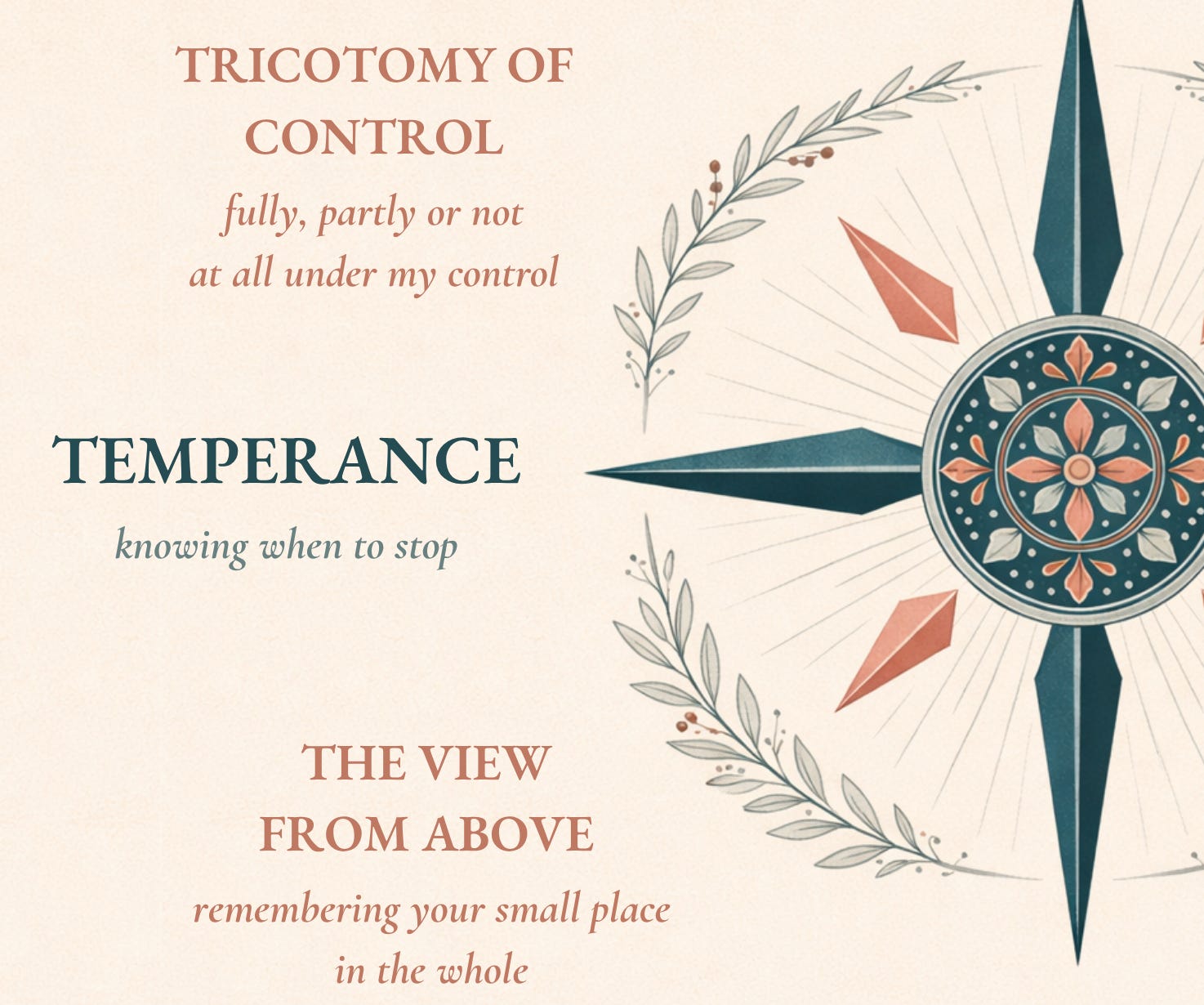
The first is the Trichotomy of Control, between Wisdom and Temperance. The sorting question shifts from “is this within my power?” to “is this genuinely mine?” Some obligations are genuinely yours: they arise from your own choices and values, and dropping them would cost you something real. Some are partially yours: you are involved, but not irreplaceably. Some are not yours at all: they have landed on your list because you did not decline them, not because they belong there.
Temperance is the virtue that does the actual work here. Temperance is the capacity to act from reason rather than from impulse, including the impulse to say yes to everything, to be available to everyone, to perform the kind of busyness that looks like care and commitment but is often their substitute. The temperate person does fewer things and does them more fully present.
The second compass point is the View from Above, between Justice and Temperance. When you are inside the overwhelm, everything on the list feels urgent and approximately equal in weight. The View from Above is the scale shift that restores proportion. From above: which of these things will matter in a month? In a year? Which of the seventeen open tabs, if closed permanently, would actually cost you something? Most overwhelm compresses time so that everything feels equally pressing. Widening the frame restores the natural hierarchy of what actually matters.
Practical Application
Six things, in the order they work.
First: list everything. Not to make the list more manageable, but to make it visible. The overwhelming thing about overwhelm is that it is usually shapeless, a felt sense of too much rather than a clear inventory. Write it all down. Every commitment, every open loop, every thing you are carrying. Then look at it.
Second: sort by genuine ownership. For each item, ask: did I choose this, or did it accumulate? Is this mine because I value it, or because I did not say no? The second category is the place to begin cutting.
Third: connect to what you actually want. Which of the things on your list are connected to what you actually want your life to look like? Which are other people’s priorities that have migrated into your schedule?
Fourth: let your deeds be few. Marcus’s prescription, and it is a specific instruction, not an aspiration. Pick the things that genuinely matter this week. Three is usually enough. Do those things properly. The rest either waits or does not get done, and you will discover that most of what you worried about not doing either resolves itself or turns out to have mattered less than it appeared.
Fifth: apply memento mori as a filter. Of everything on the list, which would matter if today were your last ordinary day? This is not a morbid exercise. It is the fastest available mechanism for restoring proportion to things competing for your time.
Sixth: practise voluntary simplicity occasionally. Seneca recommended periodic deliberate reduction, not permanent minimalism but occasional pruning, to remind yourself that less is survivable and that the discomfort of an emptier schedule is smaller than it appears. The person who has deliberately cleared a week knows they can survive one.
Journaling Prompts
These prompts are most useful on paper rather than in your head, and they work best when answered with honesty rather than with the answer you think you should give. Set a timer for ten minutes. Write without editing. See what comes up.
Audit your obligations
If I removed five things from my current list of obligations, which would I remove first? What is keeping them on the list if they would be the first to go?
Find your irreducible three
Which of today’s tasks are genuinely mine, arising from what I value, and which have I absorbed from other people’s expectations or my own difficulty saying no?
Locate the energy drain
What would I do differently this week if I knew it was my last ordinary week? What does the answer tell me about where my time is actually going?
Practice the no
When did I last say no to something that deserved to be declined? What made it difficult? What would I do differently?
Define enough, today
What is the one thing that, if done well this week, would make the greatest actual difference to what I care about?
One-Line Reminder
“If thou wouldst know contentment, let thy deeds be few.”
— Marcus Aurelius, Meditations
The 80/20
List everything currently on your plate. Identify which three things genuinely matter this week. Those get your best attention.
The rest gets whatever remains, or waits. The radical move is not doing more efficiently. It is accepting that most things can wait, and that the ones that cannot will make themselves obvious.
A Note on What’s Coming
The third and final sample chapter, on envy and comparison, is next. The Pocket Stoic covers around two dozen situations across four parts. It will be available later this year. If you want to be first to know, you are already in the right place.
Thank You
Thank you for reading, sharing, and supporting this work. Whether you’ve been here since the beginning or just found Swiss Army Mum, I’m glad you’re here.
If this one landed, I’d be grateful if you forwarded it to someone who needs it, or hit the ♥️ or ↻ Restack button. It helps more people find this space.
Medical note: This is educational, not personal medical advice. Your biology, history, and context matter. Work with a qualified healthcare professional.
References
Seneca, On the Shortness of Life, Chapter 1, trans. John W. Basore. https://en.wikisource.org/wiki/On_the_shortness_of_life
Seneca, On the Shortness of Life, Chapter 3, trans. John W. Basore. https://en.wikisource.org/wiki/On_the_shortness_of_life
Marcus Aurelius, Meditations, IV.24, trans. George Long. https://classics.mit.edu/Antoninus/meditations.html
Moral letters to Lucilius. Letter 1, trans. Richard M. Gummere (2025, February 3). In Wikisource . Retrieved 20:46, May 5, 2026, from https://en.wikisource.org/w/index.php?title=Moral_letters_to_Lucilius&oldid=14844031
Epictetus, Enchiridion, trans. Elizabeth Carter. https://classics.mit.edu/Epictetus/epicench.html