


Over the past three posts we have built the full Stoic framework: why a philosophy of life matters and why Stoicism earns its place, what Stoics actually believe and the eight-point compass they left us, and how to use that compass when life gets genuinely hard. If you have not read those, they are the foundation for everything that follows.
This post is the first of three sample chapters from The Pocket Stoic, a situation-by-situation reference guide to Stoic wisdom for the moments that are hardest to navigate that I am currently working on.
Each chapter is designed to stand alone. You do not need to read them in order. The structure is the same every time: here is the situation, here is what the Stoics said, here is what it means in plain language, here is which compass points apply, here is what to do, here are the questions worth sitting with.
Open to the page that matches your moment. Use what is useful. Close the book. Handle your life.
These posts sit within the Mind Pillar, specifically the Purpose and Philosophy of Life area. If you have been following the Body Pillar series, you already know that chronic stress is one of the most damaging forces on metabolic health, sleep quality, immune function, and hormonal regulation. The Mind Pillar is where we address the source rather than just the symptoms. Anxiety, overwhelm, and comparison are not character flaws. They are predictable responses to an undirected life, and they have real physiological costs. The Mind Pillar blueprint covers the full framework. This series works one situation at a time.
The Situation
It is 3am and you are awake. Not because anything has happened. Because of what might.
The medical result not yet back. The child who has been struggling. The money situation that is manageable, but only just. The conversation you have been avoiding. The project that is behind. The thing you said last week that you cannot stop replaying.
The anxiety is not attached to any single thing. It is more like a weather system: low pressure, ambient, pressing. You have reviewed the situation. You have done what you can do. And yet here you are, living in a future that has not arrived, suffering it in advance.
This is the oldest complaint in the Stoic literature. They had a precise account of why it happens, and what to do about it.
New here? Start here:

Swiss Army Mum is a practical guide to long-term health for busy women, built on four pillars: Body, Mind, Glow, and Flow.
Not every tool. Just the right ones.
What the Stoics Said
Seneca’s line is so compact it lands like a diagnosis: “We suffer more often in imagination than in reality.”1 He is not dismissing the suffering. He is locating it. The suffering is real. Its source is a future that exists only in your mind, and a present that you have left in order to inhabit it.
He returned to the same observation elsewhere: “The fool, with all his other faults, has this also: he is always getting ready to live.”2 The person consumed by anxiety about what is coming is doing something structurally similar: preparing to live when the uncertainty resolves, when the result arrives, when things clarify. In the meantime, the actual present slides by unlived.
Epictetus was more forensic. When he saw someone anxious, he would ask one question: what is it that they want?3 Because, he observed, there is only one source of anxiety. You are anxious when you want something outside your power. The singer performing alone is not anxious: the only variable is their own performance, and that is theirs. Put them in front of an audience and anxiety arrives, because now they want applause, and applause is not in their power to guarantee. The anxiety is not about the singing. It is about the desire that has attached itself to something outside the singer’s control.
Marcus applied this to the catastrophising mind that tries to hold the whole future at once: “Do not disturb thyself by thinking of the whole of thy life. Let not thy thoughts at once embrace all the various troubles which thou mayest expect to befall thee: but on every occasion ask thyself, what is there in this which is intolerable and past bearing?”4 His prescription was not to ignore the future, but to return to the present, to ask what is actually intolerable right now, and to notice that the answer is almost always: nothing. The suffering lives in the projected future.
Modern Translation
Anxiety is structurally identical to envy in one respect: both are failures to keep your peace contingent only on things within your power. Envy attaches your contentment to someone else’s situation. Anxiety attaches it to a future outcome that is not yet determined and may never arrive. Both are the same category error, dressed differently.
The feeling of anxiety is real. What it is pointing to is almost never a real and present threat. It is pointing to a place where you have made your inner state hostage to something outside your control, and your mind is working hard to resolve the uncertainty that results.
This is why suppressing anxiety does not work. The Stoic move is not to suppress but to examine: what specifically am I anxious about, and is it within my power? If it is within my power, the anxiety is a signal to act. If it is not, the anxiety is a false alarm, generated by a desire that was always misdirected.
Modern cognitive behavioural therapy arrived at the same diagnosis two thousand years later. The Stoic discipline of assent, learning to examine your impressions before accepting them as facts, is the direct ancestor of cognitive restructuring.5
The anxious thought is not a report on reality. It is an interpretation. And interpretations, unlike facts, can be examined and revised.
The Compass Points
The Stoic Compass is my own interpretation of a navigational framework. It has eight points in two groups: four cardinal points (the virtues) and four intercardinal points (the practical tools - the ones I find the most helpful in the Stoic repertoire). Each situation chapter identifies the one or two points most useful for that specific moment. You do not need to use all eight at once.
Anxiety calls primarily on two compass points.
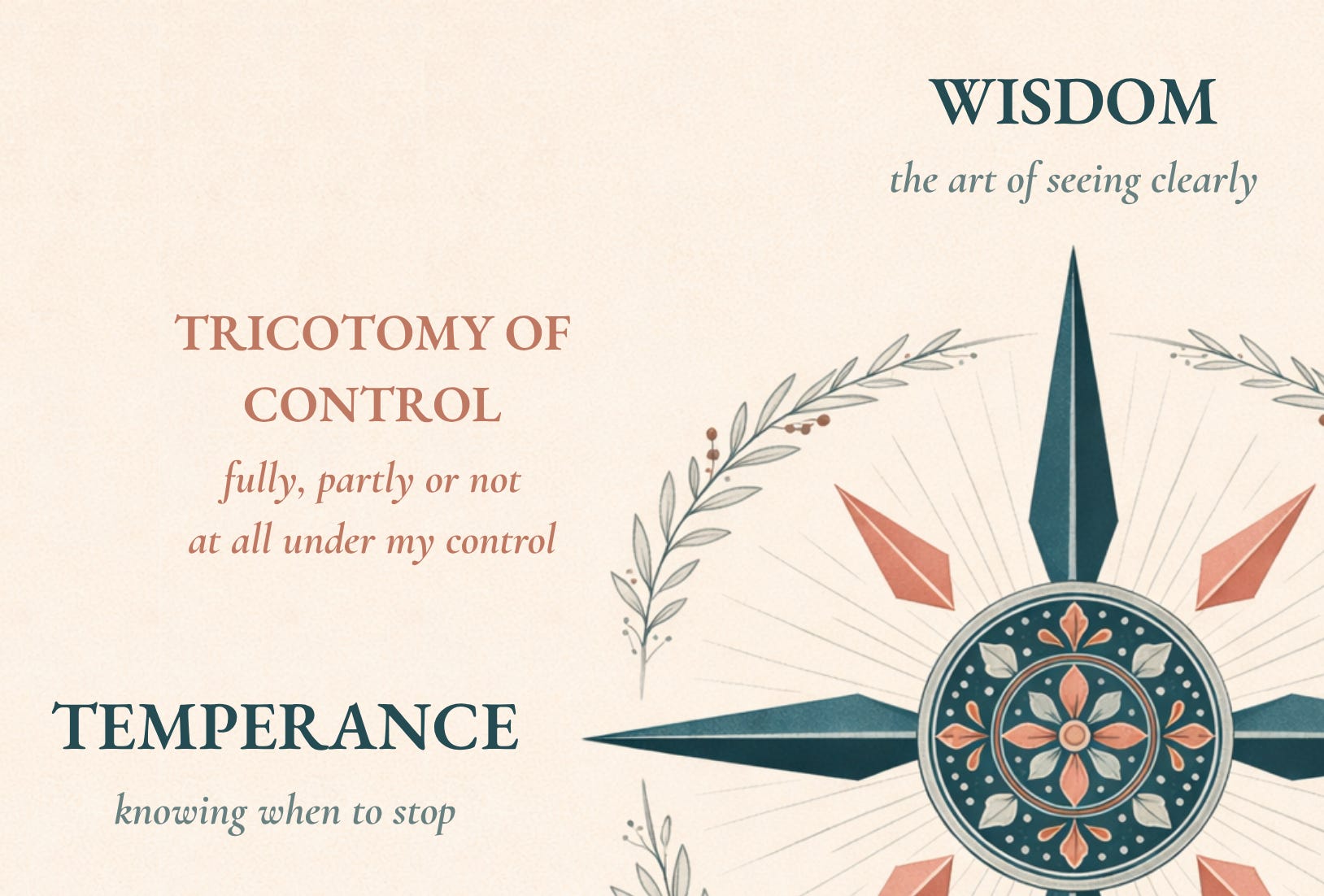
The first and most important is the Trichotomy of Control, between Wisdom and Temperance. Everything generating the anxiety falls into one of three categories: fully within your power, partially within your power, or entirely outside it.
For what is fully yours: act, and act fully. Stop worrying and start working. For what is partially yours: bring your best effort, then genuinely release your grip on the result. For what is entirely outside your power: the anxiety is pure waste. It is spending energy on a category that cannot be improved by your energy. Genuine acceptance, not forced cheerfulness, is what is called for, and it frees energy for what can actually be addressed.
The second compass point is Mind the Gap, between Wisdom and Courage. Anxiety collapses the gap between the event and your response by convincing you that the worst case has already occurred. It shows you a feared future as though it were a present fact.
Wisdom is the capacity to see that what is actually happening right now is not what the anxiety is describing. Courage is the willingness to stay in the present rather than fleeing into an anxious future.
Practical Application
Five things that work, in order of immediacy.
The first and most important: name the fear specifically. Vague anxiety is always stronger than specific anxiety. Write down in one sentence what you are actually afraid of. Not the cloud of it, but the specific thing. A named fear can be examined. An unnamed one can only be felt.
The second: run the trichotomy on what you have named. Is this within my power? If yes, stop worrying and start acting: what is the next specific step? If partially: what is my best effort, and what must I then release? If not mine at all: what would genuine acceptance look like here, not performed acceptance, but the real thing?
The third: bring the future to the present. Marcus’s instruction: ask only what is intolerable in this precise moment, right now. Not next week, not when the result arrives. Now. Almost always the answer is: nothing. The present moment is survivable. It is the imagined future that is not.
The fourth: internalise the goal. If the anxiety is about a result or outcome, shift the target. You cannot guarantee the outcome. You can guarantee the quality of your effort. Commit entirely to that and release the rest. The singer’s job is to sing as well as they can. Whether the audience applauds is not their job.
The fifth: catch and interrogate the impression. “This is going to be terrible” is not a fact. It is an interpretation, and a particularly confident one that has not earned its confidence. Ask: what do I actually know? What am I adding to what I know? Is the thing I am afraid of certain, probable, possible, or merely conceivable?
Journaling Prompts
The prompts below are designed to move you from feeling the situation to examining it. They work best on paper rather than in your head, and they work best when you answer them honestly rather than as you think you should.
There are no right answers. There is only what is true for you right now.
Name the fear
What specifically am I anxious about right now? Name it in one precise sentence, not a cluster of feelings but one actual fear.
Sort by power
Is this within my control, partially within my control, or outside my control entirely? What does the category tell me about what to do next?
Stress-test the worst case
If the worst I am afraid of actually happens, what resources do I have to handle it? What have I survived before that I was not sure I could survive?
Count the cost of carrying it
What am I not doing right now because I am inside the anxiety? What is the actual cost of the worry, in attention and in the life happening around it while I am somewhere in the future?
Ask what it cost if it never comes
If this fear never materializes, what will the cost of having carried it have been?
One-Line Reminder
“We suffer more often in imagination than in reality.”
— Seneca, Letters to Lucilius
The 80/20
Name the fear in one sentence. Run the trichotomy. Act on what is yours. Release what is not.
That sequence, done honestly rather than as a performance, does more for anxiety than any amount of breathing exercises, because it addresses the actual mechanism rather than the symptom.
A Note on What’s Coming
The Pocket Stoic will cover around two dozen situations across four parts: daily storms, life transitions, the people problem, and the bigger questions. The next sample chapter is on overwhelm and decision fatigue.
The book will be available later this year. If you want to be first to know, you are already in the right place.
Thank You
Thank you for reading, sharing, and supporting this work. Whether you’ve been here since the beginning or just found Swiss Army Mum, I’m glad you’re here.
If this post reached something real for you, I’d be grateful if you forwarded it to someone who might need it, or hit the ♥️ or ↻ Restack button. It helps more people find this space.
Medical note: This is educational, not personal medical advice. Your biology, history, and context matter. Work with a qualified healthcare professional.
References
Moral letters to Lucilius. Letter 13, trans. Richard M. Gummere (2025, February 3). In Wikisource . Retrieved 20:46, May 5, 2026, from https://en.wikisource.org/w/index.php?title=Moral_letters_to_Lucilius&oldid=14844031
Moral letters to Lucilius. Letter 13, trans. Richard M. Gummere (2025, February 3). In Wikisource . Retrieved 20:46, May 5, 2026, from https://en.wikisource.org/w/index.php?title=Moral_letters_to_Lucilius&oldid=14844031
Epictetus, Discourses, Book II, Chapter 13, trans. W.A. Oldfather. https://classics.mit.edu/Epictetus/discourses.html
Marcus Aurelius, Meditations, VIII.36, trans. George Long. https://classics.mit.edu/Antoninus/meditations.html
Beck, A. T. (1976). Cognitive therapy and the emotional disorders. International Universities Press. https://psycnet.apa.org/record/1976-28303-000
Such a useful tool, thank you for sharing it 💛 Most of the anxiety we suffer is about the stories our brain is telling us, rather than the reality. But then sometimes, the worst happens, and the anxiety feels so much more real. That's when the "what have I survived before?" becomes incredibly powerful.