



This is the third and final sample chapter from The Pocket Stoic. If you are arriving here for the first time, the full series begins with why a philosophy of life matters, moves through the Stoic framework and the compass and navigating real hardship, then offers situation chapters on anxiety and overwhelm before this one.
Each chapter stands alone. The structure is always the same: the situation, what the Stoics said, what it means in plain language, which compass points apply, what to do, and the questions worth sitting with. You do not need to read them in sequence. Open to the page that matches your moment.
These posts sit within the Mind Pillar, specifically the Purpose and Philosophy of Life area. Envy and chronic social comparison are not soft problems. Research consistently links rumination, social comparison stress, and low self-worth to elevated cortisol, disrupted sleep, and reduced immune function: the same downstream effects as other forms of chronic stress covered in the Body Pillar series. The Stoics understood something important: most of these emotional states are generated not by events, but by the values framework (or lack of one) through which we interpret them. Address the framework, and the emotional weather changes. The Mind Pillar blueprint is the place to start if you want to understand how these posts fit into the larger picture.
The Situation
You open Instagram on a Tuesday morning and the first thing you see is someone you know announcing something you wanted. The promotion. The book deal. The body. The kitchen renovation. The life that looks, from the outside, exactly like the life you thought you were working toward. You put the phone down. You pick it up again. You tell yourself you are happy for them.
You are not happy for them.
What you feel is a hot, specific, slightly shameful thing that has no respectable name in polite company but that every person reading this has felt.
Envy. The emotion nobody admits to, because admitting it means admitting that someone else’s good fortune disturbs your peace.
The Stoics were not polite about it. They named it, examined it, and explained precisely why it tells us something true about where we have placed our attention.
New here? Start here:

Swiss Army Mum is a practical guide to long-term health for busy women, built on four pillars: Body, Mind, Glow, and Flow. Four pillars. No overwhelm.
Not every tool. Just the right ones.
What the Stoics Said
Seneca went straight to the mechanism: “It is not the person who has too little, but the person who craves more, that is poor.”1 He was not talking about money. He was talking about the condition of wanting, the bottomless orientation toward what is not yet yours, what someone else has that you do not. In that condition, more never fixes anything. The person with twice what you have still compares upward. The ladder of comparison has no top rung.

Marcus Aurelius located the same problem in a different register. When people feel dissatisfied, he wrote, they look outward for relief: for the house in the country, the changed circumstance that will finally settle the restless feeling.2 But this, he noted, is the most ordinary mistake a person can make. The retreat that actually works is the retreat into yourself. Comparison happens outward. Peace happens inward. You will not find it by monitoring what other people have.
Epictetus was characteristically blunt: “As to other things, do not admire, dislike, or covet them.”3 This is not a counsel of indifference to life. It is a sorting instruction. Some things are yours to care about, yours to invest in, yours to pursue. Everything else, including what other people have built, earned, been given, or stumbled into, is simply not your category. Your attention spent there is attention subtracted from what is actually yours to work with.
Seneca closes the loop: “No person can have all they wish, but it is in their power not to wish for what they have not, and cheerfully to make the most of what is given.”4 This is the Stoic move: the deliberate reorientation from scarcity to sufficiency. Not the forced performance of gratitude. The genuine recognition that what you have is already more than you are seeing, because comparison has narrowed your vision.
Modern Translation
Here is the structural problem with envy, stated plainly.
When you envy someone, you are making two errors simultaneously. The first is treating their good fortune as relevant to your own wellbeing. It is not. Their promotion does not diminish your capacity. Their beautiful kitchen does not reduce your ability to build a good life. Their achievement exists in their lane. Yours is separate, and the only one you can actually navigate.
The second error is comparison itself. You are comparing your full picture, with all its private uncertainty, effort, fear, and context, to their curated surface. You do not know what they have given up, what it costs them, what they are not showing. You are comparing your inside to their outside, and the comparison is structurally rigged to make you feel worse.
This is what the Stoics mean when they say envy is a false judgement. The judgement is this: their having this means I am lacking. That judgement is incorrect. Their having it has no bearing on your state. The only thing it reveals is where you have allowed your peace to become contingent on someone else’s circumstances, which were never yours to begin with.
The Stoic correction is not to stop wanting things. It is to want them differently: to pursue what matters, with full effort, while releasing your grip on whether you get there by the same route, at the same speed, with the same visible markers of success as the person you have been watching.
The Compass Points
The Stoic Compass is introduced in a different post. Each chapter draws on the one or two points most directly useful for that situation. You do not need to hold the whole system in mind at once: that is what the compass is for. Envy calls on two points, in sequence.
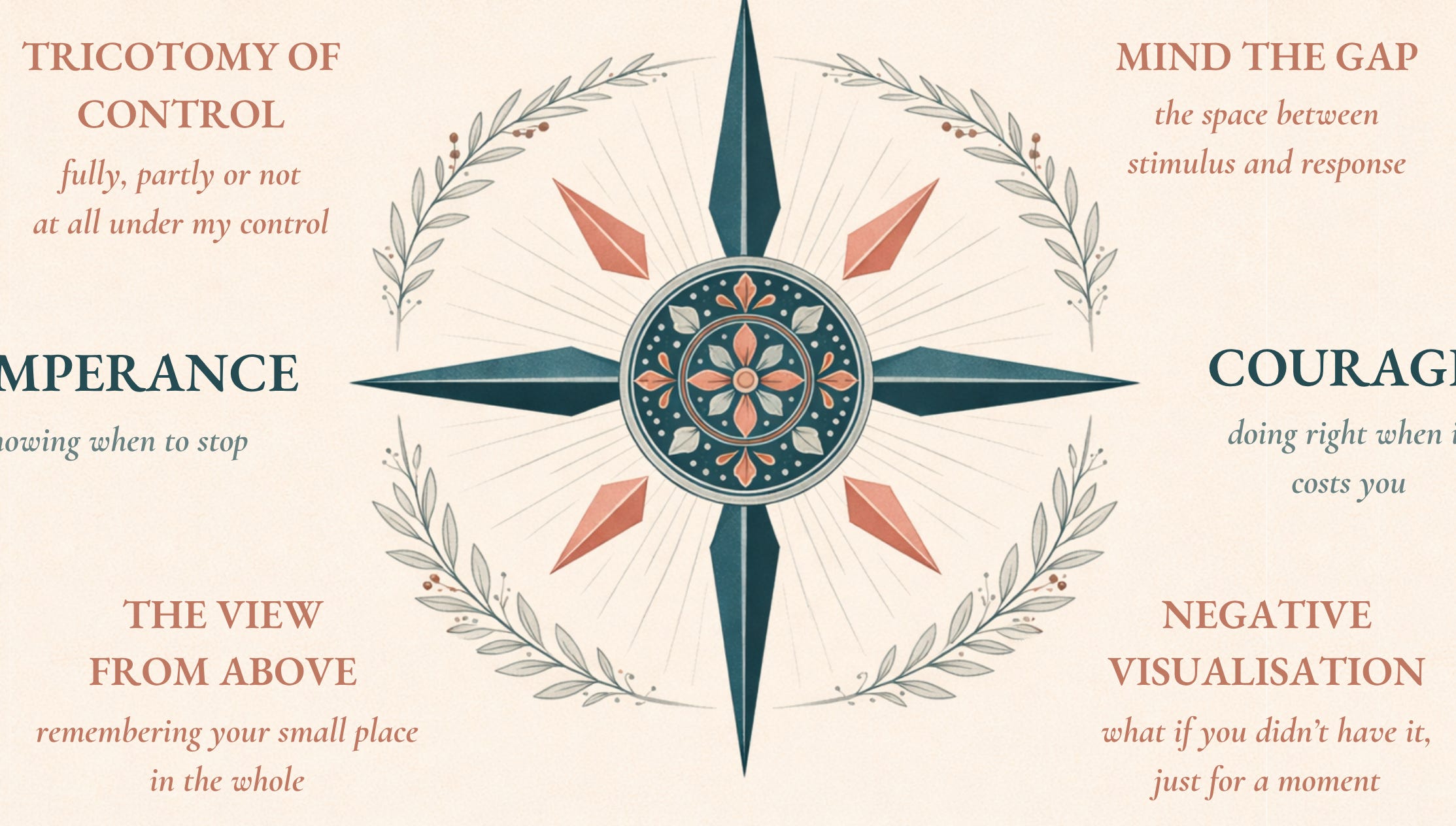
The first is Negative Visualisation, between Courage and Justice. This is the most direct antidote to the comparison trap. Negative visualisation is the deliberate practice of imagining the loss of what you already have. Not as pessimism, but as recalibration. When you hold clearly in mind that the health, the relationship, the ordinary Tuesday, the particular view from your window, could be gone, the person you were envying becomes less interesting. You were looking outward because you had stopped seeing clearly what was already there.
It takes courage to look at potential loss directly rather than away from it. And it serves justice, because it redirects you toward the people and things in your actual life, the ones whose presence you have been undervaluing while watching someone else’s.
The second is the Trichotomy of Control, between Wisdom and Temperance. Their achievement is not within your power. The quality of your effort is. Temperance is what keeps you from continuing to invest in something that cannot pay out: the monitoring, the scrolling, the comparison that has no end point. Wisdom is what allows you to see the category correctly in the first place.
Practical Application
Four things help, in this order.
The first: run the audit. Who specifically am I envying, and for what specifically? Would I want their entire life, or just the one thing I am focused on right now? The answer is almost always: just the one thing. And when you examine that one thing carefully, ask what it would actually cost, what it would require you to give up, what else comes with it. Most envied objects are less desirable on close inspection.
The second: negative visualisation. Not about their situation, about yours. Spend two minutes imagining losing something you have that matters: a relationship, your health, the particular texture of your ordinary days. Return to the present. The thing you were watching someone else have becomes less urgent, because you can see more clearly what you already have.
The third: redirect to effort. You cannot control whether you get the outcome you want, but you can control the quality of the work you put toward it. Shift from monitoring their result to investing in your process. Your job is to draw the bow as well as you can and release. Not to monitor where the arrow lands relative to someone else’s.
The fourth, if needed: retreat inward. Marcus’s prescription: the only retreat that actually settles the feeling is the one that goes inward. Put the phone down. Not because their life is not interesting, but because yours is, and you have been paying insufficient attention to it.
Journaling Prompts
Envy resists being thought about. It responds better to being written through. The prompts below work best on paper, answered honestly, without editing toward the version of yourself you prefer. Give yourself ten minutes and see what actually surfaces.
Name what you are actually envying
Who am I comparing myself to right now? Am I comparing my inside to their outside, or do I have accurate information about the full picture of their life?
Test the full trade
If I could trade lives entirely with this person, would I? Not just take the one thing I am focused on, but the whole life, every part of it. What does the answer tell me?
See what you already have
What do I currently have that, if I imagined losing it right now, I would see more clearly as something worth having?
Redirect to your own effort
Is my effort in my own work within my control, or am I measuring it against outcomes I cannot determine?
Design your comparison-free day
What would I do differently today if I were not measuring myself against anyone?
One-Line Reminder
“It is not the person who has too little, but the person who craves more, that is poor.”
— Seneca, Letters to Lucilius
The 80/20
When comparison arrives, name the specific thing you are envying. Ask whether you would want their whole life, not just that one part. Then spend two minutes on negative visualisation: what you would lose if something you currently have were taken. That sequence consistently restores proportion faster than any affirmation or detox.
The Book
These three chapters are a small sample of what The Pocket Stoic will cover. About two dozen situations across four parts: daily storms, life transitions, the people problem, and the bigger questions. Each chapter opens where you are, works through the compass, and closes with what you can use the same day.
The book will be available later this year. If you want to be first to know when it is ready, you are already in the right place.
Thank You
Thank you for reading, sharing, and supporting this work. Whether you’ve been here since the beginning or just found Swiss Army Mum, I’m glad you’re here.
If the book concept has been building for you across these three sample chapters, I’d be grateful if you shared this one with someone who might need it, or hit the ♥️ or ↻ Restack button.
Medical note: This is educational, not personal medical advice. Your biology, history, and context matter. Work with a qualified healthcare professional.
References
Moral letters to Lucilius. Letter 2, trans. Richard M. Gummere (2025, February 3). In Wikisource . Retrieved 20:46, May 5, 2026, from https://en.wikisource.org/w/index.php?title=Moral_letters_to_Lucilius&oldid=14844031
Marcus Aurelius, Meditations, VI, trans. George Long. https://classics.mit.edu/Antoninus/meditations.html
Epictetus, Enchiridion, §29, trans. Elizabeth Carter. https://classics.mit.edu/Epictetus/epicench.html
Moral letters to Lucilius. Letter 15, trans. Richard M. Gummere (2025, February 3). In Wikisource . Retrieved 20:46, May 5, 2026, from https://en.wikisource.org/w/index.php?title=Moral_letters_to_Lucilius&oldid=14844031