


In the months following the 11 September attacks in New York, researchers surveyed a probability sample of Manhattan residents about PTSD symptoms. Sixty-five percent reported one or zero symptoms six months later.1 Not after therapy. Not after a dramatic personal transformation. Simply: most people, faced with a collective traumatic event in their immediate environment, were functioning adequately within six months.
Bonanno, who has spent his career studying how people respond to adversity, has replicated this finding across bereavement, combat, serious illness, and natural disasters. The resilient trajectory (stable healthy functioning throughout or shortly after adversity) is not the exception. It is the modal response. Roughly 45-65% of people, depending on the adversity type, show it.
This is not the resilience narrative most wellness culture tells. That version involves being knocked flat, then fighting back, then emerging strengthened. It is dramatic, compelling, and according to the prospective research, characteristic of a minority rather than a majority.
Understanding what resilience actually is where this post starts.
This is the closing post in the Stress Management, Resilience and Self-Care area of the Mind Pillar. The stress management posts covered the acute toolkit. The self-care post covered maintenance. This post takes the long view: what determines how your stress system responds to adversity across months and years, and what you can actually change about it.
New here? Start here:

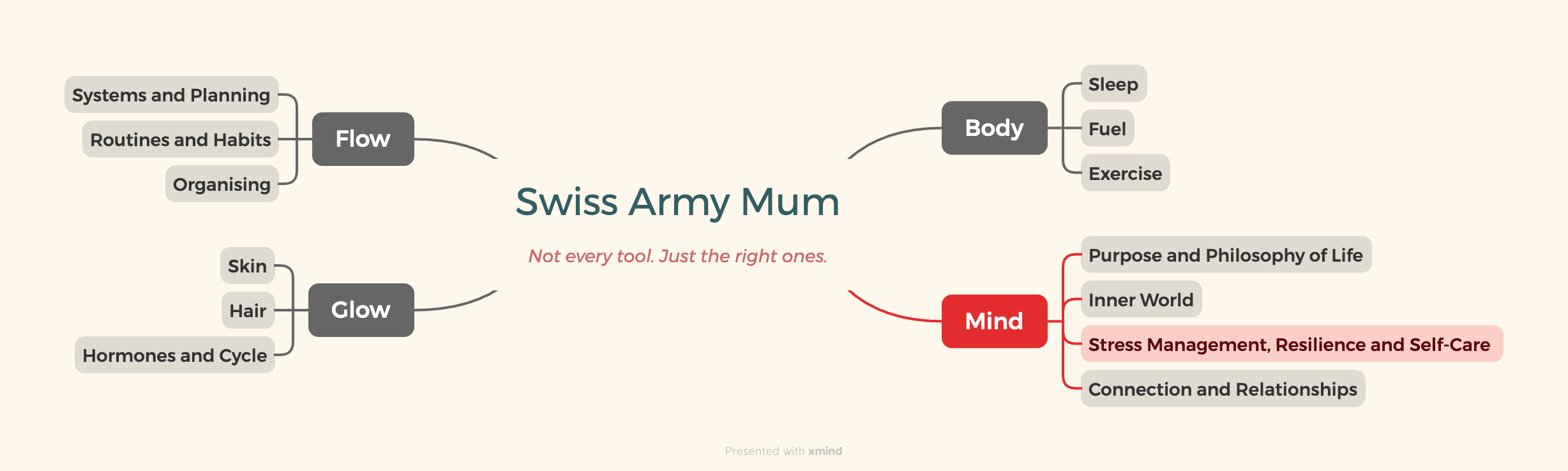
Swiss Army Mum is a practical guide to long-term health for busy women, built on four pillars: Body, Mind, Glow, and Flow.
Not every tool. Just the right ones.
What Resilience Actually Is
The scientific definition has moved considerably in the last twenty years. The old view, resilience as a stable personality trait, something you either have or do not, is now held by a minority of researchers. The dominant view is what Bonanno calls a probabilistic outcome trajectory and what Ann Masten describes with the phrase “ordinary magic.”2
Ordinary magic is worth unpacking. Masten’s claim, drawn from forty years of developmental research, is that resilience arises from basic human adaptive systems that most people already have access to: secure attachment relationships, executive function and problem-solving, self-regulation, a sense of agency, meaning-making systems, and supportive community.
It does not require extraordinary traits or exceptional effort. It requires that these ordinary systems are functioning. When they are, resilience is the default outcome. When they are not (disrupted by chronic stress, poverty, poor sleep, social isolation, or hormonal dysregulation) resilience becomes harder, not because something exceptional is missing, but because something ordinary has been depleted.
This means building resilience is not primarily about developing special capacities. It is about protecting and restoring the ordinary ones. Sleep, connection, purpose, and self-regulation are not supplementary to resilience. They are its substrate.
What the Research Says Builds It
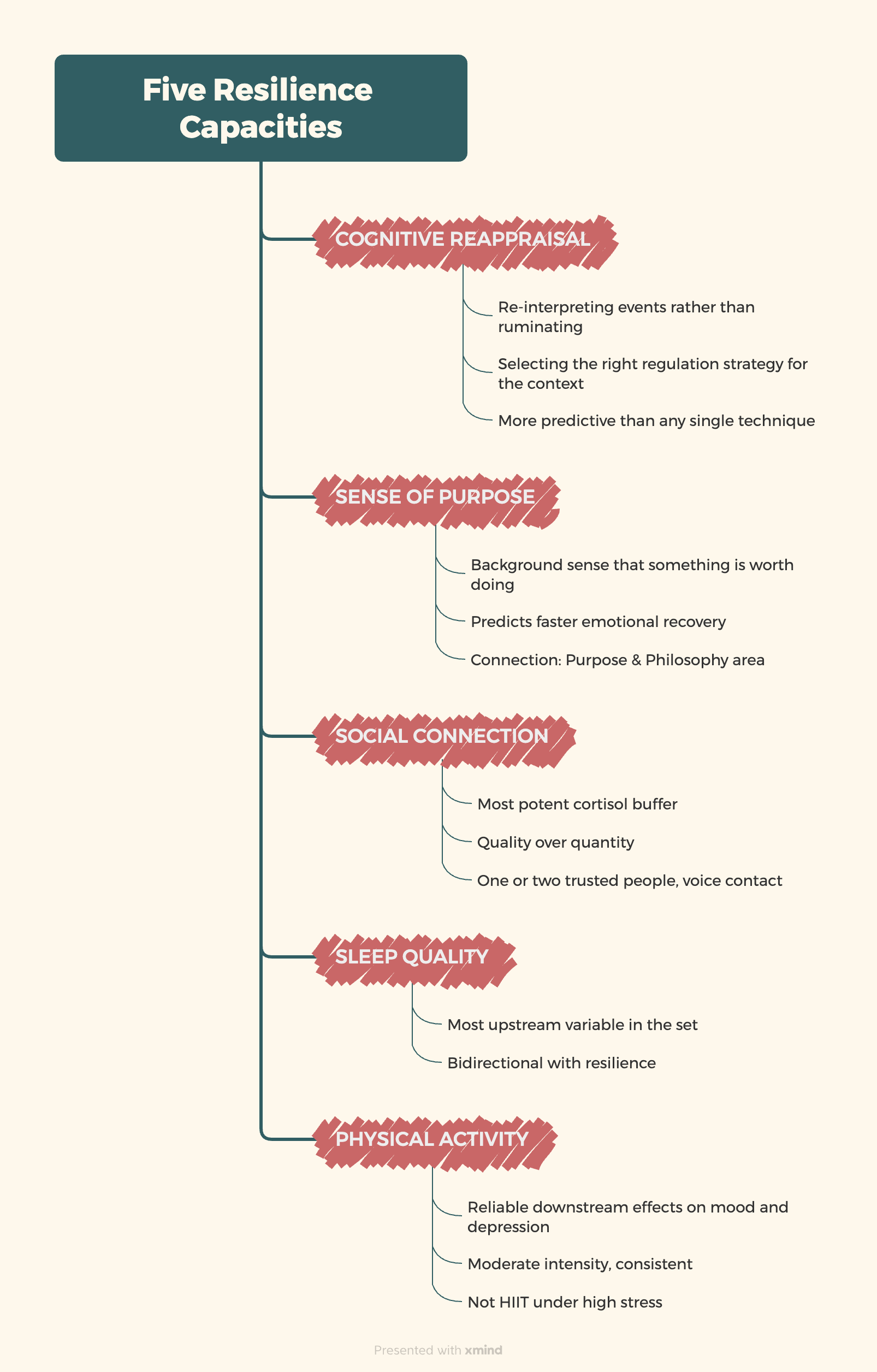
The research literature identifies five modifiable capacities. Effect sizes for any individual capacity are small to moderat, which means no single thing is a resilience switch. The cumulative effect of several functioning together is where the evidence is strongest.
Cognitive reappraisal
This is the most consistently evidenced of the five. Reappraisal is the capacity to re-interpret a situation (to find a different meaning, a different frame, a different angle) rather than suppressing the emotion or ruminating on it. Webb and colleagues’ meta-analysis found reappraisal outperforms emotional suppression on virtually every outcome measured: affect, cognition, social functioning, physiological response.3 The more refined version of this finding is that what distinguishes resilient people is not that they always reappraise, but that they can select the right emotional regulation strategy for the context and adjust when it is not working.
Sense of purpose and meaning
Sutin and colleagues’ individual-participant meta-analysis found that purpose in life is consistently associated with less subjective stress. A modest but reliable relationship that held across age, sex, ethnicity, education, and world region.4 This is not the same as optimism about outcomes, it is the background sense that there is something worth doing and someone worth being. Schaefer and colleagues found that people with higher purpose in life showed faster emotional recovery on physiological measures following negative stimuli, suggesting the effect is not merely self-report. The connection back to the Purpose and Philosophy area of the Mind Pillar is direct: the philosophical work done there is not decorative. It is protective.
Social connection
Already covered in depth in another post, so the brief version here: studies found adequate social relationships associated with a 50% greater likelihood of survival. Social connection is not just stress-buffering in the moment. It is structural to the resilience process across time.
Sleep quality
Arora and colleagues’ found consistent positive associations between both sleep duration and sleep quality and psychological resilience.5 The relationship is bidirectional: poor sleep reduces resilience, and a resilient response to adversity is supported by sleep. This is the Body Pillar loop again: the Mind Pillar cannot be fully maintained without the Body Pillar foundation.
Physical activity
The evidence for exercise as a resilience-specific intervention is still emerging. Most exercise research measures depression and anxiety rather than resilience scores directly. But the downstream effects are consistent: large meta-analyses find physical activity reliably reduces depressive symptoms by a meaningful amount and the SWAN cohort showed physical activity was prospectively protective against depressive symptoms in midlife women specifically. Moderate intensity, consistently, is the dose with the clearest signal.
The Perimenopause Layer
The resilience brief that informed this post contains one finding specific to perimenopausal women that deserves its own paragraph, because it is genuinely under-known and practically important.
Gordon and colleagues found that women receiving transdermal estradiol were 2.5 times less likely to develop clinically significant depressive symptoms over 12 months than the placebo group.6 The effect was specific to the early menopause transition. Crucially, the mood benefit of estradiol increased with the number of recent stressful life events: meaning hormonal support specifically buffered the stress-to-depression pathway.
Süss and Ehlert’s Swiss perimenopausal cohort study, is that five psychological factors load onto a coherent resilience cluster that predicts lower perceived stress, lower psychological distress, and milder menopausal symptoms: optimism, emotional stability, emotion regulation, self-compassion, and self-esteem.7
The practical implication: if you are in the early menopause transition and experiencing stress reactivity that feels qualitatively different from what you managed at 35, that is not a failure of resilience. It is a change in the hormonal buffering of the HPA axis. Worth discussing with a clinician.
Three Resilience Narratives the Evidence Does Not Support
What doesn’t kill you makes you stronger
Empirically false as a generalisation. Cumulative adversity has dose-dependent harmful effects on physical and mental health, which is what the Adverse Childhood Experiences literature has been documenting for twenty-five years. The claim that difficulty reliably builds strength is not supported. Some people are strengthened by adversity. Many are not. Context, support, and the nature of the adversity matter enormously.
Post-traumatic growth is common
It is a well-documented cognitive phenomenon: people reconstructing their past in light of the present, finding a narrative of growth even where the psychological measures do not confirm it. Perceived post-traumatic growth and measured post-traumatic growth are different things.
Bouncing back
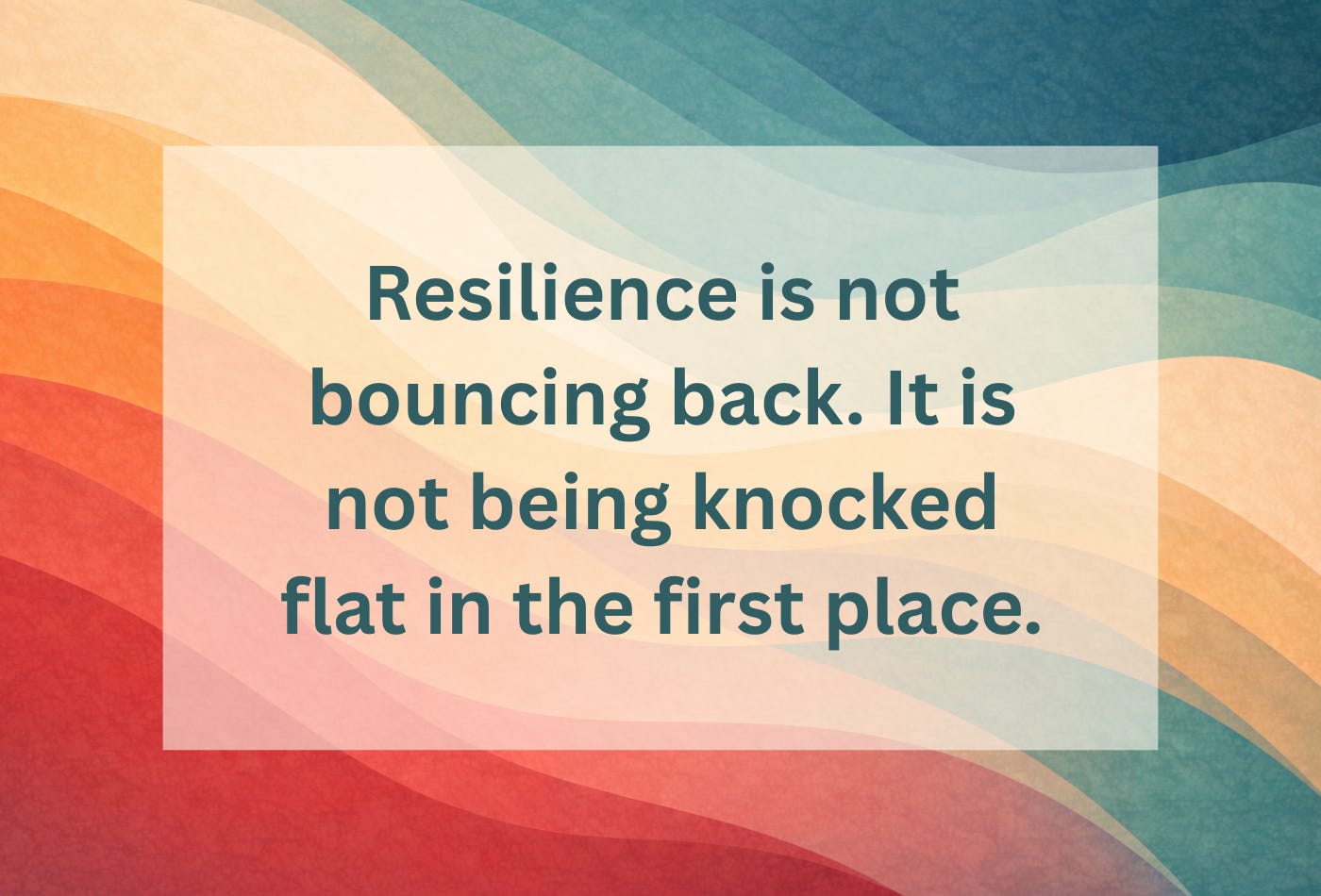
This is the most widely used resilience metaphor and the least accurate. The trajectory literature shows that resilient individuals are largely characterised by not being knocked down significantly in the first place. They maintain stable functioning. They do not bounce back dramatically because there is no dramatic fall to recover from. Bouncing back is actually the recovery trajectory, which is distinct and slower, characterised by initial disruption followed by gradual return to baseline. Conflating the two misrepresents both what resilience looks like and what recovery takes.
What This Means in Practice
Resilience is built in the ordinary stretches, not the extraordinary ones. The five capacities (reappraisal, purpose, social connection, sleep, physical activity) are not crisis interventions. They are the baseline conditions that make crisis manageable when it arrives.
The most honest framing of resilience-building is maintenance. Not training for hardship. Not manufacturing adversity. Maintaining the systems that constitute ordinary magic (the connections, the purpose, the sleep, the moderate exercise) so that when something genuinely difficult happens, the substrate is there.
Resilience training interventions, for what it is worth, produce a genuine but modest average improvement in resilience scores. That is real. It is not transformative.
Beyond Resilience: The Antifragility Frame
The resilience research describes a goal: stable functioning through adversity. Nassim Taleb, in Antifragile (2012), would say that is the floor, not the ceiling.
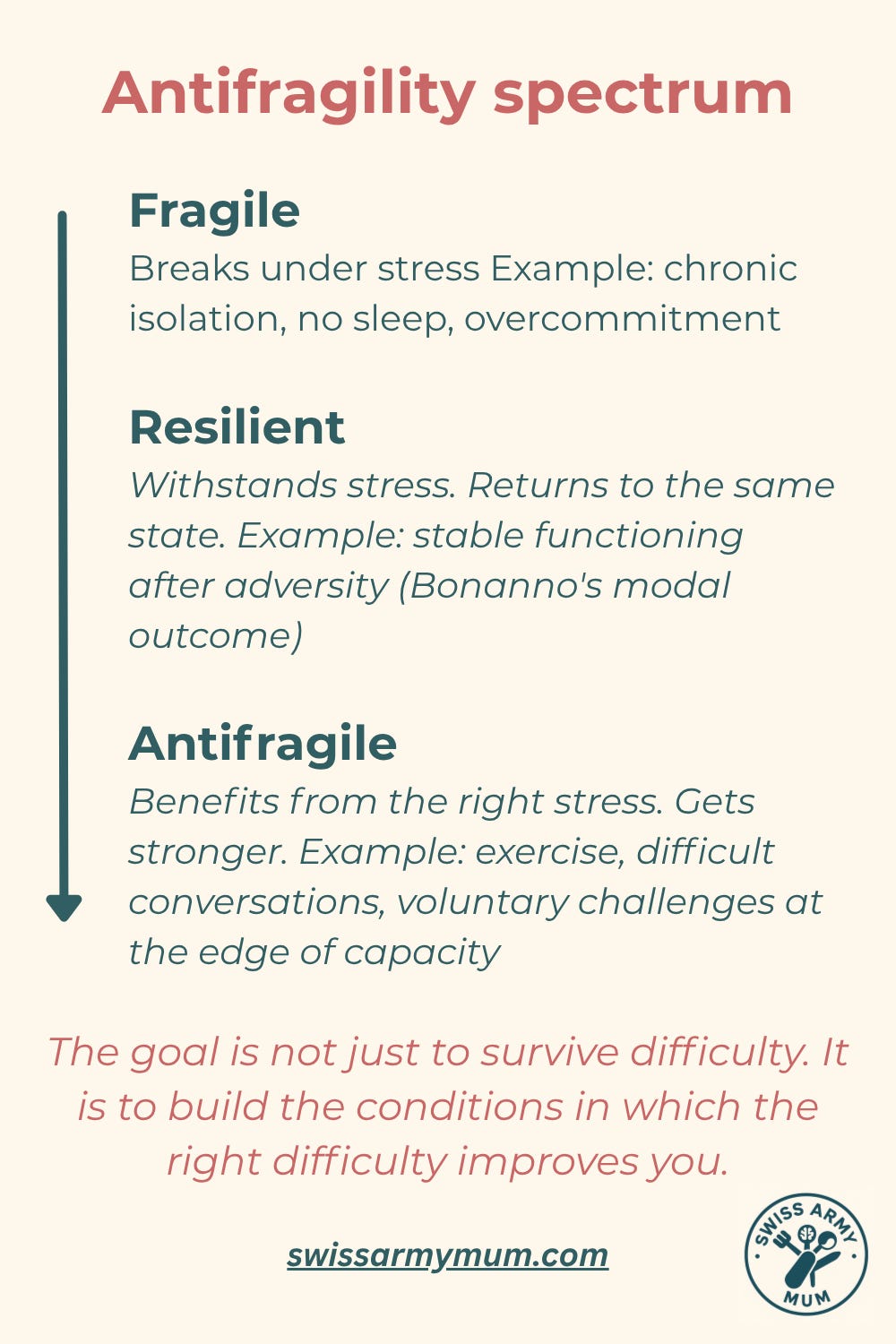
Taleb draws a distinction between three categories. Fragile things break under stress. Resilient things withstand stress and return to the same state. Antifragile things (his word, coined precisely because no existing term captures it) actually benefit from stress, disorder and volatility. They get better rather than merely surviving.
The honest caveat first: antifragility is a philosophical and business framework, not a peer-reviewed psychological intervention. Taleb is a statistician and risk analyst. The concept should be held as a useful frame, not as clinical evidence.
But the frame maps onto the research in this post in a way worth examining.
Moderate adversity (that some difficulty exposure produces better outcomes than either zero or high adversity) describes what biologists call hormesis: the dose-response phenomenon where a small stressor produces an adaptive improvement beyond baseline. Exercise is the clearest everyday example. You expose the body to controlled stress. The body adapts. The result is stronger than it was before. Hormesis is the biological substrate of what Taleb calls antifragility.
The personal application is via negativa: Taleb’s Latin framing for the idea that removal often works better than addition. Removing sources of fragility (chronic overcommitment, poor sleep, sustained social isolation) may do more for your adaptive capacity than adding breathwork, supplements or resilience workshops on top of a system that is already depleted. The ordinary magic Masten describes works best when the ordinary systems are protected, not merely supplemented. Build the floor before adding the ceiling.
Taleb cites Stoicism explicitly as one of the few philosophical traditions he considers antifragile. The practice of premeditatio malorum (deliberately imagining adversity before it arrives) is not pessimism. It is voluntary exposure to the idea of difficulty in order to reduce its power when it comes. Amor fati goes further: finding use in what happens rather than simply enduring it. That is antifragility as a philosophical practice, two thousand years before the word existed.
What is antifragility and how does it apply to personal resilience?
Nassim Taleb’s Antifragile (2012) distinguishes three categories. Fragile things break under stress. Resilient things withstand stress and return to the same state. Antifragile things benefit from stress and disorder (they improve rather than merely survive). Applied to personal resilience, the key concept is via negativa: removing sources of fragility (chronic overcommitment, poor sleep, sustained isolation) often does more for adaptive capacity than adding interventions on top of a depleted system.
The biological parallel is hormesis: the well-documented phenomenon where small doses of a stressor produce adaptations that strengthen the system beyond its previous baseline. Exercise, cold exposure (maybe?), and deliberately difficult experiences all operate through this mechanism.
Antifragility as a personal orientation is not the absence of difficulty. It is building the conditions under which the right kinds of difficulty improve you, while removing the conditions that simply deplete.
The 80/20
Three things, consistently, over the long run.
Protect sleep. The meta-analytic evidence for sleep and resilience is the strongest in the set. This is the Body Pillar lever with the largest Mind Pillar effect.
Maintain one or two close relationships with deliberate investment rather than assuming they will persist. Social connection is both the most potent stress buffer and the most consistently evidenced resilience predictor. It requires active maintenance, particularly in midlife when the structural scaffolding that maintained earlier friendships has changed.
Do something with a sense of meaning and direction, even at a small scale. The purpose research does not require a grand calling. It requires that the question “does this matter?” has an answer you find credible. The work in the Purpose and Philosophy area is the foundation for this one.
Thank you
Thank you for reading, sharing, and supporting this work. Whether you’ve been here since the beginning or just found Swiss Army Mum, I’m glad you’re here.
Building a life with more intention takes a village. If something resonated, I’d be grateful if you forwarded this to someone who might need it, or hit the ♥️ or ↻ Restack button. It helps more people find this space.
This is educational, not personal medical advice. Your biology, history, and context matter. Work with a qualified healthcare professional.
References
Bonanno, G.A., Galea, S., Bucciarelli, A., & Vlahov, D. (2006). Psychological resilience after disaster: New York City in the aftermath of the September 11th terrorist attack. Psychological Science, 17(3), 181-186. https://doi.org/10.1111/j.1467-9280.2006.01682.x
Masten, A. S. (2001). Ordinary magic: Resilience processes in development. American Psychologist, 56(3), 227–238. https://doi.org/10.1037/0003-066X.56.3.227
Webb, T. L., Miles, E., & Sheeran, P. (2012). Dealing with feeling: A meta-analysis of the effectiveness of strategies derived from the process model of emotion regulation. Psychological Bulletin, 138(4), 775–808. https://doi.org/10.1037/a0027600
Sutin AR, Luchetti M, Stephan Y, Sesker AA, Terracciano A. Purpose in life and stress: An individual-participant meta-analysis of 16 samples. J Affect Disord. 2024 Jan 15;345:378-385. https://doi.org/10.1016/j.jad.2023.10.149
Arora, Teresa et al. “A systematic review and meta-analysis to assess the relationship between sleep duration/quality, mental toughness and resilience amongst healthy individuals.” Sleep medicine reviewsvol. 62 (2022): https://doi.org/10.1016/j.smrv.2022.101593
Gordon JL, Rubinow DR, Eisenlohr-Moul TA, Xia K, Schmidt PJ, Girdler SS. Efficacy of Transdermal Estradiol and Micronized Progesterone in the Prevention of Depressive Symptoms in the Menopause Transition: A Randomized Clinical Trial. JAMA Psychiatry. 2018;75(2):149–157. https://doi.org/10.1001/jamapsychiatry.2017.3998
Süss H, Willi J, Grub J, Ehlert U. Psychosocial factors promoting resilience during the menopausal transition. Archives of Women's Mental Health. 2021 Apr;24(2):231-241. https://doi.org/10.1007/s00737-020-01055-7
This is all so true! Having been an individual who was knocked down flat by life: resilience teaches you not to let yourself be knocked down again. Life gets intense. When people complain about not being knocked down “enough “, because their story won’t be inspiring? Why in the world would you want to be knocked down on purpose?
When I think back on how I survived my rigorous and sometimes inhumane internship at Parkland Hospital in Dallas in 1978, I can attest to a profound sense of meaning (caring for very sick children and learning to be a great doctor), tremendous connections to my fellow interns (a band of nine of us), and cognitive reappraisal (I knew I was learning important and necessary things), but there was little sleep (perhaps it was really good when I was exhausted), and no exercise (except for running from bed to bed putting out fires). Internship was my resilience indicator for my life ahead, and I passed!